Ciencias Psicológicas; v20(1)
January - June 2026
10.22235/cp.v20i1.4859
Original Articles
Patterns of Cannabis Use and Socio-Cognitive Factors of People who Use Cannabis across Cannabis Sources in Uruguay
Patrones de consumo de cannabis y factores sociocognitivos de las personas
que usan cannabis según las fuentes de cannabis en Uruguay
Padrões de consumo de cannabis e fatores sociocognitivos de pessoas que usam cannabis segundo as fontes de cannabis no Uruguai
Paul Ruiz1, ORCID 0000-0003-3180-9614
Agostina Barey2, ORCID 0009-0008-1271-7451
Angelina Pilatti3, ORCID 0000-0002-7277-0835
Ricardo Pautassi4, ORCID 0000-0003-1876-2321
1 Universidad de la República, Uruguay, [email protected]
2 Instituto de Investigación Médica Mercedes y Martín Ferreyra; CONICET, Argentina
3 Universidad Nacional de Córdoba; Instituto de Investigaciones Psicológicas; CONICET, Argentina
4 Instituto de Investigación Médica Mercedes y Martín Ferreyra; Universidad Nacional de Córdoba; CONICET, Argentina
Abstract:
Introduction: Uruguay became the first country to regulate the commercialization of cannabis, offering three legal outlets: home cultivation, cannabis clubs, and pharmacies. Despite this, black-market sources remain popular. This observational (survey-based), cross-sectional study assessed the association of age, sex, and cannabis acquisition sources with patterns of cannabis use and consequences among Uruguayan residents, as well as on psychological distress, protective behavioral strategies (PBS), and cannabis use motives. We also tested the atemporal, contemporary, sequential mediation of motives and PBS in the association between distress and the cannabis outcomes. Method: People who use cannabis selected via a non-probabilistic, convenience sample (N = 928, Mage = 30.4 years), completed a survey assessing frequency, potency, consequences, and related psychological variables. Results: Cannabis clubs were the most common legal source and were associated with higher use (p < .001, η2p = .04) and increased risk of cannabis use disorder (p < .05, V = .08). Those who relied on illicit sources reported greater psychological distress and use of high-potency cannabis. Distress was indirectly associated with frequency and consequences via coping motives and reduced PBS. Conclusions: Gaps in access to potent legal cannabis may drive continued illicit use. Psychological distress is a key factor in cannabis-related harm. Interventions should address high-potency demand and promote harm-reduction strategies.
Keywords: THC; Uruguay; pharmacies; consumption.
Resumen:
Introducción: Uruguay fue el primer país en regular la comercialización de cannabis, mediante autocultivo, clubes y farmacias. A pesar de esto, el mercado negro continúa siendo una fuente de abastecimiento. Este estudio transversal y basado en una muestra de conveniencia analizó la asociación de edad, sexo y fuentes de adquisición con los patrones de consumo y las consecuencias asociadas en usuarios uruguayos. Se exploró el papel del malestar psicológico, estrategias conductuales de protección (ECP) y los motivos de consumo, analizando mediante un modelo de mediación atemporal la relación entre estas variables y consecuencias de uso de cannabis. Métodos: Participaron 928 personas que usan cannabis. Resultados: Los clubes fueron la fuente legal más común y se asociaron con mayor consumo (p < .001, η2p = .04) y riesgo de trastorno por uso (p < .05, V = .08). Las personas que recurrían a fuentes ilícitas reportaron más malestar y consumo de cannabis de alta potencia. El malestar estuvo indirectamente asociado a frecuencia y consecuencias vía motivos de afrontamiento y menor uso de ECP. Conclusiones: Las limitaciones en el acceso a cannabis legal potente favorecen el uso ilícito. El malestar emerge como un factor central en los daños asociados, lo que subraya la necesidad de intervenciones sobre la demanda y ECP.
Palabras clave: THC; Uruguay; farmacias; consumo.
Resumo:
Introdução: O Uruguai foi o primeiro país a regulamentar a comercialização de cannabis, por meio de autocultivo, clubes e farmácias. Apesar disso, o mercado ilegal continua sendo uma fonte de abastecimento. Este estudo transversal, baseado em uma amostra de conveniência, analisou a associação entre idade, sexo e fontes de aquisição com os padrões de consumo e as consequências associadas em usuários uruguaios. Explorou-se o papel do mal-estar psicológico, das estratégias comportamentais de proteção (ECP) e dos motivos de consumo, analisando, por meio de um modelo de mediação atemporal, a relação entre essas variáveis e as consequências do uso de cannabis. Métodos: Participaram 928 pessoas que usam cannabis. Resultados: Os clubes foram a fonte legal mais comum e associaram-se a maior consumo (p < 0,001, η2p = 0,04) e risco de transtorno por uso (p < 0,05, V = 0,08). As pessoas que recorriam a fontes ilícitas relataram mais mal-estar e consumo de cannabis de alta potência. O mal-estar esteve indiretamente associado à frequência e às consequências via motivos de enfrentamento e menor uso de ECP. Conclusões: As limitações no acesso à cannabis legal potente favorecem o uso ilícito. O mal-estar emerge como um fator central nos danos associados, ressaltando a necessidade de intervenções sobre a demanda e sobre as ECP.
Palavras-chave: THC; Uruguai; farmácias; consumo.
Received: 28/09/2025
Accepted: 05/03/2026
In 2013, Uruguay regulated the commercialization of THC (Tetrahydrocannabinol, the psychoactive component in cannabis), through a state-controlled model. It allows three mutually exclusive outlets for legal cannabis acquisition: home cultivation (≤ 6 plants per household), cannabis social clubs (≤ 45 members, collectively cultivating ≤ 99 plants), and pharmacies (≤ 40 grams of cannabis/month) (Laqueur et al., 2020).
Each outlet potentially attracts consumers with specific characteristics and motivations, which can result in different patterns of cannabis use and related problems. Very few studies have assessed these topics. It has been shown that Uruguayan residents who use cannabis frequently tend to use multiple outlets (Boidi et al., 2016), including black-market sources, which still holds a significant share of the market. A recent report (Instituto de Regulación y Control del Cannabis et al., 2023) indicates that the legal market is serving approximately half of the people who use cannabis. Furthermore, it has been suggested that the establishment of cannabis clubs can help reduce risky consumption (Pardo, 2014), yet to our knowledge the levels of problematic cannabis use in Uruguayans who access cannabis via clubs vs. other sources have not been analyzed.
We assessed, in Uruguayan residents, the patterns of cannabis use associated with each type of outlet in Uruguay, focusing on socio-cognitive factors that might be correlated with the choice of cannabis source and the frequency of use. Specifically, the study inquired if Uruguayans accessing cannabis via different sources significantly differed in terms of frequency and quantity of cannabis use, associated negative consequences, as well as regarding psychological distress, protective behavioral strategies (PBS) for cannabis use and cannabis motives. Sex and age effects were also scrutinized. International studies tend to show that men (Cuttler et al., 2016) and adults around 25-30 years old (Carlini & Schauer, 2022) usually display higher cannabis use than women or older individuals, women and younger participants show greater distress (Ruiz et al., 2020), and PBS are greater in women (Richards et al., 2021).
Cannabis PBS are behaviors executed to reduce harm and enhance control over cannabis consumption (Herchenroeder et al., 2022). Cannabis use motives refer to proximal reasons underlying the individuals’ decision to use cannabis (Mezquita et al., 2019). They involve using cannabis to improve social interactions, to avoid social rejection, to increase positive emotions, to alter perception and to regulate negative emotions (social, conformity, enhancement, expansion, and coping motives, respectively) (Montgomery et al., 2024).
Key questions of the study were whether problematic cannabis use and potency of the cannabis used was associated with specific sources. An ancillary aim involved estimating the percentage of people who uses legal sources of cannabis. Based on previous reports (Instituto de Regulación y Control del Cannabis et al., 2023), we expected a high endorsement of “other” (i.e., black market) sources. One possible reason the Uruguayan legal market has not fully satisfied consumer demand is the relatively low potency of legally available products. Until recently, the most potent legal option in the Uruguayan market had a THC content around 15 %. A hypothesis was that people who use cannabis via the black-market would be more likely to use cannabis of higher potency and would exhibit greater problematic use and cannabis-related consequences. Others (Alvarez et al., 2023) have highlighted that the regulation efforts in Uruguay have first dealt with the recreational use of cannabis, whereas access to cannabis for medicinal purposes is still lagging. This suggests that those relying in black-market sources may exhibit greater psychological distress and coping motives for cannabis use.
Psychological distress can increase drug use indirectly, via increased coping motives (Luciano et al., 2020). Likewise, drug use can be associated with the need to positively enhance mood, as suggested by the positive affect regulation model (Cheetham et al., 2010). Evidence for these pathways modulating alcohol use has been found in a Latin-American sample (Pilatti, Correa, Rivarola Montejano et al., 2024). It is possible that these internal motives are indirectly associated with cannabis use frequency or related consequences, and that these associations are statistically consistent with differences in PBS. Using cross-sectional data, we tested the atemporal, contemporary sequential mediation of cannabis use motives and PBS in the association between psychological distress and two cannabis outcomes (i.e., frequency of use and problems) as dependent variables. Given the cross-sectional nature of the study, the indirect-path model under analysis should be conceptualized as an associative decomposition rather than a causal or longitudinal mediation process. The potential moderating role of sex and cannabis sources was also analyzed.
Material and Methods
Study design and Sample
This was an observational (survey-based), cross-sectional, study. The study size was determined based on participant eligibility and data quality. Specifically, from 1180 responses, 119 were excluded for only providing socio-demographic information (n = 79), being ≥ 59 years (n = 8) and providing inconsistent responses (n = 32). The analytical sample, a non-probabilistic, convenience sample, included 928 participants (Mage = 30.43 ± 7.44 years; 57.86 % women (see Table1 for more sociodemographic characteristics) that reported last-month use. This approach ensured a large sample for detecting associations across multiple variables and conducting mediation and moderation analyses.
Table 1: Sociodemographic characteristics of the simple
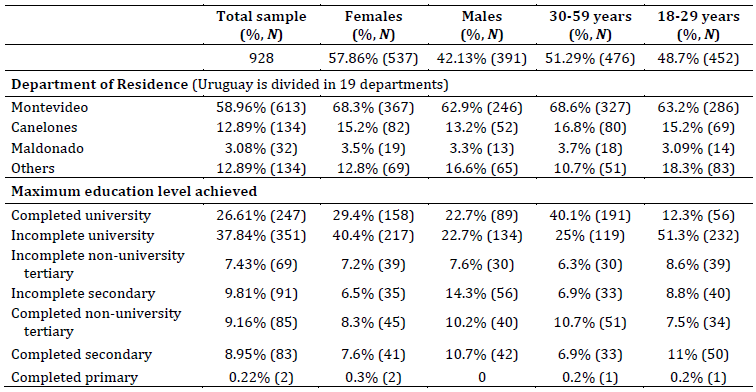
Note: Sociodemographic characteristics of the sample used to assess the association between age, sex, and cannabis acquisition sources with patterns of cannabis use and related consequences among Uruguayan residents, as well as on psychological distress, protective behavioral strategies (PBS), and cannabis use motives.
An invitation to participate in a study on socio-cognitive determinants of cannabis was shared via Facebook, X and Instagram. The invitation included a link to an online survey. A screen provided participants with detailed information about the study. Specifically, they were informed: (1) the study’s objectives, (2) the voluntary nature of participation, (3) the confidentiality of the data and (4) that the study was strictly anonymous and that no personally identifiable information would be collected. To ensure transparency and support, contact information for the principal investigator was clearly displayed for any inquiries. Furthermore, specific resources for participants experiencing distress or requiring substance-related assistance were provided. Consent was formally obtained by requiring participants to click a 'Next' button, which was explicitly labeled as the action signifying their agreement to participate in the research.
Data storage and handling procedures were explicitly governed by Decree No. 414/2009, which regulates Law No. 18.331 on the Protection of Personal Data and Habeas Data Action. Data collection occurred between December 2023-April 2024. The study followed the ethical guidelines for human research outlined in the Declaration of Helsinki. The study gave careful attention to the provisions of Chapters 2 and 3 of Decree 158/019, issued by the executive branch of the Uruguayan Government, which regulate research involving human participants.
Measures
Cannabis Use Measures: Participants answered questions about cannabis use in the past year (from “less than a month ago” to “between 10 to 12 months ago”) and the past 30 days. They also indicated their preferred source for obtaining cannabis (Home Cultivation, Cannabis Clubs, Pharmacies, or Other sources). Participants were asked how much (0-25 %, 26-50 %, 51-75 %, or 76-100 %) of the cannabis consumed in the last month came from their preferred source, and reported the usual potency of the cannabis consumed, defined by THC content: low (0-4 %), medium (5-9 %), high (10-14 %), very high (15-19 %), extremely high (≥ 20 %) or “I don’t know”. With the aid of an image depicting the grams contained in different cannabis products, participants reported the grams of cannabis consumed during each day in a typical week of the last month. By adding the grams consumed each day, we obtained the total amount of cannabis consumed in a typical week.
Brief Marijuana Consequences Questionnaire (B-MACQ): Marijuana-related problems over the past 30 days were evaluated with the Spanish version (Bravo et al., 2019) of the 21-item Brief Marijuana Consequences Questionnaire (B-MACQ) (Simons et al., 2012). Participants responded (Yes/No) to indicate whether or not they experienced each problem. The total number of items endorsed was summed up to produce a composite score (α = .85). Prior work (Bravo et al., 2019; Mezquita et al., 2022) supports the measure’s validity for assessing cannabis-related negative consequences among Uruguayan individuals (as well as in the United States, Argentina, and Spain), with evidence of configural and scalar invariance across sex and countries (ΔCFI/TLI ≤ .01; ΔRMSEA ≤ .015).
Cannabis Use Screening Test (CAST): This tool identifies problematic cannabis use and potential use disorder. We used the version adapted and validated by the Secretaría de Políticas Integrales sobre Drogas de la Nación Argentina (SEDRONAR) (Cadenas et al., 2016). It comprises six items rated on a 5-point Likert scale, including frequency of use before noon or in solitude, difficulties related to controlling use, and impacts on daily responsibilities, social life and cognition. Responses are dichotomized and added up, with higher scores indicating more problematic use. Following SEDRONAR, we distinguished levels of risk (0-1 = low; 2-3 = moderate; 4-6 = high). Reliability was acceptable (α = .75).
Marijuana Motives Questionnaire (Short Version): The 15-item Spanish version of the Marijuana Motives Questionnaire (MMQ; Mezquita et al., 2019) explored the motivations behind cannabis use over the past 30 days. Participants rated the frequency of their cannabis use for various reasons on a scale from 1 (Never/Almost Never) to 5 (Almost Always/Always). Items are divided into five subscales measuring different dimensions of the motivation for cannabis use: social, enhancement, expansion, coping, and conformity (α = ranged from .62 to .85). Prior research (Mezquita et al., 2022) supports the cross-cultural validity of this measure, with evidence of metric invariance across countries including Uruguay (as well as the United States, Argentina, Spain, England, and South Africa), supporting their use for examining associations among study constructs across different cultural groups.
Protective Behavioral Strategies for Marijuana (PBSM): The PBSM assessed how often participants engaged in PBS when using cannabis over the past 30 days. We employed the 17-item Spanish version (Richards et al., 2021) with responses ranging from 1 (Never) to 6 (Always), to indicate the frequency of cannabis PBS use. A general composite score was created (α = .83). Prior cross-national work (Herchenroeder et al., 2022) supports the PBSM as an adequate tool for assessing cannabis protective behavioral strategies among young adults across countries, including Uruguay, using the same 17-item, 6-point format.
Kessler Psychological Stress Scale: A Spanish version (Aranguren, 2010) of this scale was used, featuring 10 questions inquiring about anxiety or depression symptoms, as experienced during the last 30 days. Participants answered the items via a 5-points Likert-type format, from 1 (Never) to 5 (Always). Greater values in the composite score indicate greater distress (α = .89).
Statistical Analysis
Descriptive indicators illustrated, for the overall sample and separately for sex and age (18-29 years and 30-59 years), the percent of cannabis used and the endorsement of the different cannabis sources. The age split helped distinguishing emerging/young adulthood (when substance use prevalence and risk-taking are typically highest) from later adulthood, when consumption patterns tend to stabilize (Arnett, 2005).
Sex and age differences in the latter endorsement were determined using χ2. The possibility that those relying on “other sources” were more likely to use cannabis of higher potency was assessed via χ2, with the categories source and potency of cannabis usually consumed. The option of response “I don’t know” was dropped for this analysis, whereas the options low (0-4 %) and medium (5-9 %) potency in one hand, and high (10-14 %) and very high (15-19 %) on the other hand, were collapsed into single categories (extremely high, ≥ 20 %, remained a single category).
Separate ANOVAs analyzed frequency and quantity of cannabis use, psychological distress, PBS usage and endorsement of the five cannabis motives. Sex, age category and source of cannabis were between factors. To assess the association between preferred cannabis source and risk of problematic cannabis use, we conducted a χ2 test between source and category of risk (high, moderate and low), as yielded by CAST.
Effect sizes of ANOVAs are reported via n2p and the significant main or interactive effects were followed by Duncan’s post-hoc tests. To analyze the locus of the significant associations, we calculated the standardized deviation of expected frequencies (SDEF) for each cell and inspected the greatest deviations contributing to the χ2 (Agresti, 2013). The strength of the significant associations is reported via Cramer’s V.
We conducted bivariate correlations examining the associations between psychological distress, atemporal mediators (PBS and cannabis motives), and the outcomes. We then applied, using MPlus 8.4, path analysis to examine the direct and indirect associations of distress on the outcomes and the sequential association between the variables. The model was fully saturated. To evaluate the total, direct, and indirect effects, we used bias-corrected bootstrapped estimates (Davison & Kuonen, 2003), a technique robust against non-normality (Erceg-Hurn & Mirosevich, 2008; Fritz & MacKinnon, 2007). Significance was established through 95 % bias-corrected bootstrapped confidence intervals (CIs) that excluded zero (10,000 bootstrap samples). A multi-group mediation model assessed if the pathways were or not equivalent across the different sources and across sex.
Bias was addressed through the use of validated instruments with strong psychometric properties, control of confounding variables such as sex and age in statistical models, and application of bias-corrected bootstrapped estimates in path analysis. The study excluded inconsistent or incomplete responses, reducing selection and information bias. The anonymous recruitment helped mitigate social desirability bias. Multi-group mediation models assessed the invariance of effects across sex and cannabis sources.
Results
Descriptive analysis of cannabis source and potency
Table 2 presents frequencies of endorsement of each cannabis source and the THC potency reported, as a function of sex and age. Cannabis clubs were the preferred legal source, though a similar percentage indicated "other" sources. Approximately one in fifth indicated home cultivation or buying at pharmacies. The majority (60 %) reported obtaining most of their monthly cannabis from their reported preferred source (≥ 76 %). The percentage of females and males endorsing each source was similar for all except the “other” sources, in which the proportion of females was significantly greater than that of males (χ2 = 4.01, df = 1, p < .05, V = .05).
While a third of the sample did not know the potency of the cannabis usually consumed, 43 % and 22 % reported consuming cannabis products containing 5 % to 14 % or ≥ 15 % of THC, respectively. The χ2 analyzing the association between potency of cannabis utilized and preferred source was significant (χ2 = 56.64, df = 6, p < .001, V = .17). Inspection of SDEF revealed that using cannabis with extremely high THC content was more likely among those obtaining cannabis from clubs or from “other” sources (SDEF 2.66 and 1.02, respectively). Conversely, the use of low or medium potency cannabis products was more frequent between those getting cannabis at pharmacies (SDEF = 3.78). The distribution of home cultivation mainly followed that expected under the null hypothesis.
Table 2: Endorsement of each cannabis source and the THC potency reported as a function of sex and age
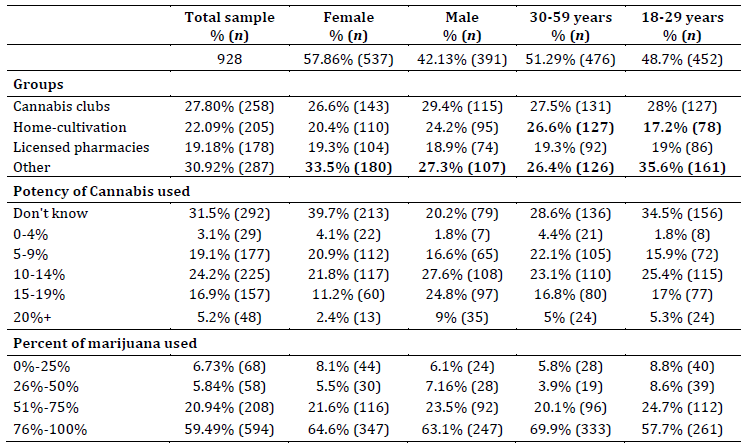
Note: Cells in bold indicate that the proportion of females endorsing “Other” sources was significantly greater than that of males (χ2 = 4.01, df = 1, p < .05, V = .05), that the proportion of participants aged 30-59 years endorsing home-cultivation was significantly greater than that of younger participants (χ2 = 11.96, df = 1, p < .001, V = .08), and that participants aged 18-29 years reported significantly greater endorsement of “other” sources”, compared to older participants (χ2 = 9.08, df = 1, p < .005, V = .07). THC: tetrahydrocannabinol.
Source and sex-related differences in cannabis use and socio-cognitive variables
The ANOVAs for cannabis frequency and quantity (g) of use (Figure 1A-B) revealed significant main effects of Sex (F1,912 = 35.31, p < .001, η2p = .04 and F1,912 = 21.41, p < .001, η2p = .02, respectively) and Source (F3,912 = 13.26, p < .001, η2p = .04 and F3,912 = 9.40, p < .001, η2p = .02, respectively). These scores were significantly higher in males vs. females and significantly higher among those obtaining cannabis from clubs compared to those getting cannabis from either pharmacies or “other” sources. Frequency of use in the latter participants was also significantly lower than that reported by those relying on pharmacies or home cultivation. Quantity of use was also significantly higher in self-growers than in those getting cannabis at pharmacies or at “other” sources.
Figure 1: Frequency and quantity of cannabis use (days in the last month and grams consumed, respectively) (Panels A-B), psychological distress and negative consequences of cannabis use (last 30 days) (Panels C-D) in Uruguayan residents aged 18-59 years as a function of preferred source for obtaining cannabis (cannabis clubs, pharmacies, home cultivation or other sources) and sex (females, males)
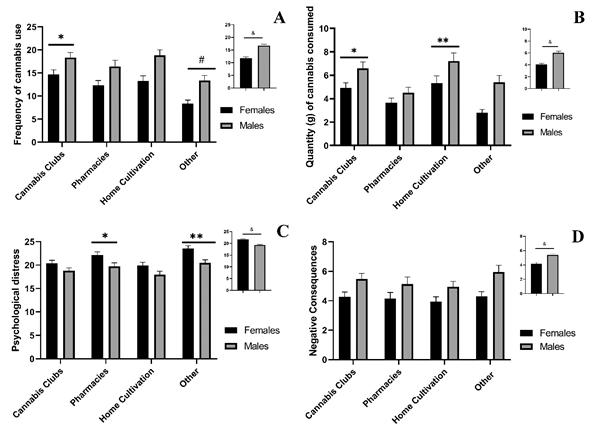
Note: Very few significant main effects of age group (18-29 or 30-59 years) were found, and age group did not significantly interact with the sex or source. Hence, the data is presented collapsed across age groups. The smaller bar graphs depict data across source and age groups. Frequency and quantity of use was significantly higher in males vs. females (indicated by the & sign) and significantly higher among club users compared to those getting cannabis from pharmacies or other sources (denoted by the * sign). Those participants accessing cannabis via other sources exhibited significantly less frequency of use than those relying on pharmacies or home cultivation (denoted by the # sign). Quantity of use was significantly higher in self-growers than in those getting cannabis at pharmacies or at other sources (denoted by the ** sign). Distress was significantly greater in female vs. males (denoted by the & sign), in younger vs. older participants (not shown) and was significantly greater in those endorsing "other" sources or buying cannabis at pharmacies than in those relying in clubs or home cultivation (denoted by the * and ** signs). Negative consequences were significantly higher in men (denoted by the & sign) and younger participants (not shown). Data is shown as mean ± SEM.
Psychological distress (Figure 1C) was significantly greater in female vs. male (F1,912 = 17.68, p < .001, η2p = .02), in younger vs. older participants (F1,912 = 20.71, p < .001, η2p = 0.02) and was affected by Source (F3,912 = 6.68, p < .001, η2p = .02). Those endorsing "other" sources or buying cannabis at pharmacies reported greater distress than those relying in clubs (p =.001 and p = .003, respectively) or home cultivation (p = .001 and p = .002, respectively). Negative consequences (Figure 1D) were significantly higher in men (F1,912 = 22.15, p < .0001, η2p = .02) and younger participants (F1,912 = 21.01, p < .0001, η2p = 0.02).
Use of PBS (see Appendix A) was significantly greater in females (F1,912 = 39.58, p < .0001, η2p = .04), and social and enhancement motives (data for motives is not shown) were significantly in greater in males vs. females (F1,912 = 15.46, p < .0001, η2p = .02 and F1,912 = 18.26, p < .0001, η2p = .02, respectively) and in younger vs. older participants (F1,912 = 4.53, p < .05, η2p = .005 and F1,912 = 3.99, p < .05, η2p = .004, respectively). Expansion motives were greater in males (F1,912 = 9.56, p < .005, η2p = .01). Conformity motives did not significantly differ as a function of either factor.
Association between source of and liability for cannabis use disorder
The Chi-square between CAST categories and Source was significant ꭓ2 = 16.16, df = 6, p < .05, V = .08. Inspection of SDEF revealed that, among those obtaining cannabis from clubs, there were more participants in the high and moderate risk categories (SDEF = 0.89 and 0.72, respectively), and less in the low-risk category (SDEF = -0.91), than what was expected under the null hypothesis of lack of association. A similar pattern but with less deviation in the high-risk category, was found for those buying cannabis at pharmacies (high and moderate risk categories: SDEF = 0.50 and 0.74, respectively; low risk category: SDEF = -0.79). Participants engaging in home cultivation were much more likely to be in the low-risk category (SDEF = 1.20), and much less likely to be in the high-risk category (SDEF = ‑1.39).
Bivariate and path analysis results
The bivariate correlations between the included variables are presented in the Appendix A. The path model was invariant across different sources of cannabis acquisition (p = .058) and across sex (p = .093). Therefore, the results of the proposed model are presented within the total sample. Table 3 and Figure 2 summarize the total, indirect, and direct effects.
Cannabis-related negative consequences: Psychological distress was significantly and positively associated with negative consequences. Psychological distress was also indirectly associated with more cannabis-related negative consequences through a positive association with coping motives (psychological distress → coping → negative consequences) and via a negative association through PBS (psychological distress → PBS → negative consequences). The double mediated path from distress to negative consequences via coping and PBS (psychological distress → coping → PBS → negative consequences) was statistically significant. Individuals experimenting higher levels of psychological distress tend to use cannabis to alleviate their distress, which is then associated with a lower use of PBS which is associated with a greater number of consequences. It was also observed that individuals with higher enhancement motives showed a significantly lower number of protective strategies, which were associated with more consequences. Enhancement was also positively and directly associated with greater negative consequences.
Frequency of cannabis use: Psychological distress was negatively directly associated with frequency of cannabis use, and also indirectly associated via coping, expansion and conformity motives, and via PBS. Individuals experiencing higher levels of psychological distress tended to report higher coping, conformity and expansion motives, which in turn were linked to changes in frequency of cannabis use. Additionally, a double mediation pathway was observed via coping motives and PBS. Those with greater psychological distress reported more coping motives, which were associated with a lower use of protective strategies, leading to higher frequency of cannabis use.
Table 3: Summary of total, indirect, and direct effects of the mediation path model
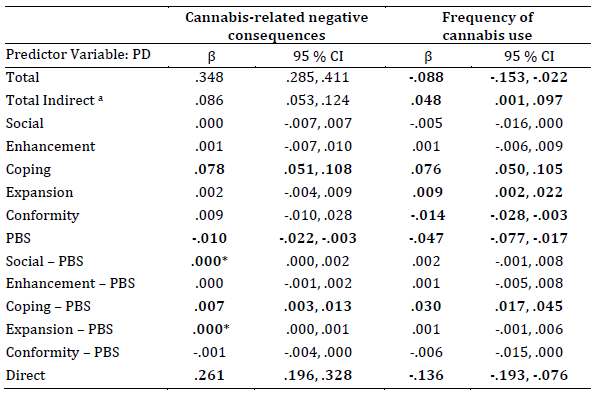
Note: Significant associations are in bold typeface for emphasis and were determined by a 95 % bias-corrected standardized bootstrapped confidence interval (based on 10,000 bootstrapped samples). PD: Psychological Distress. PBS: Protective behavior strategies. a. Reflects the combined indirect associations within the model. * These significant associations should be taken with caution given a non-significant direct association between Social/Expansion and PBS.
Figure 2: Depiction of the significant standardized direct effects of psychological distress on cannabis use frequency and cannabis-related problems via the different cannabis use motives and protective behavioral strategies
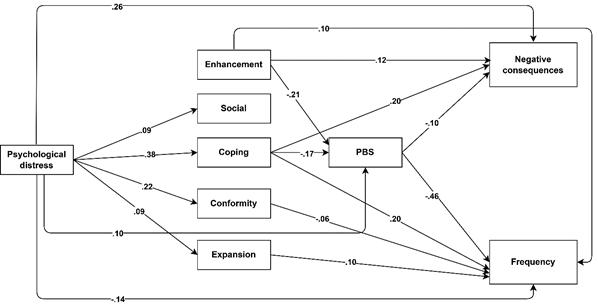
Note: Significant associations were determined by a 95 % bias-corrected standardized bootstrapped confidence interval (based on 10,000 bootstrapped samples) that does not contain zero. Non-significant path coefficients are not shown in the figure for reasons of parsimony. These path coefficients are presented in Table 2.
Discussion
Alternative sources remain significantly popular in Uruguay. Slightly less than a third of the sample reported getting cannabis from sources other than those legally provided by the Uruguayan state. This is in line with recent reports (Instituto de Regulación y Control del Cannabis et al., 2023) and with the study by Boidi et al. (2016). These results, however, have to be taken with caution, as the sample under analysis was not probabilistic.
Our findings also highlight age and sex differences in usage patterns, with males consuming cannabis more frequently and in larger quantities than females, who, as shown before (Richards et al., 2021), engaged more in cannabis PBS. Age-related effects showed that younger participants were more likely to consume higher quantities and report more negative consequences, aligning with global trends (Carlini & Schauer, 2022).
At the time the data was gathered, the most potent legal option was the "Gamma" variety (THC content: ≤ 15 %). Our results indicated a significant association between source of cannabis and potency, with those endorsing alternative sources reporting higher use of products with potency ≥ 20 %. Research suggests (Xing & Shi, 2024) that when legally available cannabis products have lower THC potency, consumers seeking stronger effects may turn to illicit markets to obtain higher-potency cannabis. This suggests that the limited potency of legally available cannabis in Uruguay contributes to unmet consumer demand, leading some Uruguayans to seek higher-potency products outside the legal market.
At a descriptive level, cannabis social clubs ranked as the most endorsed legal source. This contrasts with a study conducted shortly after the introduction of the cannabis regulation in Uruguay (Queirolo et al., 2016), which reported that only 13 % of people who use cannabis intended to join a Cannabis Club. It is likely that changes in the organization and membership of clubs underlie these differences. Queirolo et al. (2016) indicated that, by the time of their study, clubs were composed mainly by males, whereas we observed an even sex representation.
Those obtaining cannabis from clubs showed higher cannabis use and, compared with participants obtaining cannabis from other sources, a higher probability of exhibiting moderate or high liability for cannabis use disorder. These findings highlight the need for targeted prevention efforts for cannabis club users. Those endorsing ‘other’ sources or buying cannabis at pharmacies reported greater distress, possibly indicating cannabis use to cope with psychological issues. Yet none of the measured motives differed across source.
The study highlights the role of psychological distress as a correlate of cannabis outcomes, acting via cannabis use motives and PBS. This is concerning given the relative high prevalence of distress (Ruiz & Pautassi, 2023), and its facilitating role on alcohol use in the Uruguayan population (Ruiz et al., 2020). The path analysis indicated that distress is associated with cannabis use frequency and related consequences via greater coping motives, which are in turn associated with diminished emission of PBS. Enhancement motives were also linked to fewer PBS and more consequences. These results are consistent with those previously shown in an international sample which included Uruguayan students (Herchenroeder et al., 2022). Our hypothesis that the reported pathways would vary by source of cannabis or by sex, given that these differ in frequency and quantity of use, as well as in likelihood of cannabis use disorder, was not confirmed.
It is important to highlight that the direct associations between psychological distress and cannabis-related outcomes diverged. Psychological distress, consistent with findings from prior studies on alcohol use (Pilatti, Correa, Michelini et al., 2024), was positively associated with the number of negative consequences yet inversely related to frequency of use. This suggests that individuals experiencing higher psychological distress may not necessarily use cannabis more often but may instead engage in riskier patterns of use that are associated with greater harm. Specifically, distressed individuals may use cannabis primarily for coping purposes, making them more prone to less regulated use, characterized by reduced engagement in PBS. The negative direct association between distress and frequency could reflect reduced social engagement or functional impairment associated with the distress, which may limit opportunities for frequent cannabis use. Nevertheless, when cannabis is used, coping-driven motives and reduced PBS could be associated with greater vulnerability to adverse outcomes. Consistent with this interpretation, participants reporting greater psychological distress endorsed stronger coping motives, which were in turn associated with lower PBS use and higher cannabis use frequency. These findings reinforce the need to assess motives and protective behaviors alongside both frequency and consequences.
This study has several limitations. First, its cross-sectional design precludes causal inferences regarding the relationships between the measured variables. More in detail, although indirect pathways were tested using mediation models, these analyses were conducted using cross-sectional data and, therefore, findings should be interpreted as atemporal associations and not as evidence of longitudinal mediation (Maxwell & Cole, 2007; Maxwell et al., 2011; O’Laughlin et al., 2018). Accordingly, the present findings are best understood as hypothesis-generating and warrant confirmation using longitudinal or experimental designs. In other words, due to the cross-sectional nature of the design employed, the indirect effects reported may be biased and should be interpreted as descriptive of contemporaneous associations.
A second limitation is that the reliance on self-reported data may introduce recall or social desirability biases, despite the anonymity of responses. Third, a portion of participants did not know the potency of the cannabis they consumed, potentially confounding the accuracy of potency-related analyses. Moreover, some participants who selected “other” as their acquisition source may have obtained cannabis through friends or family members. Although this route may technically fall outside the legal market, it does not necessarily correspond to the types of illicit activities typically implied by the term “black market”. Fourth, the sample was not probabilistic and may not fully represent all Uruguayan people who use cannabis. Finally, the categorization of cannabis acquisition sources did not account for those who obtain cannabis from multiple sources, which could influence the observed associations. Also, effects sizes for many of the reported differences are small, and some of the measures do not have evidence of validity for use in Uruguay.
Despite these shortcomings, the study highlights the complex dynamics of cannabis use in Uruguay. Overall, the findings emphasize the need to address unmet demand for higher-potency products and to mitigate associated risks. Probably the most important finding was that club users were more likely than expected by chance to fall into the moderate- and high-risk categories of the CAST. It is important to note, however, that we also found greater psychological distress among individuals who obtained cannabis through illicit sources or purchased it at pharmacies. Given the significant role of psychological distress in modulating cannabis use in this study, it is tempting to suggest that those accessing cannabis via illicit sources or pharmacies may be at elevated risk for cannabis-related problems. In this study, greater psychological distress was associated with heavier cannabis use through higher coping motives and lower use of PBS. These results underscore the need for tailored prevention and intervention strategies centered on mental health, differentiated by source of access.
References
Agresti, A. (2013). Categorical data analysis (3rd ed.). John Wiley & Sons.
Alvarez, E., Queirolo, R., & Sotto, B. (2023). Conflicting forces in the implementation of medicinal cannabis regulation in Uruguay. Journal of Cannabis Research, 5(1), 26. https://doi.org/10.1186/s42238-023-00189-6
Aranguren, M. (2010). Adaptación argentina de la Escala de Malestar Psicológico de Kessler (K10). Revista de Psicología, 28(2), 308-340. https://doi.org/10.18800/psico.201002.005
Arnett, J. (2005). The developmental context of substance use in emerging adulthood. Journal of Drug Issues, 35, 235-253. https://doi.org/10.1177/002204260503500202
Boidi, M. F., Queirolo, R., & Cruz, J. M. (2016). Cannabis consumption patterns among frequent consumers in Uruguay. Interantional Journal of Drug Policy, 34, 34-40. https://doi.org/10.1016/j.drugpo.2016.05.008
Bravo, A. J., Pearson, M. R., Pilatti, A., Mezquita, L., & Cross-Cultural Addictions Study, T. (2019). Negative marijuana-related consequences among college students in five countries: measurement invariance of the Brief Marijuana Consequences Questionnaire. Addiction, 114(10), 1854-1865. https://doi.org/10.1111/add.14646
Cadenas, N., Rosendo, E., & Brasesco, M. V. (2016). Validación Estadística de la Escala CAST.
Carlini, B. H., & Schauer, G. L. (2022). Cannabis-only use in the USA: prevalence, demographics, use patterns, and health indicators. Journal of Cannabis Research, 4(1), 39. https://doi.org/10.1186/s42238-022-00143-y
Cheetham, A., Allen, N. B., Yücel, M., & Lubman, D. I. (2010). The role of affective dysregulation in drug addiction. Clinical Psychology Review, 30(6), 621-634. https://doi.org/10.1016/j.cpr.2010.04.005
Cuttler, C., Mischley, L. K., & Sexton, M. (2016). Sex differences in cannabis use and effects: A cross-sectional survey of cannabis users. Cannabis and Cannabinoid Research, 1(1), 166-175. https://doi.org/10.1089/can.2016.0010
Davison, A., & Kuonen, D. (2003). An introduction to the bootstrap with applications in R. Statisticial Computing and Statistical Graphics Newsletter, 13.
Erceg-Hurn, D. M., & Mirosevich, V. M. (2008). Modern robust statistical methods: An easy way to maximize the accuracy and power of your research. American Psychologist, 63(7), 591-601. https://doi.org/10.1037/0003-066X.63.7.591
Fritz, M. S., & MacKinnon, D. P. (2007). Required sample size to detect the mediated effect. 18(3), 233-239. https://doi.org/10.1111/j.1467-9280.2007.01882.x
Herchenroeder, L., Mezquita, L., Bravo, A. J., Pilatti, A., Prince, M. A., & Study Team, C. A. (2022). A cross-national examination of cannabis protective behavioral strategies' role in the relationship between Big Five personality traits and cannabis outcomes. The American Journal of Drug and Alcohol Abuse, 48(1), 27-37. https://doi.org/10.1080/00952990.2021.1919689
Instituto de Regulación y Control del Cannabis, Observatorio Uruguayo de Drogas & Junta Nacional de Drogas. (2023). Mercado regulado del cannabis (Informe XVII, 31/12/2023). https://acortar.link/dCzTPA
Laqueur, H., Rivera-Aguirre, A., Shev, A., Castillo-Carniglia, A., Rudolph, K. E., Ramirez, J., Martins, S. S., & Cerdá, M. (2020). The impact of cannabis legalization in Uruguay on adolescent cannabis use. International Journal of Drug Policy, 80, 102748. https://doi.org/10.1016/j.drugpo.2020.102748
Luciano, M. T., Acuff, S. F., McDevitt-Murphy, M. E., & Murphy, J. G. (2020). Behavioral economics and coping-related drinking motives in trauma exposed drinkers: Implications for the self-medication hypothesis. Experimental and Clinical Psychopharmacology, 28(3), 265-270. https://doi.org/10.1037/pha0000318
Maxwell, S. E., & Cole, D. A. (2007). Bias in cross-sectional analyses of longitudinal mediation. Psychological Methods, 12(1), 23-44. https://doi.org/10.1037/1082-989X.12.1.23
Maxwell, S. E., Cole, D. A., & Mitchell, M. A. (2011). Bias in cross-sectional analyses of longitudinal mediation: Partial and complete mediation under an autoregressive model. Multivariate Behavioral Research, 46(5), 816-841. https://doi.org/10.1080/00273171.2011.606716
Mezquita, L., Bravo, A. J., Pilatti, A., Ortet, G., Ibáñez, M. I., & Cross-Cultural Addictions Study Team (2022). Quantifying cannabis problems among college students from English and Spanish speaking countries: Cross-cultural validation of the Cannabis Use Disorders Identification Test-Revised (CUDIT-R). Addictive Behaviors, 127, 107209. https://doi.org/10.1016/j.addbeh.2021.107209
Mezquita, L., Ruiz-Valero, L., Martínez-Gómez, N., Ibáñez, M. I., & Ortet, G. (2019). Desarrollo y validación de la versión breve del cuestionario de motivos de consumo de marihuana (MMM SF). Adicciones, 31(2), 106-116. https://doi.org/10.20882/adicciones.979
Montgomery, Z. L., Michelini, Y., Bravo, A. J., Pilatti, A., & Mezquita, L. (2024). Substance use motives as mediators of the associations between self-control constructs and negative substance use consequences: A cross-cultural examination. Cannabis, 7(2), 77-92. https://doi.org/10.26828/cannabis/2024/000211
O’Laughlin, K. D., Martin, M. J., & Ferrer, E. (2018). Cross-sectional analysis of longitudinal mediation processes. Multivariate Behavioral Research, 53(3), 375-402. https://doi.org/10.1080/00273171.2018.1454822
Pardo, B. (2014). Cannabis policy reforms in the Americas: A comparative analysis of Colorado, Washington, and Uruguay. International Journal of Drug Policy, 25(4), 727-735. https://doi.org/10.1016/j.drugpo.2014.05.010
Pilatti, A., Correa, P., Michelini, Y., Bravo, A. J., Pacini, G., & Pautassi, R. M. (2024). The association between mindfulness facets and substance use via emotional psychopathology and coping motives in Argentinian college students. Substance Use & Misuse, 59(12), 1731-1742. https://doi.org/10.1080/10826084.2024.2370026
Pilatti, A., Correa, P., Rivarola Montejano, G., Michelini, Y., Bravo, A. J., & Pautassi, R. M. (2024). Positive and negative pathways linking depressive symptoms to problematic alcohol use among Argentinian college students: An examination of positive and negative urgency traits and internal drinking motives. Journal of Psychoactive Drugs, 1-10. https://doi.org/10.1080/02791072.2024.2405677
Queirolo, R., Boidi, M. F., & Cruz, J. M. (2016). Cannabis clubs in Uruguay: The challenges of regulation. International Journal of Drug Policy, 34, 41-48. https://doi.org/10.1016/j.drugpo.2016.05.015
Richards, D. K., Schwebel, F. J., Bravo, A. J., & Pearson, M. R. (2021). A comparison of cannabis protective behavioral strategies use across cultures and sex. Addictive Behaviors, 120, 106966. https://doi.org/10.1016/j.addbeh.2021.106966
Ruiz, P., Pilatti, A., & Pautassi, R. M. (2020). Consequences of alcohol use, and its association with psychological distress, sensitivity to emotional contagion and age of onset of alcohol use, in Uruguayan youth with or without college degree. Alcohol, 82, 91-101. https://doi.org/10.1016/j.alcohol.2019.09.001
Ruiz, P., & Pautassi, R. M. (2023). Malestar psicológico y su relación con edad, sexo, trabajo, estudio, zona de residencia, en jóvenes uruguayos. Avances en Psicología Latinoamericana, 41. https://doi.org/10.12804/revistas.urosario.edu.co/apl/a.12731
Simons, J. S., Dvorak, R. D., Merrill, J. E., & Read, J. P. (2012). Dimensions and severity of marijuana consequences: development and validation of the Marijuana Consequences Questionnaire (MACQ). Addictive Behaviors, 37(5), 613-621. https://doi.org/10.1016/j.addbeh.2012.01.008
Xing, J., & Shi, Y. (2024). Cannabis consumers’ preferences for legal and illegal cannabis: evidence from a discrete choice experiment. BMC Public Health, 24(1), 2397. https://doi.org/10.1186/s12889-024-19640-1
Data availability: The data set supporting the results of this study is not available.
Funding: The authors of this paper have no financial disclosures to report.
Conflict of interest: The authors declare that they have no conflicts of interest.
How to cite: Ruiz, P., Barey, A., Pilatti, A., & Pautassi, R. M. (2026). Patterns of Cannabis Use and Socio-Cognitive Factors of People who Use Cannabis across Cannabis Sources in Uruguay. Ciencias Psicológicas, 20(1), e-4859. https://doi.org/10.22235/cp.v20i1.4859
Authors’ contribution (CRediT Taxonomy): 1. Conceptualization; 2. Data curation; 3. Formal Analysis; 4. Funding acquisition; 5. Investigation; 6. Methodology; 7. Project administration; 8. Resources; 9. Software; 10. Supervision; 11. Validation; 12. Visualization; 13. Writing: original draft; 14. Writing: review & editing.
P. R. has contributed in 1, 2, 3, 4, 5, 6, 7, 10, 13, 14; A. B. in 2, 3, 6, 7, 9, 10, 11, 12, 13, 14; A. P. in 2, 3, 6, 10, 11, 12, 13, 14; R. M. P. in 1, 2, 3, 5, 6, 7, 8, 9, 10, 11, 12, 13, 14.
Scientific editor in-charge: Dr. Cecilia Cracco.
Ciencias Psicológicas; v20(1)
January - June 2026
10.22235/cp.v20i1.4859