Ciencias Psicológicas; v20(1)
January - June 2026
10.22235/cp.v20i1.4823
Original Articles
Psychometric Properties of the Work Autonomy Scale in the Brazilian Context
Propiedades psicométricas de la Escala de Autonomía en el Trabajo en el contexto brasileño
Propriedades psicométricas da Escala de Autonomia no Trabalho no contexto brasileiro
Evânia Silva Louro1, ORCID 0000-0002-2782-235X
Larissa Gabardo-Martins2, ORCID 0000-0003-1356-8087
Claudio Eduardo dos Santos Costa Junior3, ORCID 0000-0003-3531-1338
Karyn Sthefanie Dias Madureira Gurgel4, ORCID 0009-0002-1881-5956
1 Universidade Salgado de Oliveira, Brazil, [email protected]
2 Universidade Salgado de Oliveira, Brazil
3 Universidade Salgado de Oliveira, Brazil
4 Universidade Salgado de Oliveira, Brazil
Abstract:
Work autonomy is understood as the freedom of workers to manage the different aspects that involve carrying out their own tasks, such as scheduling, criteria, and work methods. In this sense, the objective of this study was to adapt and seek validity evidence of the Work Autonomy Scale in the Brazilian context. A total of 718 Brazilian workers participated, with ages ranging from 18 to 74 years. Confirmatory factor analysis evidenced that the structure that best fits the data was the second-order one. Multigroup confirmatory factor analysis attested invariance in the groups divided according to whether or not they occupy a supervisory position, and according to the response format (online or paper and pencil). Internal consistency indices were adequate. Finally, work autonomy showed positive correlations with job satisfaction and with affective organizational commitment. It is concluded that the scale meets psychometric criteria and is shown to be a useful instrument applicable in organizational analysis processes aimed at building more autonomous and productive work environments.
Keywords: work autonomy; job satisfaction; affective organizational commitment; adaptation and validity evidence; psychometric properties.
Resumen:
La autonomía en el trabajo se entiende como la libertad de los trabajadores para gestionar los diferentes aspectos que implican la conducción de sus propias tareas, tales como la programación, los criterios y los métodos de trabajo. En este sentido, el objetivo de este estudio fue adaptar y buscar evidencias de validez de la Escala de Autonomía en el Trabajo, en el contexto brasileño. Participaron 718 trabajadores brasileños con edades que variaban de 18 a 74 años. El análisis factorial confirmatorio evidenció que la estructura que mejor se ajustó a los datos fue la de segundo orden. El análisis factorial confirmatorio multigrupo atestiguó la invarianza en los grupos divididos en cuanto al hecho de ocupar o no un cargo de supervisión, y en cuanto a la forma de respuesta (en línea o lápiz y papel). Los índices de consistencia interna fueron adecuados. Por último, la autonomía en el trabajo presentó correlaciones positivas con la satisfacción en el trabajo y con el compromiso organizacional afectivo. Se concluye que la escala atiende a los criterios psicométricos y se muestra como un instrumento útil aplicable en procesos de análisis organizacional que busquen la construcción de entornos de trabajo más autónomos y productivos.
Palabras clave: autonomía en el trabajo; satisfacción laboral; compromiso organizacional afectivo; adaptación y evidencias de validez; propiedades psicométricas.
Resumo:
A autonomia no trabalho é entendida como a liberdade dos trabalhadores para gerenciar os diferentes aspectos que envolvem a condução das próprias tarefas, tais como o agendamento, os critérios e os métodos de trabalho. Nesse sentido, o objetivo deste estudo foi adaptar e buscar evidências de validade da Escala de Autonomia no Trabalho, no contexto brasileiro. Participaram 718 trabalhadores brasileiros com idades variando de 18 a 74 anos. A análise fatorial confirmatória evidenciou que a estrutura que melhor se ajustou aos dados foi a de segunda ordem. A análise fatorial confirmatória multigrupo atestou a invariância nos grupos divididos quanto ao fato de ocupar ou não cargo de chefia, e quanto à forma de resposta (online ou lápis e papel). Os índices de consistência interna foram adequados. Por fim, a autonomia no trabalho apresentou correlações positivas com a satisfação no trabalho e com o comprometimento organizacional afetivo. Conclui-se que a escala atende aos critérios psicométricos e se mostra como um instrumento útil aplicável em processos de análise organizacional que visem à construção de ambientes de trabalho mais autônomos e produtivos.
Palavras-chave: autonomia no trabalho; satisfação no trabalho; comprometimento organizacional afetivo; adaptação e evidências de validade; propriedades psicométricas.
Received: 11/03/2025
Accepted: 17/03/2026
The digital transformation of the labor market has driven changes in organizational management practices, leading to a growing demand for increasingly autonomous workers (Bonacci et al., 2024). The traditional model, previously structured around hierarchies and centralized control, has gradually given way to more flexible work arrangements in which autonomy plays a crucial role in the achievement of goals and objectives (Manullang & Mesra, 2024). Today, resourcefulness, decision-making ability, self-governance, and adaptability to change have become distinguishing attributes, especially in organizations that prioritize innovation and agility (Marcon et al., 2022).
Autonomy has become established as a fundamental resource in contemporary labor relations (Bonacci et al., 2024). The construct refers to the ability to perform tasks independently, with the capacity to make decisions and act based on one's own skills and experience (Diaa et al., 2024). In a classic conceptualization of the construct, Breaugh (1999) defined autonomy as employees’ freedom of choice regarding aspects of their work: scheduling autonomy, criteria autonomy, and methods autonomy. Scheduling autonomy refers to the freedom to plan and self-manage the time allocated to tasks. Criteria autonomy involves the ability to choose or modify the standards used to evaluate one’s own performance. Lastly, method autonomy refers to the freedom to define appropriate strategies for task execution. This definition reflects the construct’s importance in enabling individuals to decide how and when to complete their tasks, allowing them to quickly adapt to the daily demands of the workday (Marcon et al., 2022).
Work autonomy is postulated as a positive resource associated with well-being in several theoretical models, namely: the Job Demands-Resources (JD-R) Model, the Job Characteristics Model, and Self-Determination Theory (SDT). In the JD-R model, work autonomy is characterized as a job resource that can help reduce stress related to job demands, enhance goal achievement, and stimulate personal and professional development (Bakker et al., 2023). In the Job Characteristics Model, autonomy is associated with positive affective outcomes, which contribute to the perception of responsibility for work results (Hackman & Oldham, 1976). Finally, according to Self-Determination Theory, autonomy is part of a basic psychological need which, when fulfilled, can foster intrinsic motivation and improve performance (Ryan & Deci, 2000). These models converge in affirming that autonomy in the workplace can be a resource that supports coping with demands, while strengthening self-confidence, satisfaction, and performance (Gabardo-Martins et al., 2024).
Several studies have shown that levels of workplace well-being are linked to varying degrees of autonomy. Accordingly, some studies have suggested that low levels of autonomy may pose risks to health (Hämmig & Vetsch, 2021) and compromise the quality of healthcare services (Yimer et al., 2024). On the other hand, autonomy may function as a protective resource against the negative effects of loneliness (Yan et al., 2024). Furthermore, high levels of autonomy can lead to positive outcomes such as greater psychological well-being (Clausen et al., 2021), performance (Sørlie et al., 2022), harmonious passion for work (Nie et al., 2023), job satisfaction (Zychová et al., 2023), self-commitment and career adaptability (Alarifi et al., 2024), among others. However, it is important to note that too much autonomy can lead to emotional exhaustion at work (Warr, 1987). In such cases, excessive autonomy may become a job demand rather than a resource, as it can deplete employees’ energy (Brink et al., 2015; Clinton & Conway, 2024; Zhou, 2020).
With regard to the measurement of the construct, in a broader sense, Borges-Andrade et al. (2019) contributed to the Brazilian literature by adapting the Work Design Questionnaire (WDQ). The WDQ has been widely used by researchers because it presents a comprehensive structure for assessing different characteristics of work design, including task characteristics. Within this dimension, work autonomy is included and is defined as the freedom that workers have to plan, decide, and implement their work methods. Within this framework, it is important to highlight that the autonomy investigated in this scale represents only one of the facets within a broader set of characteristics related to work design.
More specifically, Breaugh (1985) developed the Work Method Autonomy Scale based on two studies. The first involved 97 American workers, including a test–retest with a subsample of 22 participants in order to assess temporal reliability one month after the initial administration. The second study included 312 American workers, aiming to verify the generalization of the results. The results of the Exploratory Factor Analysis, using oblique rotation, revealed a three-factor structure (scheduling autonomy, criteria autonomy, and method autonomy) in both study samples. In Study 1, internal consistency was: scheduling autonomy (α = .81), criteria autonomy (α = .77), and method autonomy (α = .92). In Study 2, the indices were: scheduling autonomy (α = .81), criteria autonomy (α = .83), and method autonomy (α = .91).
In 1989, Breaugh conducted a new study with the aim of seeking additional evidence for the scale. To this end, the study was carried out with a sample of 9,421 workers from a multinational organization. Confirmatory Factor Analysis (CFA) showed that the three-factor model presented significant fit indices (AGFI = .95 and delta coefficient = .97). Internal consistency was: scheduling autonomy (α = .85), criteria autonomy (α = 0.78), and method autonomy (α = .91). Moreover, the factors were positively correlated with each other: method autonomy and scheduling autonomy (r = .52); method autonomy and criteria autonomy (r = .45); scheduling autonomy and criteria autonomy (r = .58). These results demonstrated that although related, each factor measured distinct aspects of work autonomy.
Years later, Breaugh (1999) replicated the scale in two different studies, aiming to provide further validity evidence and also to confirm whether the previous results could be reproduced in different contexts and with new samples.
The first study examined the correlation between employees’ perceptions of their autonomy and the occupational descriptions contained in the Dictionary of Occupational Titles (DOT), a publication produced by the United States Department of Labor with detailed descriptions of occupations, later replaced by an online database. In addition, more specifically, it compared levels of autonomy between those working full-time and part-time. A total of 133 undergraduate business administration students from a public university participated. However, analyses were conducted with a final sample of 128 participants, as five were excluded by the judges for not having been able to identify the job description appropriate to the DOT. The results of Pearson correlation analyses and mean comparison analyses using the independent samples t-test revealed significant differences between the groups and the three facets of autonomy. The results indicated adequate internal consistency, being: method autonomy (α = .93); scheduling autonomy (α = .88); and criteria autonomy (α = .85). These findings demonstrate that the scale items were appropriate for measuring the construct of work autonomy, once again providing evidence of a robust instrument.
In the second study, Breaugh (1999) aimed to conduct a test–retest in order to verify whether the instrument continued to demonstrate good reliability over time. In addition, an analysis was performed to assess the convergence between workers’ perceptions of autonomy and those of their supervisors and colleagues. Finally, correlation analyses were conducted between autonomy and other related variables, such as job satisfaction, satisfaction with supervision, and the autonomy scale from the Job Diagnostic Survey (JDS) by Hackman and Oldham (1976). This study included the participation of 79 MBA students who were working full-time, along with their 35 supervisors and 44 colleagues. The test-retest results were .73 for method autonomy, .76 for scheduling autonomy, and .73 for criteria autonomy. The results of the Pearson correlations indicated the existence of significant relationships between the instrument and the related variables. Thus, for this analysis, the following findings were observed: job satisfaction (r = .46 for method autonomy, r = .62 for scheduling autonomy, r = .53 for criteria autonomy); satisfaction with supervision (r = .31 for method autonomy, r = .41 for scheduling autonomy, r = .47 for criteria autonomy); and the JDS scale (r = .80 for method autonomy, r = .62 for scheduling autonomy, r = .53 for criteria autonomy). In summary, all correlations were psychometrically significant (p < .01). Finally, Breaugh (1999) assessed the correlations between workers’ perceptions of autonomy and the evaluations of their supervisors and colleagues. Regarding supervisors’ perceptions, the results indicated: method autonomy (r = .17; p > .05), scheduling autonomy (r = .32; p < .05), and criteria autonomy (r = .36; p < .05). On the other hand, regarding colleagues’ perceptions, the following results were found: method autonomy (r = .37; p < .05), scheduling autonomy (r = .46; p < .05), and criteria autonomy (r = .34; p < .05). The internal consistency in this second study, calculated using Cronbach’s alpha, showed good indices: method autonomy (α = .88), scheduling autonomy (α = .87), and criteria autonomy (α = .81). These results, when compared to previous studies, indicate that the instrument has demonstrated good reliability over time (Breaugh, 1999).
Given its robustness, the Work Autonomy Scale, created by Breaugh (1985) more than three decades ago, has been frequently applied in different types of studies. Among some more recent examples of the use of the scale are correlational studies with other variables, such as job satisfaction (Caroline et al., 2022), job crafting (Jindal et al., 2023), performance (Zaheer et al., 2024), productive organizational energy (Gabardo-Martins et al., 2024), and psychological well-being (Sharma & Sharma, 2024); as well as the study by Yagil and Oren (2021), who used the construct as a moderating variable.
A search of the national databases SciELO (Scientific Electronic Library Online) and PePSIC [Periódicos Eletrônicos de Psicologia], conducted in August 2025 with the descriptors “escala,” “autonomia no trabalho,” “evidências de validade da autonomia no trabalho,” and “propriedades psicométricas da autonomia no trabalho,” indicated the absence of national studies focused on the adaptation of the Work Autonomy Scale. In the PsycINFO database (American Psychological Association), using the same descriptors in English, it was found that only the studies by Breaugh (1985, 1989, 1999) allow the investigation of the construct based on its specific dimensions: methods autonomy, criteria autonomy, and work scheduling autonomy. In the Brazilian context, although the WDQ can measure work autonomy, it appears as a facet that composes part of the task characteristics and is therefore not the central objective of the research conducted by Borges-Andrade et al. (2019). In this sense, the adaptation of instruments specifically aimed at assessing work autonomy becomes relevant, such as the Work Autonomy Scale, which allows for a more detailed and specific analysis of this construct in the organizational context. Thus, a gap can be identified, even in the international literature, regarding the proposal of instruments whose primary objective is to seek validity evidence for the construct of work autonomy, as carried out by Breaugh (1985, 1989, 1999).
In the work context, studying the construct of autonomy is particularly important due to its direct relationship with job satisfaction, performance, and motivation, as well as its contribution to productivity and occupational well-being (Sørlie et al., 2022). Autonomy provides workers with greater control over their activities and decisions, fostering positive aspects at work and greater engagement (Diaa et al., 2024). In this sense, it is observed that autonomy plays an essential role in improving workflow. Therefore, given the importance of the construct in the work context, the main objective of this study was to adapt and seek validity evidence for the Work Autonomy Scale by Breaugh (1985). Specifically, the aim was to obtain validity evidence based on internal structure (through factor analysis, internal consistency, and item parameter invariance) and on correlations with external variables, such as affective commitment at work and job satisfaction.
To achieve the established objectives, six hypotheses were formulated. First, considering that the nine items of the scale are organized into a three-dimensional structure, as originally suggested by Breaugh (1985), the following hypothesis was proposed:
Hypothesis 1: The Work Autonomy Scale will present a structure of nine items, equally divided into three factors.
The second hypothesis is based on the reliability of the scale, which in Breaugh’s studies (1985, 1989, 1999) demonstrated good results of internal consistency, measured by Cronbach’s alpha. Based on these studies, it was hypothesized that the scale items remain adequate for measuring the construct of work autonomy, reinforcing the robustness of the instrument. Thus, the following hypothesis was formulated:
Hypothesis 2: The factors of the Work Autonomy Scale will show adequate indices of internal consistency.
The third hypothesis is based on the invariance of item parameters. According to Fischer and Karl (2019), the invariance of an instrument is a technique that allows verifying whether an instrument measures the proposed construct equivalently across different groups. In this case, invariance was assessed in relation to groups based on managerial position and mode of scale administration (online and paper-and-pencil).
With regard to holding a managerial position, it is currently observed that organizations tend to reduce direct control over their employees and offer more autonomy to encourage them to make their own decisions (Kubicek et al., 2017). In this context, workers in managerial positions tend to have more autonomy to perform their entrusted tasks. This is a natural development, given that their roles generally provide greater decision-making power, flexibility, and control over their own activities (Diaa et al., 2024). For these reasons, it becomes necessary to verify invariance between managerial and non-managerial positions, since its absence may indicate distinct interpretations of the perception of autonomy. Thus, despite such differences, it is expected that the items of the scale will maintain their structure and consistent measurement, regardless of whether the worker occupies a managerial position or not. Based on these considerations, the following hypothesis was formulated:
Hypothesis 3: The items of the Work Autonomy Scale will be invariant across managerial and non-managerial positions.
Regarding the mode of data collection, it is expected that the format (paper-and-pencil or online) did not compromise the quality of the information obtained. Resolution 510/2016 of the Brazilian National Health Council reinforces the importance of clear and accessible instructions to ensure participant understanding. Vieira et al. (2022) point out that uniform instructions and proper administration of the instrument are essential to reduce bias, especially when data are collected via social media. Therefore, it is crucial that researchers ensure equivalent conditions of administration, with clear instructions, regardless of whether the format is physical or digital. Considering the growing preference for online data collection, the invariance of the scale across administration modes (paper-and-pencil or online) remains underexplored, which supports the following hypothesis:
Hypothesis 4: The items of the Work Autonomy Scale will be invariant across administration modes (paper-and-pencil or online).
Concerning the relationship between work autonomy and external variables, the constructs job satisfaction and affective organizational commitment will be used. Job satisfaction is described as a positive emotional state resulting from evaluations of one's own work (Silva & Ferreira, 2009). In this sense, workers experience satisfaction when they engage positively with others in the workplace and with the tasks they are required to perform (Spector, 2022). Therefore, it is expected that workers with greater autonomy will be more likely to report higher levels of job satisfaction, leading to the following hypothesis:
Hypothesis 5: Work autonomy will be positively and significantly correlated with job satisfaction.
Affective organizational commitment refers to the employee’s emotional involvement, expressed in feelings of pride in their work. This involvement influences workplace relationships and fosters a desire to continue performing tasks proactively, thereby enhancing performance in achieving expected outcomes (Allen & Meyer, 1990). In this regard, Bastos et al. (2008) define affective organizational commitment as the positive and negative emotions that employees hold toward their organization. Based on these definitions, it is expected that autonomous workers will emotionally identify with the organizations to which they belong, thereby strengthening their affective commitment. Accordingly, the following hypothesis was formulated:
Hypothesis 6: Work autonomy will be positively and significantly correlated with affective organizational commitment.
Method
Participants
The final sample consisted of 718 Brazilian workers of both sexes (55.8 % women), from 22 states and the Federal District. Most participants resided in the state of Rio de Janeiro (74.4 %). Participants’ ages ranged from 18 to 74 years (M = 37.1; SD = 11.5). Regarding race or ethnicity, 51 % identified as White, while 44.4 % self-identified as Black. Concerning educational attainment, 26.9 % had completed a lato sensu postgraduate degree, and 20.2 % had completed high school (general or technical). In terms of marital status, nearly half were married or living with a partner (49.2 %), and the majority had no children (50.3 %). Most participants worked in the private sector (60.2 %) and performed their work in person (80.9 %). The most common income range was between one and three minimum wages (52.6 %). The most prevalent employment type was permanent/CLT (Brazilian Labor Law regime) (55.8 %). The most frequently represented professional sectors were education (33.1 %) and healthcare (22.3 %). Most participants did not hold leadership or managerial positions (76.3 %). The length of time in their current position ranged from 1 to 50 years (M = 6.2; SD = 6.9), and total work experience ranged from 1 to 50 years (M = 15.8; SD = 10.2). Data collection was predominantly conducted online, with 532 participants, while 186 responded to the researcher in person. To be included in the sample, participants were required to have a formal employment relationship (registered work card, work contract, public servant status, or internship) for at least one year in any type of organization/institution within the Brazilian job market at the time of the study.
Instruments
Work Autonomy Scale (Breaugh, 1989). The instrument consists of nine items distributed across three dimensions of autonomy: method autonomy, scheduling autonomy, and criteria autonomy. Items were rated on a seven-point Likert scale ranging from 1 (strongly disagree) to 7 (strongly agree). Example items include: Method Autonomy – “I am allowed to determine how to go about doing my work (the procedures to use)”; Scheduling Autonomy – “I have control over the scheduling of my work”; and Criteria Autonomy – “I am able to modify what my job objectives are (what I am supposed to accomplish).” Internal consistency indices, calculated using Cronbach’s alpha, were as follows in Breaugh’s (1989) study: scheduling autonomy (α = .85), criteria autonomy (α = .78), and method autonomy (α = .91).
The adaptation of the Work Autonomy Scale from English to Brazilian Portuguese was initially conducted by a bilingual professional/translator. Subsequently, a backtranslation process was carried out by another bilingual professional/translator. After these two initial stages, both versions were submitted to a focus group of psychology experts for a final consensus review, in order to verify the clarity of instructions and the adequacy of item wording (Borsa et al., 2012).
Job Satisfaction Scale (Silva & Ferreira, 2009). This is a unidimensional instrument composed of five items rated on a six-point Likert scale ranging from 1 (strongly disagree) to 6 (strongly agree). Example item: “I feel satisfied with my job.” In the original study, the internal consistency coefficient (Cronbach’s alpha) was α = .89. In the present study, internal consistency was assessed using both Cronbach’s alpha (α) and McDonald’s omega (Ω), which both yielded values of .92.
Affective Organizational Commitment Scale (Bastos et al., 2008). This is a brief, unidimensional instrument composed of five items rated on a five-point Likert scale ranging from 1 (not at all) to 5 (extremely). Example item: “The company I work for makes me feel proud of it.” In the original study, Cronbach’s alpha was α = .93. In the present study, internal consistency was evaluated using both Cronbach’s alpha (α) and McDonald’s omega (Ω), which were .96 and .94, respectively.
The study also included a Sociodemographic Questionnaire containing items about participant characteristics. The questionnaire included the following questions: gender, age, marital status, number of children, educational level, income range, occupation, Brazilian state of residence, sector of the organization (public, private, or third sector), industry type (e.g., industrial, commercial, service sector), type of employment relationship (formal contract, civil servant, contractor, or intern), work modality (in-person, remote, or hybrid), leadership position (yes or no), current job tenure, and total work experience.
Data Collection Procedures
The questionnaire was administered both online and via paper-and-pencil. The online application was distributed through social media platforms (WhatsApp, Facebook, Instagram, and LinkedIn), as well as by email. The paper-based application was conducted in person by the researchers at participants’ workplaces and with workers within their professional networks. Completion of the questionnaire took approximately 10 minutes.
Data Analysis Procedures
Descriptive analyses were performed using JASP statistical software (version 0.19.2.0). To analyze the internal structure of the Work Autonomy Scale, CFA was conducted through Structural Equation Modeling. The analysis was carried out using the Lavaan package in R software, employing the WLSMV estimator (Weighted Least Squares Mean and Variance Adjusted). The following fit indices were used to evaluate model fit: Chi-square (χ²), Root Mean Square Error of Approximation (RMSEA), Comparative Fit Index (CFI), and Tucker–Lewis Index (TLI). As suggested by Gana and Broc (2019), good model fit was indicated by RMSEA values below .10 and CFI and TLI values greater than .95.
Before testing item parameter invariance, group differences in autonomy scores were examined using the Mann-Whitney U test, as the normality assumption was not met. Subsequently, measurement invariance was assessed through Multigroup Confirmatory Factor Analysis, in which models were tested with fixed item and factor structures (configural invariance), factor loadings (metric invariance), and intercepts (scalar invariance). To confirm measurement invariance, differences between nested models had to be considered negligible (ΔCFI > .01; Cheung & Rensvold, 2002).
Internal consistency for the instruments was analyzed using Cronbach’s alpha and McDonald’s omega. To examine the relationship between autonomy and external variables, correlations between latent variables were tested using Structural Equation Modeling.
Ethical Considerations
The study was previously submitted to and approved by the institution’s Research Ethics Committee, as evidenced by the Certificate of Presentation for Ethical Consideration (CAAE), number 64026322.8.0000.5289. Participants were assured that there were no right or wrong answers. The Informed Consent Form (ICF), made available online, contained all relevant information regarding the research. Upon choosing to participate, participants provided consent to the ICF and then began completing the questionnaire responses. For in-person administration, workers were approached by the researcher, who explained the objectives of the study and clarified the content of the ICF, as well as the guarantee of anonymity of responses. Those who voluntarily agreed to participate read, dated, and signed the ICF and subsequently responded to the research items. Confidentiality and privacy of the information provided in both online and paper-and-pencil formats were ensured in accordance with Resolutions 466/2012 and 510/2016 of the Brazilian Ministry of Health.
Results
Factor Structure of the Work Autonomy Scale
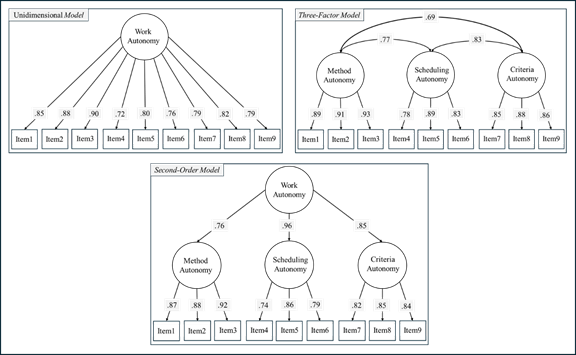
Initially, CFA was conducted for the three-factor model, as proposed by Breaugh (1989). Subsequently, alternative models were tested to verify the best fit, including: (i) a single-factor model and (ii) a second-order model. The results revealed that the correlated three-factor model presented better fit indices, CFI and TLI, than the other models. However, in this model, the RMSEA value was not adequate (above .10). In addition, the factors showed strong correlations with each other (method autonomy and scheduling autonomy: r = .77; p < .001; method autonomy and criteria autonomy: r = .69; p < .001; scheduling autonomy and criteria autonomy: r = .83; p < .001), which may suggest the presence of a second-order factor. Since, in the second-order model, the chi-square value was lower, and the values of CFI, TLI, and RMSEA were adequate, this structure was adopted. In this regard, these results refute Hypothesis 1. Table 1 presents a summary of these analyses. The path diagram of the models tested is presented in Figure 1.
Table 1: Confirmatory Factor Analysis of the Work Autonomy Scale

Notes: χ²: chi-square; df: degrees of freedom; CFI: Comparative Fit Index; TLI: Tucker–Lewis Index; RMSEA: Root Mean Square Error of Approximation; CI: Confidence Interval; SRMR: Standardized Root Mean Square Residual.
Figure 1: Path Diagrams of the Confirmatory Factor Models Tested for the Work Autonomy Scale
Internal Consistency
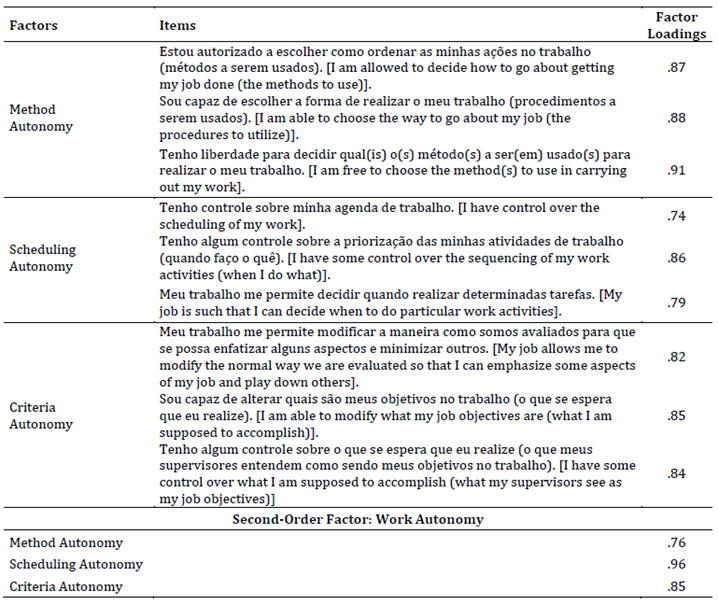
The internal consistency of the scale was examined using Cronbach’s alpha and McDonald’s omega coefficients for each factor and for the higher-order factor. The results indicated satisfactory reliability for all dimensions of the Work Autonomy Scale, supporting Hypothesis 2. The reliability coefficients are presented in Table 2. Table 3 presents the item descriptions (in both Portuguese and English) and their standardized factor loadings, which were high.
Table 2: Internal Consistency of the Work Autonomy Scale
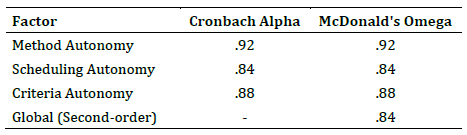
Table 3: Standardized Factor Loadings of the Items from the Work Autonomy Scale
Measurement Invariance
With regard to the instrument’s invariance across leadership position and administration mode, statistical differences in work autonomy between these groups were tested. The Mann-Whitney U test was used, as the data did not meet the assumption of normality (Shapiro-Wilk, p < .001). The results revealed a significant difference between participants with and without leadership roles (U = 34,048.500, p < .001), with higher mean autonomy reported by those in leadership positions (M = 4.93; SD = 1.51) compared to those without such roles (M = 4.18; SD = 1.50). On the other hand, no statistically significant difference was observed between administration modes (in-person vs. online; U = 49,085.500, p > .05).
Based on the identified second-order model, a Multigroup Confirmatory Factor Analysis (MG-CFA) was conducted to assess item parameter invariance across managerial and non-managerial positions, as well as across administration modes (in-person and online). The results provided evidence of configural, metric, and scalar invariance in both cases, as the differences in fit indices (ΔCFI) were below the cutoff point of .01, as recommended by Cheung and Rensvold (2002). Specifically, autonomy scores can be validly compared between managerial and non-managerial positions, supporting Hypothesis 3. Likewise, the instrument’s scores can be compared across in-person and online administrations without bias related to the administration format, confirming Hypothesis 4. Table 4 presents a summary of these findings.
Table 4: Measurement Invariance Analysis of the Instrument
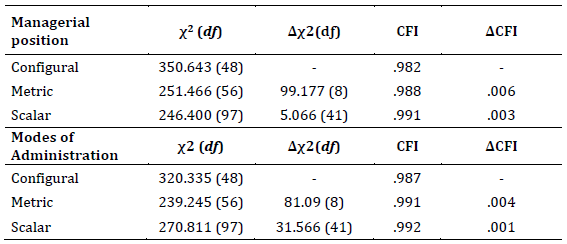
Notes: χ²: chi-square; df: degrees of freedom; CFI: Comparative Fit Index; ∆: variation; N managerial positions = 170; N non-managerial positions = 548; N online = 532; N paper-and-pencil = 186.
Convergent Validity
Convergent validity evidence was verified through the correlation between the Work Autonomy Scale and the Job Satisfaction and Affective Organizational Commitment Scale (Table 5). The data obtained showed that work autonomy presents positive correlations with job satisfaction (r = .59; p < .001) and with affective organizational commitment (r = .55; p < .001). These results confirm Hypotheses 5 and 6.
Table 5: Correlations Among the Study Variables
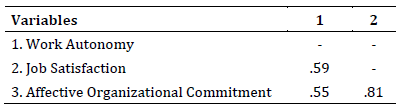
Note: All correlations are significant at p < .001.
Discussion
Work autonomy is one of the resources related to well-being that provides freedom to manage one’s own tasks in the way deemed most appropriate (Diaa et al., 2024). This freedom influences how workers deal with their work in a positive way, feeling more engaged and performing their duties better, even when working remotely (Juyumaya et al., 2024; Malik et al., 2026). As a result of greater work autonomy, reduced levels of stress and exhaustion are observed, directly impacting workers’ quality of life (Clinton & Conway, 2024; Wei et al., 2025). Therefore, in daily work life, this construct becomes essential by enabling greater flexibility and dynamism in the management of work activities (Marcon et al., 2022).
Research on this construct reinforces its relevance as a job resource in organizational contexts, as proposed in the JD–R model (Bakker & Demerouti, 2024; Pederson & Slowiak, 2026). In Brazil, work autonomy has been measured within broader work design structures, as reflected in the WDQ scale proposed by Borges-Andrade et al. (2019). However, the present study contributes a new instrument that assesses only work autonomy directly, based on an internationally consolidated scale developed by Breaugh (1985, 1989, 1999). For this reason, unlike the proposal of Borges-Andrade et al. (2019), and recognizing the relevance of this construct, this study was dedicated to adapting and gathering validity evidence for the Work Autonomy Scale in the Brazilian context.
Theoretical Implications
The results of the CFAs demonstrated that the second-order model presented better fit indices than the other models (single-factor and three first-order factors). Therefore, Hypothesis 1 was refuted, since the three-factor model of the original scale was not the most applicable for the Brazilian samples, thus providing a new structural perspective of the Work Autonomy Scale. However, in Breaugh’s previous studies (1985, 1989, 1999), the second-order structure had not been tested. Moreover, Breaugh (1999) found high correlations among the factors (method autonomy and scheduling autonomy: r = .72; p < .001; method autonomy and criteria autonomy: r = .62; p < .001; scheduling autonomy and criteria autonomy: r = .57; p < .001), as also occurred in the present study. High correlations among first-order factors may suggest the presence of a second-order factor, since a second level of factors contains correlations among the first-order factors (Brown, 2015). Thus, such a structure should be tested in other contexts.
The reliability of the scale was obtained from the good indices of internal consistency, which confirms Hypothesis 2, even though the model is now second-order. The results are similar to those found in previous studies, which also reported good indices of internal consistency (Caroline et al., 2022; Gabardo-Martins et al., 2024; Jindal et al., 2023; Zaheer et al., 2024). Therefore, the findings demonstrate that the instrument is psychometrically adequate for assessing autonomy in the Brazilian work context. In this sense, it is concluded that the scale can be used in academic research and practical applications of organizational interest.
In the comparison test, the statistically significant differences found through the Mann-Whitney test indicate that work autonomy scores differ between workers who hold managerial positions and those who do not. This result is consistent with the literature regarding leadership positions, which tend to provide greater decision-making power, flexibility, and control over work. In this context, studies have reported that individuals in managerial positions are generally more proactive because they have greater freedom to define their routines, establish priorities, delegate tasks, and make strategic decisions, which naturally contributes to a higher perception of autonomy (Diaa et al., 2024; Slemp et al., 2018; Yang et al., 2024). On the other hand, the perception of autonomy may fluctuate for those who do not hold managerial positions. These workers are often subject to more direct supervision, with less flexibility to control their own work pace, methods, and task scheduling, thereby limiting themselves to the fulfillment of their functions (Chiavenato, 2020). Thus, the results found through the MG-CFA indicated that the item parameters of the instrument demonstrated metric, configural, and scalar invariance between these groups, confirming Hypothesis 3.
On the other hand, no significant differences were observed between the administration modes of the instrument (paper-and-pencil and online), suggesting that the method of data collection did not influence participants’ responses regarding the perception of autonomy. According to Weigold et al. (2013), data collection methods by paper-and-pencil and via the Internet are generally equivalent. Therefore, these findings provide evidence that both administration methods were effective, with similar results found between these two modalities. As expected, the MG-CFA indicated that the item parameters of the instrument also demonstrated metric, configural, and scalar invariance in these groups, confirming Hypothesis 4.
With regard to invariance, no response biases were observed between groups with and without managerial positions, as well as between administration modes (in-person and online). Therefore, it was verified that work autonomy scores were invariant across these groups and could be compared with one another (Fischer & Karl, 2019). These results also suggest that the item parameters of the scale maintain stability across different respondent groups, which reinforces the psychometric robustness of the instrument.
With regard to external variables, it was verified that autonomy showed a positive correlation with satisfaction, providing empirical support for Hypothesis 5 of the study. These findings are consistent with those of Amna et al. (2025), Clausen et al. (2021), Hackman and Oldham (1976), and Zychová et al. (2023), who point out that autonomy in the work environment contributes significantly to increased job satisfaction. In this sense, workers who perform with greater autonomy at work tend to feel more satisfied, as they have greater control over their own tasks and a higher level of contentment with their work (Zhalifunnas et al., 2023).
Additionally, work autonomy showed a positive and significant correlation with affective organizational commitment, which provides empirical support for Hypothesis 6. These results are similar to those found in the studies of Alarifi et al. (2024), Judi et al. (2025), and Naqvi et al. (2013), which found that work autonomy is associated with an increase in job satisfaction and is positively related to organizational commitment. This result indicates that workers who perceive greater autonomy in their activities tend to demonstrate higher levels of affective bond with the organization. In other words, autonomy may function as a factor that motivates and strengthens emotional involvement and the sense of belonging to the organization (Allen & Meyer, 1990).
Practical Implications
With regard to practical implications, the scale investigated in this study can be seen as a reliable instrument for measuring levels of work autonomy. The practical application of this instrument makes it possible to obtain responses about workers’ perceptions of their own degrees of autonomy at work. In this sense, assessing whether the autonomy granted is adequate and sufficient is fundamental for the formulation of management practices consistent with the reality experienced by workers. Thus, the use of this instrument by organizations can contribute to decision-making in a way that promotes well-being, improves satisfaction, and achieves greater productivity.
Limitations and Future Studies
With regard to the limitations of this study, the use of self-report instruments stands out, which may be subject to biases arising from common method variance. In addition, the cross-sectional nature of the research makes it impossible to draw causal inferences about the relationships observed among the variables. Another limitation concerns the difficulties in generalizing the results, since the sample was predominantly concentrated in the state of Rio de Janeiro, making it impossible to assert that it represents the entire Brazilian population.
With regard to a future research agenda, it is recommended that new studies investigate the adequacy of the instrument’s second-order structure in different cultural contexts and in specific occupational groups, in order to broaden the understanding of the instrument’s invariance in other sample profiles. Other studies could also examine the correlations of work autonomy with variables such as perceptions of feedback at work and job performance. In addition, it would be relevant to analyze whether autonomy is capable of fostering self-regulation and intrinsic motivation, aspects that are directly related to job performance. Such future studies could adopt a longitudinal approach in order to facilitate a deeper understanding of these relationships and of the functioning of affective states in work environments.
Final Considerations
In summary, the results of the present study indicate that the Work Autonomy Scale presented initial validity evidence in a Brazilian sample. From a theoretical perspective, the acquisition of a second-order model stands out, as it allows for a more comprehensive and integrated understanding of autonomy as a multidimensional construct supported by a general factor. This finding brings innovation compared to previous studies that tested the original three first-order factor structure, as previously proposed by the author of the original scale. This means that this research contributes to the conceptual refinement of the construct, in addition to expanding the possibilities for further structural analyses in future studies.
From a practical perspective, the proposition of this instrument can serve as a facilitating tool for understanding levels of autonomy, being a viable resource to support diagnostics and interventions aimed at strengthening motivational bonds, improving performance, and retaining talent. Thus, the scale not only meets psychometric criteria but also proves applicable in organizational analysis processes and in strategies aimed at building more autonomous and productive work environments.
References:
Alarifi, A., Bajaba, S., & Basahal, A. (2024). From self-commitment to career crafting: The mediating role of career adaptability and the moderating role of job autonomy. Acta Psychologica, 248, 104387. https://doi.org/10.1016/j.actpsy.2024.104387
Allen, N. J., & Meyer, J. P. (1990). The measurement and antecedents of affective, continuance and normative commitment to the organization. Journal of Occupational Psychology, 63(1), 1-18. https://doi.org/10.1111/j.2044-8325.1990.tb00506.x
Amna, A., Aftab, K. S., Mukhtar, M., & Ahmed, S. (2025). Assessing the impact of autonomy on job satisfaction among critical care nurses. Indus Journal of Bioscience Research, 3(1), 354-361. https://doi.org/10.70749/ijbr.v3i1.498
Bakker, A. B., & Demerouti, E. (2024). Job demands–resources theory: Frequently asked questions. Journal of Occupational Health Psychology, 29(3), 188-200. https://doi.org/10.1037/ocp0000376
Bakker, A. B., Demerouti, E., & Sanz-Vergel, A. (2023). Job Demands-Resources Theory: Ten years later. Annual Review of Organizational Psychology and Organizational Behavior, 10, 25-53. https://doi.org/10.1146/annurev-orgpsych-120920-053933
Bastos, A. V. B, Siqueira, M. M. M., Medeiros, C. A. F., & Menezes, I. G. (2008). Comprometimento organizacional. In M. M. M. Siqueira (Org.), Novas medidas do comportamento organizacional (pp. 49-96). Artmed.
Bonacci, I., Scarozza, D., & Menshikova, M. (2024). Changes in work organization between flexibility and adaptation: The new normal. PuntOorg International Journal, 1(1). https://doi.org/10.19245/25.05.of.21.07.24.1
Borges-Andrade, J. E., Lemos Alves Peixoto, A., Queiroga, F., & Pérez-Nebra, A. R. (2019). Adaptation of the work design questionnaire to Brazil. Revista Psicologia: Organizações e Trabalho, 19(3), 720-731. https://doi.org/10.17652/rpot/2019.3.16837
Borsa, J. C., Damásio, B. F., & Bandeira, D. R. (2012). Adaptação e validação de instrumentos psicológicos entre culturas: Algumas considerações. Paidéia, 22(53), 423-432. https://doi.org/10.1590/s0103-863x2012000300014
Breaugh, J. A. (1985). The measurement of work autonomy. Human Relations, 38(6), 551-570. https://doi.org/10.1177/001872678503800604
Breaugh, J. A. (1989). The work autonomy scales: Additional validity evidence. Human Relations, 42(11), 1033-1056. https://doi.org/10.1177/001872678904201105
Breaugh, J. A. (1999). Further investigation of the work autonomy scales: Two studies. Journal of Business and Psychology, 13(3), 357-373. https://doi.org/10.1023/A:1022926416628
Brink, A. G., Emerson, D. J., & Yang, L. (2015). Job autonomy and counterproductive behaviors in Chinese accountants: The role of job-related attitudes. Journal of International Accounting Research, 15(1), 115-131. https://doi.org/10.2308/jiar-51194
Brown, T. A. (2015). Confirmatory Factor Analysis for Applied Research (2nd ed.). Guilford Press.
Caroline, N., Ogbogo, C., & Clarion, N. (2022). Job autonomy, workload and home-work conflict as predictors of job satisfaction among employed women in academia. European Journal of Educational Management, 5(1), 35-48. https://doi.org/10.12973/eujem.5.1.35
Cheung, G. W., & Rensvold, R. B. (2002). Evaluating goodness-of-fit indexes for testing measurement invariance. Structural Equation Modeling, 9(2), 233-255. https://doi.org/10.1207/S15328007SEM0902_5
Chiavenato, I. (2020). Gestão de pessoas: O novo papel da gestão do talento humano (5th ed.). Atlas.
Clausen, T., Pedersen, L. R. M., Andersen, M. F., Theorell, T. & Madsen, I. E. H. (2021). Job autonomy and psychological well-being: A linear or a non-linear association? European Journal of Work and Organizational Psychology, 31(3), 395-405. https://doi.org/10.1080/1359432X.2021.1972973
Clinton, M. E., & Conway, N. (2024). Within-person increases in job autonomy linked to greater employee strain. Work & Stress, 1-22. https://doi.org/10.1080/02678373.2024.2364593
Diaa, N. M., Abidin, A. Z. U., & Roller, M. (2024). Examining the relationship of career crafting, perceived employability, and subjective career success: The moderating role of job autonomy. Future Business Journal, 10(1). https://doi.org/10.1186/s43093-024-00304-w
Fischer, R., & Karl, J. A. (2019). A primer to (cross-cultural) multi-group invariance testing possibilities in R. Frontiers in Psychology, 10, 1-18 https://doi.org/10.3389/FPSYG.2019.01507
Gabardo-Martins, L., Silva Louro, E., & Tinoco Caldas, A. (2024). Recursos e energia organizacional produtiva: A mediação da motivação no trabalho. Revista de Psicología, 42(2), 1029-1060. https://doi.org/10.18800/psico.202402.013
Gana, K. & Broc, G. (2019). Structural equation modeling with Lavaan. Wiley Online Library. https://doi.org/10.1002/9781119579038
Hackman, J. R., & Oldham, G. R. (1976). Motivation through the design of work: Test of a theory. Organizational Behavior & Human Performance, 16(2), 250-279. https://doi.org/10.1016/0030-5073(76)90016-7
Hämmig, O., & Vetsch, A. (2021). Stress-buffering and health-protective effect of job autonomy, good working climate, and social support at work among health care workers in Switzerland. Journal of Occupational and Environmental Medicine, 63(12), e918-e924. https://doi.org/10.1097/JOM.0000000000002404
Jindal, D., Boxall, P., Cheung, G. W., & Hutchison, A. (2022). How do work engagement and work autonomy affect job crafting and performance? An analysis in an Indian manufacturer. Personnel Review, 52(8), 2008-2024. https://doi.org/10.1108/pr-11-2019-0646
Judi, A., Parizad, N., Mohammadpour, Y., & Alinejad, V. (2025). The relationship between professional autonomy and job performance among Iranian ICU nurses: The mediating effect of job satisfaction and organizational commitment. BMC Nursing, 24(1). https://doi.org/10.1186/s12912-024-02551-2
Juyumaya, J., Torres-Ochoa, C., & Rojas, G. (2024). Boosting job performance: The impact of autonomy, engagement and age. Revista de Gestão, 31(4), 397-414. https://doi.org/10.1108/rege-09-2023-0108
Kubicek B., Paškvan M., & Bunner J. (2017). The bright and dark sides of job autonomy. In C. Korunka & B. Kubicek (Eds.), Job demands in a changing world of work: Impact on workers’ health and performance and implications for research and practice (pp. 45-63). Springer International Publishing AG. https://doi.org/10.1007/978-3-319-54678-0_4
Malik, M. J. N., Ali, M., Malik, A., & Malik, S. (2026). Work dynamics and job autonomy as drivers of sustainable workplace well-being in digitally enabled remote work settings. Discover Sustainability, 7, 538. https://doi.org/10.1007/s43621-026-02767-z
Manullang, L., & Mesra, B. (2024). The influence of work environment and work flexibility on job satisfaction with competence as an intervening variable in BPJS Employment Pematang Siantar Branch and Kisaran Branch. Sinomika Journal: Publikasi Ilmiah Bidang Ekonomi dan Akuntansi, 3(1), 1-18. https://doi.org/10.54443/sinomika.v3i1.2245
Marcon, S. R. A., Lucas, J. I. P., Kanan, L. A., Madalozzo, M. M., Michelin, F. T., & Diniz, N. C. F. (2022). Autonomia da tarefa nas organizações: Um estudo comparativo entre jovens, adultos e idosos. Conjecturas, 24(1), 425-444. https://doi.org/10.53660/conj-2195-2z55
Ministério da Saúde. (2013, June 13). Resolução no 466, de 12 de dezembro de 2012. Aprova as seguintes diretrizes e normas regulamentadoras de pesquisas envolvendo seres humanos. Conselho Nacional de Saúde. Diário Oficial da União.
Ministério da Saúde. (2016, May 24). Resolução no 510, de 7 de abril de 2016. Trata sobre as diretrizes e normas regulamentadoras de pesquisa em ciências humanas e sociais. Conselho Nacional de Saúde. Diário Oficial da União.
Naqvi, S. R., Ishtiaq, M., Kanwal, N., & Ali, M. (2013). Impact of job autonomy on organizational commitment and job satisfaction: The moderating role of organizational culture in fast food sector of Pakistan. International Journal of Business and Management, 8(17), 92. https://doi.org/10.5539/ijbm.v8n17p92
Nie, T., Tian, M., Cai, M., & Yan, Q. (2023). Job autonomy and work meaning: Drivers of employee job-crafting behaviors in the VUCA times. Behavioral Sciences, 13(6), 493. https://doi.org/10.3390/bs13060493
Pederson, L., & Slowiak, J. M. (2026). Job autonomy and innovation in healthcare and human services: Pathways through appraisal, engagement, and burnout. Healthcare, 14(4), 437. https://doi.org/10.3390/healthcare14040437
Ryan, R. M., & Deci, E. L. (2000). Self-determination theory and the facilitation of intrinsic motivation, social development, and well-being. American Psychologist, 55(1), 68-78. https://doi.org/10.1037/0003-066x.55.1.68
Sharma, A., & Sharma, H. (2024). Job autonomy and employee psychological well-being: The mediating effect of employee voice. South Asian Journal of Human Resources Management. https://doi.org/10.1177/23220937241257279
Silva, A. P. C., & Ferreira, M. C. (2009). Escala de Satisfação Geral no Trabalho (Resumo). In Instituto Brasileiro de Avaliação Psicológica (Org.), Anais do IV Congresso Brasileiro de Avaliação Psicológica (p. 246).
Slemp, G. R., Kern, M. L., Patrick, K. J., & Ryan, R. M. (2018). Leader autonomy support in the workplace: A meta-analytic review. Motivation and Emotion, 42(5), 706-724. https://doi.org/10.1007/s11031-018-9698-y
Sørlie, H. O., Hetland, J., Bakker, A. B., Espevik, R., & Olsen, O. K. (2022). Daily autonomy and job performance: Does person-organization fit act as a key resource? Journal of Vocational Behavior, 133, 1-15. https://doi.org/10.1016/j.jvb.2022.103691
Spector, P. E. (2022). Job satisfaction. Routledge. https://doi.org/10.4324/9781003250616-1
Vieira, G. P., Kamazaki, D. F., & Dias, A. C. G. (2022a). Ética em pesquisa: A utilização de levantamento on-line em psicologia. Psicologia: Ciência e Profissão, 42, e238789. https://doi.org/10.1590/1982-3703003238789
Warr, P. (1987). Work, unemployment, and mental health. Oxford University Press.
Wei, Z., Abdul-Ghani, R., Mat, N., & Mat Isa, R. (2025). Multitasking and workplace wellbeing: The roles of job stress and job autonomy. Frontiers in Psychology, 16. https://doi.org/10.3389/fpsyg.2025.1611876
Weigold, A., Weigold, I. K., & Russell, E. J. (2013). Examination of the equivalence of self-report survey-based paper-and-pencil and internet data collection methods. Psychological Methods, 18(1), 53-70. https://doi.org/10.1037/a0031607
Yagil, D., & Oren, R. (2021). Servant leadership, engagement, and employee outcomes: The moderating roles of proactivity and job autonomy. Journal of Work and Organizational Psychology, 37(1), 58-65. https://doi.org/10.5093/jwop2021a1
Yan, H., Huang, X., Qian, C., & Chen, B. (2024). When lonely employees are productive: An intervention study on workplace mindfulness and job autonomy. Current Psychology. https://doi.org/10.1007/s12144-024-06036-y
Yang, C., Bao, Y., & Zhang, Z. (2024). More autonomy, more proactive? The (in)congruence effects of autonomy on proactive behaviour. Management Decision, 62(5), 1560-1575. https://doi.org/10.1108/MD-05-2023-0867
Yimer, A., Zewdie, A., Feleke, A., Dellie, E., Ahmed, M., Seid, S., Debebe, W., Ahmed, H., Korma, W., Adem, M., & Kebede, A. (2024). Work autonomy and its associated factors among health professionals in public hospitals of North East Ethiopia. Scientific reports, 14(1), 15747. https://doi.org/10.1038/s41598-024-66865-6
Zaheer, M. A., Raza, M. A., Manzoor, M., & Raja, U. A. (2024). Is role clarity and workplace autonomy the key dilemma for multinational telecommunication organizations in developing countries? Upravlenets, 15(2), 48-65. https://doi.org/10.29141/2218-5003-2024-15-2-4
Zhalifunnas, M. S., Bakar, R. M., & Rahmat, A. (2023). Increasing well-being in the workplace: The role of job autonomy. International Journal of Research and Scientific Innovation, X(XI), 159-166. https://doi.org/10.51244/ijrsi.2023.1011012
Zhou, E. (2020). The “too-much-of-a-good-thing” effect of job autonomy and its explanation mechanism. Psychology, 11(02), 299-313. https://doi.org/10.4236/psych.2020.112019
Zychová, K., Fejfarová, M., & Jindrová, A. (2023). Job autonomy as a driver of job satisfaction. Central European Business Review, 13(2), 117-140. https://doi.org/10.18267/j.cebr.347
Data availability: The data supporting the findings of this study are available in Mendeley Data: “Psychometric Properties of the Work Autonomy Scale in the Brazilian Context” (2025), Mendeley Data, V1, 10.17632/n58hwnx26b.1 [https://data.mendeley.com/datasets/n58hwnx26b/1].
Funding: Evânia Silva Louro is supported by a research grant from the Rio de Janeiro State Research Support Foundation (FAPERJ), Grant number: 2024033134.
Conflict of interest: The author states that there is no conflict of interest.
How to cite: Silva Louro, E., Gabardo-Martins, L., Dos Santos Costa Junior, C. E., & Dias Madureira Gurgel, K. S. (2026). Psychometric Properties of the Work Autonomy Scale in the Brazilian Context. Ciencias Psicológicas, 20(1), e-4823. https://doi.org/10.22235/cp.v20i1.4823
Scientific editor in-charge: Dr. Cecilia Cracco.
Ciencias Psicológicas; v20(1)
January - June 2026
10.22235/cp.v20i1.4823