Ciencias Psicológicas; v20(1)
January - June 2026
10.22235/cp.v20i1.4546
Original Articles
Relationships between Academic Adaptation and Healthy and Subclinical Personality Traits
Relaciones entre adaptación académica y rasgos de personalidad sanos y subclínicos
Relações entre a adaptação acadêmica e os traços de personalidade saudáveis e subclínicos
Marina Cerceu Silva1, ORCID 0009-0007-1924-3343
Adriana Satico Ferraz2, ORCID 0000-0002-9856-0094
Joao Gabriel Nunes Modesto3, ORCID 0000-0001-8957-7233
Neide de Brito Cunha4, ORCID 0000-0003-4945-4495
Leandro Silva Almeida5, ORCID 0000-0002-0651-7014
1 Escola de Saúde Pública do Distrito Federal, Brazil
2 Centro Universitário de Brasília; Centro Universitário Belas Artes de São Paulo, Brazil, [email protected]
3 Universidade Estadual de Goiás, Brazil
4 Fatec Bragança Paulista, Brazil
5 Universidade do Minho, Brazil
Abstract:
In this paper, the relationships between personality traits (Big Five Model and the D Factor Model) and dimensions of academic adaptation in a sample of 231 higher education students from Brazilian institutions were investigated. The Academic Adaptation to Higher Education Questionnaire, the Big Five Mini-Markers, and the D16 Scale were administered, and the software programs JASP, Mplus, and SPSS were used to conduct descriptive statistics analyses, linear regression analyses, confirmatory factor analysis, and network analysis. The results indicated stronger correlations between the Personal-Emotional dimension and the trait of Neuroticism, as well as between the Study dimension and the trait of Conscientiousness. The combination of the two personality models (Agreeableness, Neuroticism, Extraversion, Conscientiousness, Callousness, and Sadism traits) explained 31 % of the variance in academic adaptation. In the network analysis, the highest strength index revealed connections between the Study dimension and the traits of Neuroticism, Extraversion, and Sadism. The Study dimension also showed higher closeness and betweenness indices in its connections with Extraversion and Revenge. The findings highlight the need for further studies with larger and more representative samples, as well as with subgroups of students with prior diagnoses of mental disorders, to deepen the understanding of the associations between personality and academic adaptation, with particular attention to the role of the D Factor.
Keywords: adaptation to higher education; Big Five models; dark personality traits.
Resumen:
Este artículo investigó las relaciones entre rasgos de personalidad (modelo de los Cinco Grandes Factores y modelo del Factor D) y dimensiones de la adaptación académica en una muestra de 231 estudiantes de educación superior provenientes de instituciones brasileñas. Se emplearon el Cuestionario de Adaptación a la Educación Superior, los Marcadores Reducidos de la Personalidad y la Escala D16. Asimismo, se utilizaron los programas JASP, Mplus y SPSS para realizar análisis estadísticos descriptivos, regresión lineal, análisis factorial confirmatorio y análisis de redes. Los resultados indicaron correlaciones más elevadas entre la dimensión personal-emocional y el neuroticismo; así como entre la dimensión estudio y conciencia. La combinación de los dos modelos de personalidad (rasgos de amabilidad, neuroticismo, extroversión, responsabilidad, insensibilidad y sadismo) explicó el 31 % de la varianza en los niveles de adaptación académica. En el análisis de redes, el índice de mayor fuerza evidenció conexiones entre la dimensión estudio y los rasgos de neuroticismo, extraversión y sadismo. La dimensión estudio presentó mayores índices de cercanía e intermediación en sus conexiones con extroversión y venganza. Los hallazgos señalan la necesidad de nuevos estudios con muestras más amplias y representativas, así como con subgrupos de estudiantes con diagnósticos previos de trastornos mentales, con el fin de profundizar en la comprensión de las asociaciones entre personalidad y adaptación académica, con especial atención al papel del Factor D.
Palabras clave: adaptación a la educación superior; modelo de Cinco Grandes Factores; rasgos oscuros de personalidad.
Resumo:
Este artigo investigou as relações entre traços de personalidade (modelos Cinco Grandes Fatores e Fator D) e dimensões da adaptação acadêmica em uma amostra de 231 estudantes do ensino superior provenientes de instituições brasileiras. Foram empregados o Questionário de Adaptação ao Ensino Superior, os Marcadores Reduzidos da Personalidade e a Escala D16, além dos softwares JASP, Mplus e SPSS para a realização de análises das estatísticas descritivas, regressão linear, análise fatorial confirmatória e análise de redes. Os resultados indicaram correlações mais elevadas entre a dimensão Pessoal-Emocional e o traço Neuroticismo; assim como entre a dimensão Estudo e o traço Conscienciosidade. A combinação dos dois modelos de personalidade (traços Socialização, Neuroticismo, Extroversão, Conscienciosidade, Insensibilidade e Sadismo) explicou 31 % da variância nos níveis de adaptação acadêmica. Na análise de redes, o índice de maior força evidenciou conexões entre a dimensão Estudo e os traços Neuroticismo, Extroversão e Sadismo. A dimensão Estudo obteve maiores índices de proximidade e intermediação nas conexões com Extroversão e Vingança. Os achados apontam para a necessidade de novos estudos com amostras mais amplas e representativas, bem como com subgrupos de estudantes com diagnósticos prévios de transtornos mentais, a fim de aprofundar a compreensão das associações entre personalidade e adaptação acadêmica, com especial atenção ao papel do Fator D.
Palavras-chave: adaptação acadêmica; modelo dos Cinco Grandes Fatores; traços sombrios da personalidade.
Received: 21/07/2025
Accepted: 05/03/2026
Information and knowledge constitute central elements for social organization and individual development, justifying social and family investments in formal educational institutions, such as Higher Education Institutions (HEIs) (Baptista et al., 2020). These environments are permeated by academic, institutional, emotional, social, and professional demands, which may entail opportunities, challenges, susceptibilities, and biopsychosocial repercussions (Soares et al., 2021; Soares et al., 2024).
That is, entry, permanence, and completion of Higher Education (HE) encompass intrinsic and extrinsic situations that require students to mobilize personal resources and coping strategies, aspects that characterize academic adaptation (Almeida et al., 2024; Baptista et al., 2020; Farias et al., 2022). Established as a complex process involving intra- and interpersonal aspects, as well as bidirectional relationships between the individual and the context, academic adaptation encompasses students’ capacity for integration and adjustment to the specific experiences and demands of HE (Almeida et al., 2024; Porto & Soares, 2017).
Among the intrapersonal variables associated with the quality of managing the new standards established by HE, personality stands out, understood as the dynamic, relatively stable, and enduring organization of psychological and physical functions inherent to individuals' behaviors (Abood et al., 2020). This organization, by involving consistent patterns of cognition, emotions, and behavior, can act as a facilitating or limiting factor for academic adaptation and success, as well as for overall well-being, and serves as a predictor of individual differences among diverse student populations exposed to similar contexts (Abood et al., 2020; Kumar & Tankha, 2023; Shaninah & Mohd Noor, 2024).
Personality can be conceptualized through various models, such as the classical Big Five Factor Model (Big Five) and the contemporary Dark Factor of Personality or D factor.
The Big Five is structured based on the specificities and equivalences among the general factors/dimensions of Neuroticism, Extraversion, Openness to Experience, Agreeableness, and Conscientiousness (John, 2021). It was adopted in this study because it allows for the identification of both desirable and adaptive responses related to mental health, as well as more undesirable and maladaptive functioning associated with vulnerability to stress and mental disorders (Shaninah & Mohd Noor, 2024; Zanon et al., 2019). According to some available literature, higher levels of Extraversion, Agreeableness, Openness to Experience, and Conscientiousness, as well as lower levels of Neuroticism, are predictors of academic adaptation. These traits positively influence how students interact with their social and physical environments within and beyond HEIs (Abood et al., 2020; Baptista et al., 2020; Zanon et al., 2019).
The D factor defines the tendency to maximize one's own utility at the expense of others' disutility, relying on implicit or explicit beliefs that justify and maintain a positive self-concept (Horsten et al., 2024; Moshagen et al., 2018). The personality structure from this perspective refers to a tendency that seeks to encompass all subclinical aversive/dark traits related to socially, morally, or ethically questionable, antagonistic, and aversive behaviors (Moshagen et al., 2020; Ramos-Vera et al., 2024). In the present study, this model was adopted because it negatively influences individuals’ functioning across different contexts and is associated with a higher risk of maladjustment, including socioemotional deficits, interpersonal difficulties, and psychopathology (Bader et al., 2021; Horsten et al., 2024), as well as with Big Five components – particularly low levels of Agreeableness, Conscientiousness, and Extraversion, and high levels of Neuroticism. These patterns characterize individuals who are less sociable, disciplined, and empathetic, as well as more anxious, irritable, and negative (Hilbig et al., 2021; Moshagen et al., 2018).
Within this framework, the general objective of the present study was to investigate the overall relationships between personality traits (Big Five and D factor) and academic adaptation among HE students. The specific objectives were: (1) to examine the predictive potential of each personality model for academic adaptation, both independently (considering the Big Five and D factors separately) and jointly; and (2) to identify the main associations between the dimensions of academic adaptation and personality traits that were most salient in the study sample across both analyzed models.
Based on these objectives and the theoretical framework presented, the researchers examine personality functioning from both clinical and subclinical perspectives, as this approach reflects patterns consistent with empirical reality. Although evidence indicates that personal factors contribute to student dropout and to the prevalence of mental disorders among university students (Baalmann, 2024; Leow et al., 2025; Mammarella et al., 2024), the literature remains limited regarding the relationships between the Big Five and Academic Adaptation as proposed by Leandro Almeida (Abood et al., 2020; Zanon et al., 2019), and no studies have yet investigated this academic construct in light of the D factor.
It is noteworthy that previous studies identified associations between personality trait models and university course choice, particularly in the social, personal, and emotional dimensions, as well as in career planning (Kokkinos et al., 2025; Vedel & Thomsen, 2017). Moreover, personality traits relate to key competencies required in academic settings and the labor market, considering graduate profiles (Hu et al., 2023). Specifically, research has consistently found relationships between the Big Five and academic performance, highlighting the positive influence of Conscientiousness (Chen et al., 2025; Melkumyan & Sahakyan, 2024; Novikova & Vorobyeva, 2017; Shaninah & Mohd Noor, 2024). Additionally, evidence shows that Big Five traits influence emotional regulation, coping strategies, and health-related behaviors in university students, with Conscientiousness and Extraversion acting as regulatory factors, while Neuroticism functions as a dysregulatory factor (De la Fuente et al., 2024).
Consequently, investigating the relationships between non-clinical and subclinical personality traits and academic adaptation represents an advance in research aimed at expanding the understanding of personality functioning in the context of HE. Accordingly, it is expected that relationships between the Big Five model, Dark personality traits, and academic adaptation will be identified at some level of intensity (Hu et al., 2023; Kokkinos et al., 2025; Vedel & Thomsen, 2017).
Method
Participants
A total of 237 students participated in the study. However, the researchers included only 231 participants in the final analysis to align with the research criteria, enrollment, and attendance in HE programs. Of this sample, 180 participants identified as female (77.92 %), 49 identified as male (21.21 %), one identified as non-binary (.43 %), and one preferred not to disclose their gender (.43 %). Regarding age, the minimum age was 18 years, the maximum was 63 years, and the mean age was 25.60 years (SD = 8.61). In terms of geographic distribution, 158 participants resided in the Central-West region (68 %), 20 in the Northeast (9 %), 7 in the North (3 %), 35 in the Southeast (15 %), and 12 in the South (5 %) of Brazil.
When participants responded to the sociodemographic questionnaire, particularly the questions regarding psychological health, 166 reported having no diagnosed mental disorder (71 %), while 66 (29 %) reported experiencing such difficulties, with some receiving psychological and/or psychiatric care. The most prevalent mental disorders reported were anxiety, depression, and bipolar disorder, either individually or as comorbid conditions. Additionally, participants also reported neurodevelopmental disorders such as Attention- Deficit/Hyperactivity Disorder (ADHD).
Most students enrolled in the following degree programs: Psychology (n = 66, accounting for 29 %), Nursing (n = 46; 20 %), Law (n = 21; 9 %), and Medicine (n = 18; 8 %). The remaining students (n = 80; 34.63 %) enrolled in these programs: Biotechnology; Computer, Accounting, and Social Sciences; Design; Physical Education; Engineering; Statistics; Aesthetics; Pharmacy; Physics; Physiotherapy; Human and Public Resource Management; History; Classical and Portuguese Literature; Mathematics; Veterinary Medicine; Nutrition; Dentistry; Pedagogy; Advertising and Public Relations; Radiology; Information Technology; and Occupational Therapy. Regarding academic standing, 70 first- year students (30.30 %) attended the 1st to 3rd semesters, 121 intermediate-level students (52.38 %) attended the 4th to 8th semesters, and 40 graduating students (17.32 %) attended the 9th to 11th semesters.
Instruments
Higher Education Adaptation Questionnaire (QAES; Araújo et al., 2014) includes 40 items that assess university students' experiences, opinions, and feelings regarding their adaptation to HE, described across five dimensions: Personal-Emotional, Social, Institutional, Career Planning, and Study Adaptation. Respondents answer the QAES using a Likert scale where 1 indicates Total Disagreement and 5 indicates Total Agreement. Researchers have conducted validity and reliability studies in Brazil and Portugal, and these studies confirm the psychometric quality of the instrument, supporting researchers’ use of it in both research and intervention contexts (Araújo et al., 2014). For the sample in the present study, the QAES produced the following internal structure values: χ2/df = 1.71; CFI = .95; TLI = .95; RMSEA = .06 (CI .05, .06); and the instrument showed the following internal consistency values (composite reliability [CR]): Institutional Adaptation: CR = .85; Study Adaptation: CR = .88; Personal-Emotional Adaptation: CR = .94; Social Adaptation: CR =.95; Career Planning Adaptation: CR = .95.
Big Five Mini-Markers (Hauck et al., 2012), include 25 adjectives divided into five subscales: Extraversion, Conscientiousness, Neuroticism, Agreeableness, and Openness to Experience. Respondents answer the scale using a Likert format where 1 indicates Total Disagreement and 5 indicates Total Agreement. For the sample in this study, the Big Five Mini-Markers produced the following internal structure values: χ2/df = 2.80; CFI = .85; TLI =.83; RMSEA = .09 (CI .08, .10). The instrument showed the following internal consistency values (composite reliability [CR]): Agreeableness Factor: CR = .83; Neuroticism Factor: CR= .82; Extraversion Factor: CR = .81; Openness Factor: CR = .72; Conscientiousness Factor: CR = .86.
The D16 (Bonfá-Araujo et al., 2023), includes 16 statements representing four dark personality traits: Insensitivity, Deception, Sadism, and Revenge. Respondents answer the scale using a Likert scale where 1 indicates Strong Disagreement and 5 indicates Strong Agreement. For the sample in this study, the D16 produced the following internal structure values: χ2/df = 2.00; CFI = .87; TLI = .84; RMSEA = .07 (CI .05, .08). The instrument showed the following internal consistency values (composite reliability [CR]): Insensitivity: CR = .59; Deception: CR = .61; Revenge: CR = .61; Sadism: CR = .76.
Data Collection Procedures
The Research Ethics Committee of Centro Universitário de Brasília approved the research project under approval number 6.282.327. Data were collected remotely and asynchronously via Google Forms. The research protocol included the Informed Consent Form (ICF), the Identification Questionnaire for sample characterization, the QAES, the Big Five Mini- Markers, and the D16 Scale. For data collection, the researchers employed a snowball sampling technique, initially disseminating the study through social media platforms (Instagram and Facebook), a messaging application (WhatsApp), academic communities (Dopamine Reservoir Community), and a professional network plataform (LinkedIn Corporation). Participants who received the link were invited to take part in the study, provided they met the target population criteria (being a university student aged 18 years older) and gave informed consent. They were also asked to share the survey link with other potential respondents via their social networks, which characterized a snowball sampling approach. Data was collected between September and December 2023, with an average response time of 30 minutes. The researchers did not control the potential effects of fatigue or rushed responses, which may have influenced the results obtained from the sample.
Data Analysis Procedures
Data were analyzed using JASP (version .18.3; Goss-Sampson, 2024), Mplus (version 8.8; Muthén & Muthén, 2017), and SPSS (version 26.0). Descriptive statistics were applied to characterize the sample in terms of sociodemographic and academic data and assess the sample’s academic adaptation and personality functioning within the Big Five Model (Big-5) and the Dark Factor of Personality (D). The descriptive measures support the interpretation of the results from correlation, regression, and network analyses, as well as the contextually grounded generalization of the findings to samples with similar characteristics in terms of construct functioning. Due to the departure from normality detected by the Shapiro-Wilk test (p-values < .05), researchers used Spearman's rank correlation analysis (ρ), with reference values for interpreting correlation magnitude as ≤ .10 (weak), .11 to .49 (moderate), and ≥ .50 (strong) (Goss-Sampson, 2024).
To analyze the predictive potential of personality on academic adaptation, the researchers conducted linear regression analysis using the enter method across three models, with the dimensions of academic adaptation assessed by QAES as the dependent variable. For the independent variables, Model 1 included personality traits from the Big Five (Big Five Mini-Markers), Model 2 included D (D16), and Model 3 combined both personality models. The Durbin-Watson (D-W) test was used to assess the independence of residuals, expecting values between 1.5 and 2.5. Researchers considered the adjusted R² and standardized regression coefficient (β) for interpreting the explained variance (Field, 2021).
Confirmatory Factor Analysis (CFA) were performed to assess the psychometric quality of the measurement instruments (validity evidence based on internal structure) and to select the instrument items with the highest factor loadings for inclusion in the network analysis model, aiming to examine the functioning of the variables. All three CFA models used the Weighted Least Squares Mean and Variance Adjusted (WLSMV) estimator. Since the Deception factor in D16 contained only one item, it was excluded from the CFA to avoid identification issues (Kline, 2015). The following fit indices were considered to ensure the plausibility of the CFA models: χ²/df ≤ 5, Confirmatory Fit Index (CFI) and Tucker- Lewis Index (TLI) ≥ .90, and Root Mean Square Error of Approximation (RMSEA) ≤ .08 (Kline, 2015). Researchers evaluated internal consistency using the composite reliability coefficient (CR) to assess the reliability of the measurement instruments. They presented the results of the internal structure and consistency at the end of the instrument descriptions. They included the selected items for network analysis (indicators) in the footnotes of Figure 1.
The network analysis, aimed at exploring the main connections between the variables, was structured using 17 items, representing the five dimensions of Academic Adaptation (Personal-Emotional, Social, Institutional, Career Planning, and Study), the Big Five Factor Model (Extraversion, Conscientiousness, Neuroticism, Agreeableness, and Openness to Experience), and the Dark Factor of Personality (Insensitivity, Deception, Sadism, and Revenge). Researchers applied the EBICglasso estimator to construct the network analysis model. They used sparsity values between 0 to assess the magnitude of the connections. They considered the following centrality indices to interpret the identified connections in the network: strength, closeness, and betweenness (Epskamp et al., 2018).
Results
Table 1 presents the participants' academic adaptation and personality results based on the Big Five Factor Model and the Dark Factor of Personality (D traits), using descriptive statistics from the applied measurement instruments. The researchers recorded the mean scores based on the Likert scales used in item responses. In academic adaptation, researchers recorded the highest mean in the Career dimension and the lowest mean in the Personal-Emotional dimension. They also found the highest mean in the Agreeableness and Conscientiousness factors, while the recorded lowest mean in the Neuroticism factor of the Big Five model.
Regarding the D model, the researchers observed consistently low mean scores. Although all means fell below the theoretical midpoint of the scale (3.0), this pattern reflects the limited endorsement of items related to malevolent traits in this sample. Among the factors assessed, Revenge presented the highest mean and Deception the lowest.
Table 1: Results in the Dimensions of Academic Adaptation, Big Five Factor Model, and Dark Factor of Personality (N = 231)
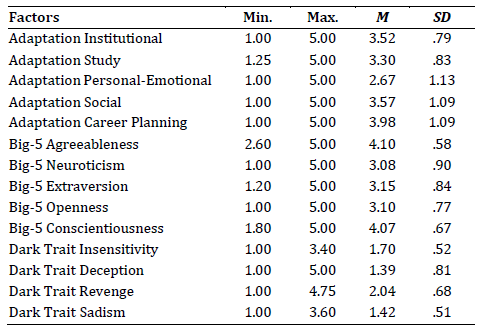
Table 2 presents the correlation coefficients between personality traits and the dimensions of academic adaptation. Although several correlations reached statistical significance, most were low magnitude, particularly those involving the relationships between dark personality traits and dimensions of academic adaptation. Noteworthy findings include a strong negative correlation between the Big Five Neuroticism factor and the Personal-Emotional dimension, as well as a strong positive correlation between the Big Five Conscientiousness factor and the Study dimension. Regarding the associations between the two personality perspectives examined, statistically significant relationships were observed only between Agreeableness and Conscientiousness (Big Five) and the four D traits, all of which were negative in direction and low in magnitude.
Table 2: Correlations between Academic Adaptation, the Big Five Factor Model, and the Dark Factor of Personality (N = 231)
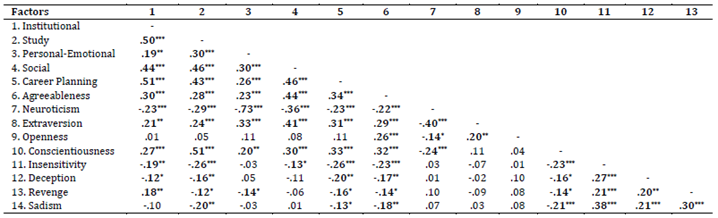
Note: Statistically significant ρ values are bold. *p < .05; **p < .01; ***p < .001
Table 3 presents the results of the linear regression analyses for the three proposed models, explaining the predictive relationships between the two personality models and academic adaptation. Model 1 (composed of the traits from the Big Five) explained 54 % of the variance in the Personal-Emotional dimension – where the presence of the Neuroticism trait reduced this component of academic adaptation. Academic Study adaptation had 31 % of its variance explained by personality traits —Conscientiousness increased this academic dimension, while Neuroticism had the opposite effect. The model explained 27 % of the variance in Social adaptation— where the traits Extraversion, Agreeableness, and Conscientiousness enhanced this component, while Neuroticism contributed to maladjustment. The Career Planning dimension had a variance of 22 %, which Conscientiousness, Extraversion, and Agreeableness explain. The Institutional dimension had a variance of 13 %, which Agreeableness and Conscientiousness explain. The Openness personality trait did not demonstrate predictive potential for academic adaptation dimensions.
In Model 2 (which encompassed the D), the Insensitivity trait explained 7 % of the variance in the Study and Career adaptation dimensions. The presence of this trait indicated a decrease in both dimensions of academic adaptation (see Table 3). The traits Insensitivity and Revenge explain 3 % of the variance in Institutional adaptation, which is associated with a reduction in this component. The D traits did not impact the Personal-Emotional and Social dimensions of academic adaptation. It is clarified that, although the Revenge trait presented a statistically significant standardized regression coefficient for the Personal–Emotional dimension, the model did not explain a statistically significant portion of the variance in this outcome, as indicated by the non-significant adjusted R² adjusted (Table 3).
Model 3 showed that combining the Big Five model and the D traits yielded an explanatory contribution like that obtained in Model 1 for the Institutional (13 %), Personal- Emotional (54 %), and Social (27 %) dimensions. However, the β coefficients indicated a different configuration in the predictive patterns of personality traits for the Institutional and Social dimensions. Institutional adaptation continued to be predicted solely by the Agreeableness factor (Big Five). In turn, Social adaptation was predicted by adding Sadism (D traits), alongside Agreeableness, Extraversion, and Conscientiousness (Big Five), although the effect of Sadism can be considered of small magnitude. Neuroticism remained a trait that negatively affected this dimension of academic adaptation.
Still in Table 3, it can be observed that, when considering both personality models, Model 3 represented an increase of one point in the explained variance of the Study (32 %) and Career (23 %) dimensions compared to Model 1. In Model 3, the dark trait Insensitivity proved to be a factor that reduces both dimensions of adaptation to HE.
Table 3: Regression Models Involving Personality Traits and Academic Adaptation
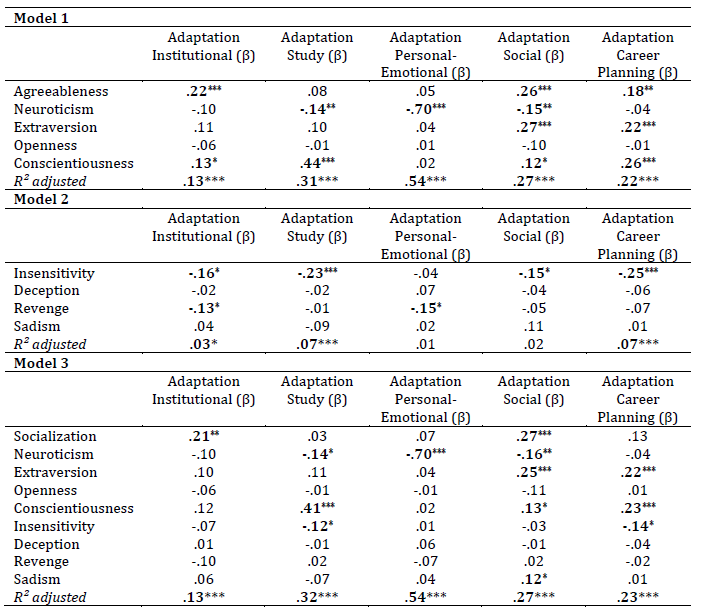
Note 1: Statistically significant β values appear in bold. *p < .05; **p < .01; ***p < .001
Note 2: Durbin-Watson values, Model 1: Institutional Adaptation, D-W = 1.95; Study Adaptation, D-W = 2.09; Personal-Emotional Adaptation, D-W = 2.10; Social Adaptation, D-W = 2.14; Career Adaptation, D-W = 1.95.
Note 3: Durbin-Watson values, Model 2: Institutional Adaptation, D-W = 1.85; Study Adaptation, D-W = 1.91; Personal-Emotional Adaptation, D-W = 1.80; Social Adaptation, D-W = 2.00; Career Adaptation, D-W = 1.84.
Note 4: Durbin-Watson values, Model 3: Institutional Adaptation, D-W = 1.92; Study Adaptation, D-W = 2.74; Personal-Emotional Adaptation, D-W = 2.09; Social Adaptation, D-W = 2.14; Career Adaptation, D-W = 1.88.
Figure 1 presents the connections between the traits of the two personality models and the dimensions of academic adaptation. The network yielded 14 nodes (41 edges ≠ 0) and a sparsity value of .54 (moderate). Since the nodes refer to items with stronger associations with the latent factor of each construct, the description of the subsequent results highlights the semantic content of the items, applied both to the analysis of the graph and to the centrality indices. A visual inspection of the edge thickness in the graph on the left reveals strong and moderate magnitude connections linking the trait Conscientiousness (Identifying with the adjective "dedicated person") to the dimensions Study (Making an effort in studies/being determined to achieve good results), Career (Being certain about being in the best course), Social (Feeling close to one’s established group of friends in college), and Institutional (Identifying with the higher education institution). The Personal-Emotional dimension (Not feeling sad/down) exhibits strong and moderate magnitude connections with the traits Neuroticism (Identifying with the adjective "depressed person"), Extroversion (Identifying with the adjective "communicative person"), and the dark trait Revenge (Considering it wise to withhold information to use later against others).
The graph in the top right corner of Figure 1 displays the network's centrality indices. According to the strength index, the most important nodes in the network correspond to the Study adaptation dimension, the Big Five traits Neuroticism and Extraversion, and the dark trait Sadism (Not feeling discomfort in harming someone). Based on the closeness index (nodes that can quickly affect other nodes in the network) and the betweenness index (the frequency which a node appears on the shortest path between two nodes), the key elements were the Study adaptation dimension and the personality traits Extraversion and Revenge.
Conversely, the centrality index graph in Figure 1 indicates that the least important nodes (strength index) and those with the lowest potential to affect other nodes in the network (closeness index) correspond to the Institutional dimension and the traits Openness (Identifying with the adjective "creative person") and Insensitivity (Not feeling regret when something one does upsets others). The nodes that were most prominent in the shortest paths between two nodes (betweenness index) were the Institutional dimension, the Big Five traits Neuroticism and Openness, and the dark traits Deception (Considering it better to be important and dishonest than humble and honest) and Insensitivity.
Figure 1: Graphs of the Connections between Personality Traits and Academic Adaptation Dimensions and the Strength, Centrality and Betweenness Indices
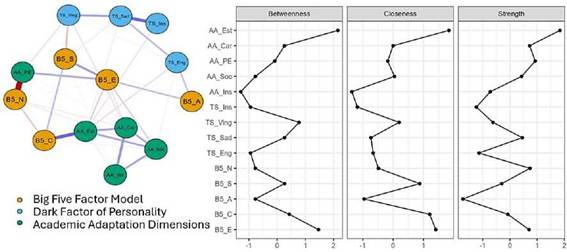
Note 1: Selected Items – Academic Adaptation: Study Dimension (AA_Est): “Making an effort in studies/being determined to achieve good results” factor loading = .87; Career Planning Dimension (AA_Car): “Being certain about being in the best course” factor loading = .93; Social Dimension (AA_Soc): “Feeling close to the established group of friends in college” factor loading = .90; Institutional Dimension (AA_Ins): “Identifying with the higher education institution” factor loading = .72; Personal-Emotional Dimension (AA_PE): “Not feeling sad/down” factor loading = .96.
Note 2: Selected Items – Big Five Factor. Trait Conscientiousness (B5_C): “Identifying with the adjective dedicated person”, factor loading = .85; Trait Neuroticism (B5_N): “Identifying with the adjective depressed person”, factor loading = .79; Trait Extraversion (B5_E): “Identifying with the adjective "communicative person"”, factor loading = .85; Trait Openness (B5_A): “Identifying with the adjective creative person”, factor loading = .73, Trait Agreeableness (B5_S): “Identifying with the adjective kind person”, factor loading = .82.
Note 3: Selected Items – Dark Factor of Personality. Dark Trait Revenge (TS_Ving): “Considering it wise to withhold information to use later against others”, factor loading = .66; Dark Trait Deception (TS_Eng): “Considering it better to be important and dishonest than humble and hones”, factor loading = .22; Dark Trait Sadism (TS_Sad): “Not feeling discomfort in harming someone”, factor loading = .69; Dark Trait Insensitivity (TS_Ins): “Not feeling regret when something one does upsets others”, factor loading = .64.
Discussion
This study investigated the possible relationships between personality (Big Five and D traits) and academic adaptation among HE students. The researchers found that, overall, the participants demonstrated good academic adaptation, a predominance of positive Big Five characteristics, and low expression of the D factor structure. They also observed that academic adaptation was broadly influenced —both adaptively and maladaptively— by personality traits, with certain Big Five factors exerting the greatest impact.
The descriptive analyses indicated that the Career Planning and Personal-Emotional dimensions showed high and low means, respectively, suggesting that the students felt confident about their course choice and personal and professional prospects, while also displaying greater emotional vulnerability in the university context. Regarding personality traits, the researchers found high means for Conscientiousness and Agreeableness, and low means for Neuroticism and the D factor, characterizing a student profile associated with desirable and adaptive responses. These findings align with previous evidence highlighting the centrality of vocational and emotional aspects in HE adaptation, as well as the role of personality in either facilitating or limiting this process and overall well-being, depending on trait configuration and sample characteristics (Abood et al., 2020; Shaninah & Mohd Noor, 2024; Zanon et al., 2019).
The correlations confirm relationships between personality (Big Five and D factor) and academic adaptation, with the strongest associations occurring between the Big Five factors and the dimensions of academic adaptation. These findings indicate that students’ integration into the academic context depends on their personal resources. The researchers noted that these results align with previous studies examining the relationship between the Big Five and academic adaptation (Abood et al., 2020; Zanon et al., 2019), although they differ regarding the influence of Agreeableness, Openness to Experience, and Conscientiousness observed by Abood et al. (2020). The researchers also emphasized that the influence of the D factor on the dimensions of academic adaptation appears limited and is possibly mediated by other factors, such as sample characteristics and patterns identified in the descriptive analyses.
In particular, the positive association between Conscientiousness and the Study dimension aligns with evidence reported by Zanon et al. (2019) and indicates that students who are more diligent, responsible, and organized tend to adopt more effective study strategies and demonstrate greater self-regulation and engagement with academic activities, thereby facilitating learning and academic performance. The researchers emphasized that, although Melkumyan and Sahakyan (2024), Novikova and Vorobyeva (2017), and Shaninah and Mohd Noor (2024) did not directly investigate academic adaptation, their findings contributed to understanding the positive influence of Conscientiousness on academic performance.
In contrast, the inverse relationship between Neuroticism and the Personal-Emotional dimension supports the findings reported by Zanon et al. (2019) and Abood et al. (2020), who indicated that individuals with higher vulnerability to negative emotions and emotional instability tend to experience impairments in academic adaptation due to physical and psychological distress. The researchers highlighted that students’ susceptibility to stress and anxiety can compromise their well-being, learning process, academic performance, and success, as noted by De la Fuente et al. (2024), Novikova and Vorobyeva (2017), and Shaninah and Mohd Noor (2024), although these results contrast with those of Melkumyan and Sahakyan (2024), who did not find statistical significance.
The correlations also confirmed relationships between the personality models, particularly between the Agreeableness and Conscientiousness factors and the D factor, supporting the findings of Moshagen et al. (2018; 2020), who showed that individuals who are less disciplined, organized, responsible, social, altruistic, and cooperative tend to maximize their personal utility at the expense of others’ utility. The researchers emphasized that the D factor reflects a combination of personal characteristics that cannot be reduced to a single basic trait, and that it influences behavior across different contexts and increases the risk of maladjustment, including socioemotional deficits, interpersonal difficulties, and psychopathology (Bader et al., 2021; Moshagen et al., 2018).
The linear regression analyses reinforced these observations and showed that the Big Five traits explain most of the variance in academic adaptation. Although certain traits associated with the D factor also demonstrated predictive capacity for some dimensions of academic adaptation, the researchers found their impact to be limited and possibly mediated by other factors. This distinction highlights the complexity of academic adaptation, which the researchers understand as a construct influenced by intrapersonal and interpersonal aspects, as well as by bidirectional relationships between the individual and the context (Almeida et al., 2024; Porto & Soares, 2017). These findings emphasize the importance of considering this complexity when designing and implementing support strategies in HEIs.
Beyond the positive influence of Conscientiousness on the Study dimension and the negative impact of Neuroticism on the Personal-Emotional dimension, the researchers found that social integration and the quality of interpersonal relationships (Social dimension) depend on both emotional stability and disciplined, cooperative, and prosocial behaviors. Furthermore, they observed that more adaptive and socially desirable behavioral patterns promote both students’ satisfaction and career planning, as well as their contentment and use of institutional resources provided by HEIs, reflected respectively in the Career Planning and Institutional dimensions. These findings corroborate the results of Zanon et al. (2019) and Abood et al. (2020), showing that the way university students experience the academic environment can contribute —or not— to their adaptation, reinforcing the Big Five as a theoretical framework for identifying predictors of academic experiences.
Despite the limited impact of the D factor on academic adaptation, the researchers found relevant nuances regarding the use of both personality models to explain the variance of this construct. They observed that Institutional adaptation was predicted exclusively by the Agreeableness factor, whereas Social dimension showed a slight increase in explanatory power with the inclusion of Sadism. These findings highlight the complexity of academic adaptation and support the idea that dark traits can influence social behaviors differently depending on the context (Almeida et al., 2024; Moshagen et al., 2018; Moshagen et al., 2020; Porto & Soares, 2017).
The network analysis modeled the interactions between personality traits (Big Five and D factor) and the dimensions of academic adaptation, revealing both the structural complexity of the constructs and the semantic specificity of the items that measure them. Strong and moderate connections between Conscientiousness and the dimensions Study, Career, Social, and Institutional dimensions suggest that this trait organizes adaptation.
Similarly, strong and moderate connections between the Personal-Emotional dimension and the Neuroticism, Extraversion, and Revenge indicate that intrapersonal factors play a key role in adaptation. These findings extend previous evidence from linear approaches regarding the relationship between the Big Five and academic adaptation (Abood et al., 2020; Shaninah & Mohd Noor, 2024; Zanon et al., 2019), as well as their association with academic performance (Melkumyan & Sahakyan, 2024; Novikova & Vorobyeva, 2017), showing that these relationships form interdependent arrangements rather than merely associative ones.
These interdependent arrangements suggest that interventions should address contextual, intrapersonal, and interpersonal aspects simultaneously to promote more adaptive patterns of functioning. Academic support programs that strengthen diligence, combined with institutional strategies for emotional support, socialization, and peer assistance, can facilitate students’ entry, retention, and completion in HE (Kumar & Tankha, 2023; Porto & Soares, 2017; Shaninah & Mohd Noor, 2024). This perspective highlights the need for integrative approaches, in which individual characteristics and environmental conditions mutually influence each other, emphasizing the complexity of adaptation.
We note that certain personality traits (Neuroticism, Extraversion, Sadism, and Revenge) and academic dimensions (Study) play a central and strategic role in shaping the interrelationships among the constructs under investigation, while other factors (Institutional, Openness, and Insensitivity) help organize and integrate interdependent arrangements.
This distinction highlights the complexity of academic adaptation, as both adaptive responses related to mental health and maladaptive responses associated with risk behaviors and maladjustment influence the process. In this context, secondary factors shape the overall configuration and emphasize the importance of HEIs providing resources and activities to promote adaptation and reduce potential negative outcomes, through interventions with systemic effects that reverberate across academic, professional, and interpersonal networks.
However, researchers should approach the generalization of the results with caution. This study is one of the first to directly examine the relationship between these constructs, which limits opportunities to compare the findings with the existing literature. In addition, the instruments used to assess personality —the Big Five Mini-Markers (Hauck et al., 2012) and the D16 (Bonfá-Araujo et al., 2023)— showed low evidence of validity based on their internal structure. Regarding the D Factor, the analyses also revealed compromised internal consistency across its factors, except for Sadism. Therefore, future researchers need to administer these instruments to samples of university students to evaluate the psychometric properties of their scores. This recommendation extends beyond investigating the relationships between the Big Five and the D Factor with academic adaptation and also includes examining other constructs associated with personality, such as vocational interests (Wilmot & Ones, 2021) and the motives underlying academic dropout (Hughes et al., 2023).
This paper reported that students showed better adaptation in the Career Planning dimension, suggesting that academic programs reflect, in their curricula, relevance to the labor market. Conversely, students exhibited lower levels of adaptation in the Personal- Emotional dimension. Concerns regarding mental health in HE should therefore include first-year students, with systematic assessment of this aspect at entry.
In terms of personality, the traits that stood out within the Big Five Factor Model were Agreeableness and Conscientiousness, whereas Neuroticism was the least prominent. This scenario may be considered positive, given that personality functions as an antecedent factor for academic adaptation.
No substantial endorsement of the Dark Factor (D) was observed among students; however, Revenge emerged as the most salient trait, while Deception showed the lowest prevalence, which was already minimal. These findings may be linked to sociocultural influences disseminated not only through everyday interpersonal relationships but also through exposure to cultural industry productions consumed by young people, such as cinema and other audiovisual media. On the one hand, attitudes associated with Revenge may be interpreted as a justifiable “act of justice” when an individual responds to perceived wrongdoing. On the other hand, attitudes related to deception may not be legitimized in the same manner.
The low correlations between personality and academic adaptation indicate that, although personality traits are associated with antecedents of adaptation to HE, they are not entirely determinant. From a practical standpoint, the findings suggest that interventions should assess whether maladjustment in the Personal-Emotional dimension is associated with personality characteristics, such as high levels of Neuroticism. Likewise, in promoting adaptation in the Study dimension, the results indicate that implementing self- regulated learning programs may be beneficial, particularly for students with lower levels of Conscientiousness.
The regression analyses revealed that, for some dimensions of academic adaptation, incorporating both the Big Five Factor Model and the Dark Factor does not substantially increase predictive power. However, adaptation in certain dimensions, such as Study, Social, and Career Planning, was enhanced by the inclusion of D traits, which may therefore be considered in assessment and intervention strategies aimed at fostering academic adaptation throughout students’ educational trajectories. In the case of the Dark Factor, its traits may be particularly relevant in interventions involving student groups, conflictual relationships among students, interactions with faculty, and institutional dynamics. Such considerations should not be limited to first-year students, as these issues may emerge at different stages of academic training through deeper engagement with the educational process.
When seeking to assess the phenomenon to understand and subsequently intervene, the results of the network analysis may guide more specific and tailored actions according to the characteristics of the student population served. In this regard, examining the most salient items provides practical indications for application. Nevertheless, further research on the Dark Factor is warranted, as the low endorsement of its items in the present sample may have affected its factorial structure, particularly in terms of factor loadings, in addition to previously noted psychometric considerations.
Accordingly, a future research agenda should include studies with larger and more representative samples, employing additional measurement instruments, especially for assessing the Dark Factor. Also with a more robust student sample, it is important to reassess the psychometric characteristics of both scales, as the CFI and TLI, as well as composite reliability in case of D16, are below the critical levels required in literature. Moreover, controlling for social desirability will be important, particularly for D Factor items that may contain content with which students identify but feel unable to endorse due to moral or cultural constraints. This field of research holds promising prospects, as it focuses on personality functioning in adult development within formal educational settings characterized by high demands and increasingly heterogeneous student populations. Such heterogeneity has been driven by HE accesses policies implemented in Brazil and other countries, as well as by the market-oriented expansion of education, exemplified by the growth of private HEIs.
References:
Abood, M. H., Alharbi, B. H., Mhaidat, F., & Gazo, A. M. (2020). The relationship between personality traits, academic self-efficacy and academic adaptation among university students in Jordan. International Journal of Higher Education, 9(3), 120-128. https://doi.org/10.5430/ijhe.v9n3p120
Almeida, L. S., Casanova, J. R., & Canal, C. P. P. (2024). Adaptation and academic success of students in higher education: contributions from educational psychology. In Z. Eisenberg, E. Santos, & S. B. Guimarães (Orgs.), The perspective of educational psychology on higher education (pp. 33-49). CRV.
Araújo, A. M., Almeida, L. S., Ferreira, J. A., Santos, A. D., Noronha, A. P., & Zanon, C. (2014). Higher education adaptation questionnaire (QAES): Construction and validation of a new questionnaire. Psychology, Education and Culture, 18(1), 131-145.
Baalmann, T. (2024). Health-related quality of life, success probability and students’ dropout intentions: Evidence from a German longitudinal study. Research in Higher Education, 65(1), 153-180. https://doi.org/10.1007/s11162-023-09738-7
Bader, M., Hartung, J., Hilbig, B. E., Zettler, I., Moshagen, M., & Wilhelm, O. (2021). Themes of the dark core of personality. Psychological Assessment, 33(6), 511-525. https://doi.org/10.1037/pas0001006
Baptista, M. N., Ferraz, A. S., & Inácio, A. L. M. (2020). Academic adaptation and mental health in higher education. In A. B. Soares, L. Mourão, & M. C. Monteiro (Eds.), The Brazilian university student: Mental health, professional choice, adaptation to university and career development (pp. 21-36). Appris.
Bonfá-Araujo, B., Ferreira, L. B., Jesuíno, A. D. S. A., Hauck-Filho, N., & Iglesias, F. (2023). Measuring the dark core: A Brazilian adaptation and comparison between the general population and incarcerated men. Journal of Criminal Justice, 89, 102-133. https://doi.org/10.1016/j.jcrimjus.2023.102133
Chen, S., Cheung, A. C. K., & Zeng, Z. (2025). Big Five personality traits and university students' academic performance: A meta-analysis. Personality and Individual Differences, 240, 113163. https://doi.org/10.1016/j.paid.2025.113163
De la Fuente, J., Sander, P., Umerenkova, A. G., Urien, B., Pachón-Basallo, M., & Luis, E. O. (2024). The Big Five factors as differential predictors of self-regulation, achievement emotions, coping and health behavior in undergraduate students. BMC Psychology, 12, article 267. https://doi.org/10.1186/s40359-024-01768-9
Epskamp, S., Borsboom, D., & Fried, E. I. (2018). Estimating psychological networks and their accuracy: A tutorial paper. Behavior Research Methods, 50(1), 195-212. https://doi.org/10.3758/s13428-017-0862-1
Farias, R. V., Gouveia, V. V., & Almeida, L. S. (2022). Adaptation and academic success in Brazilian first-year higher education students. Journal of Studies and Research in Psychology and Education, 9(1), 58-75.
Field, A. (2021). Discovering statistics using SPSS (5th ed.). Sage.
Goss-Sampson, M. A. (2024). Statistical Analysis in JASP 0.18.3: A guide for students. University of Greenwich & JASP Team.
Hauck Filho, N., Machado, W. D. L., Teixeira, M. A. P., & Bandeira, D. R. (2012). Evidence of validity of reduced markers for personality assessment in the Big Five factor model. Psychology: Theory and Research, 28(4), 417-423. https://doi.org/10.1590/S0102-37722012000400007
Hilbig, B. E., Moshagen, M., Horsten, L. K., & Zettler, I. (2021). Agreeableness is dead. Long live agreeableness? Reply to Vize and Lynam. Journal of Research in Personality, 91, 104074. https://doi.org/10.1016/j.jrp.2021.104074
Horsten, L. K., Thielmann, I., Moshagen, M., Zettler, I., Scholz, D., & Hilbig, B. E. (2024). Testing the equivalence of the aversive core of personality and a blend of agreeableness‑related items. Journal of Personality, 92(2), 393-404. https://doi.org/10.1111/jopy.12830
Hu, A., Li, X., & Song, H. (2023). The influence of Big Five personality traits on college students’ key competencies: the mediating effect of psychological capital. Frontiers in Psychology, 14, 1242557. https://doi.org/10.3389/fpsyg.2023.1242557
Hughes, D. J., Adie, J. W., Kratsiotis, I. K., Bartholomew, K. J., Bhakta, R., & Martindale, J. (2023). Dark personality traits and psychological need frustration explain future levels of student satisfaction, engagement, and performance. Learning and Individual Differences, 103, 102273. https://doi.org/10.1016/j.lindif.2023.102273
John, O. P. (2021). History, measurement, and conceptual elaboration of the Big Five trait taxonomy: The paradigm matures. In O. P. John & R. W. Robins (Eds.), Handbook of personality: Theory and research (pp. 35-82). Guilford Press.
Kline, R. B. (2015). Principles and practice of structural equation modeling (4th ed.). Guilford Press.
Kokkinos, C. M., Voulgaridou, I., & Tsouloupas, C. N. (2025). Personality shadows: Dark triad traits and academic major choices among Greek university- students. International Journal of Educational Psychology, 14(2), 94-117. https://doi.org/10.17583/ijep.15904
Kumar, V. V., & Tankha, G. (2023). Association between the Big Five and trait emotional intelligence among college students. Psychology Research and Behavior Management, 16, 915-925. https://doi.org/10.2147/prbm.s400058
Leow, T., Li, W. W., Miller, D. J., & McDermott, B. (2025). Prevalence of university non-continuation and mental health conditions, and effect of mental health conditions on non-continuation: A systematic review and meta-analysis. Journal of Mental Health, 34(2), 222-237. https://doi.org/10.1080/09638237.2024.2332812
Mammarella, S., Giusti, L., Del Vecchio, S., Salza, A., Casacchia, M., & Roncone, R. (2024). Psychological distress and academic success: A two-year study comparing the outcome of two online interventions at a university counseling and consultation service in Italy. Frontiers in Psychiatry, 15, article 1427316. https://doi.org/10.3389/fpsyt.2024.1427316
Melkumyan, A., & Sahakyan, M. (2024). Psychological and educational aspects of students’ adaptation in the context of digitalization. BIO Web of Conferences, 120, 01063.
Moshagen, M., Hilbig, B. E., & Zettler, I. (2018). The dark core of personality. Psychological Review, 125(5), 656-688. https://doi.org/10.1037/rev0000111
Moshagen, M., Zettler, I., & Hilbig, B. E. (2020). Measuring the dark core of personality. Psychological Assessment, 32(2), 182-196. https://doi.org/10.1037/pas0000778
Muthén, L. K., & Muthén, B. O. (2017). Mplus user’s guide (8th ed.).
Novikova, I. A., & Vorobyeva, A. A. (2017). Big Five Factors and academic achievement in Russian students. Psychology in Russia: State of the Art, 10(4), 95-112. https://doi.org/10.11621/pir.2017.0409
Porto, A. M. da S., & Soares, A. B. (2017). Expectations and college adjustment in college students. Psychology: Theory and Practice, 19(1), 208-219. https://doi.org/10.5935/1980-6906/psicologia.v19n1p208-219
Ramos-Vera, C., García O’Diana, A., Calle, D., Basauri-Delgado, M., Bonfá-Araujo, B., Lima-Costa, A. R., Duradoni, M., Nasir S., Calizaya-Milla Y. E., & Saintila, J. (2024). A network analysis approach to understanding centrality and overlap of 21 dark triad items in adults of 10 countries. Psychology Research and Behavior Management, 17, 467-483. https://doi.org/10.2147/prbm.s435871
Shaninah, F. S. E., & Mohd Noor, M. H. (2024). The impact of big five personality traits in predicting student academic performance. Journal of Applied Research in Higher Education, 16(2), 523-539. https://doi.org/10.1108/jarhe-08-2022-0274
Soares, A. B., de Almeida Lima, C., Monteiro, M. C., de Alcântara Sousa, B., dos Santos, G. G. B., & da Silva Rodrigues, I. (2021). Academic adaptation of first-year psychology students. Studies and Research in Psychology, 21(2), 513-532. https://doi.org/10.12957/epp.2021.61054
Soares, A. B., Santos, Z. de A., & Brito, A. D. (2024). Predictors of academic adaptation of beginners in the psychology course. International Journal of Higher Education, 10, e024003. https://doi.org/10.20396/riesup.v10i00.8668325
Vedel, A., & Thomsen, D. K. (2017). The Dark Triad across academic majors. Personality and Individual Differences, 116, 86-91. https://doi.org/10.1016/j.paid.2017.04.030
Wilmot, M. P., & Ones, D. S. (2021). Occupational characteristics moderate personality– performance relations in major occupational groups. Journal of Vocational Behavior, 131, 103655. https://doi.org/10.1016/j.jvb.2021.103655
Zanon, C., Araújo, A., & Hutz, C. S. (2019). The relevance of the Big Five model to students’ adaptation to the academic environment personality and academic experiences. Psico, 50(4), e31599. https://doi.org/10.15448/1980-8623.2019.4.31599
Funding: Scholarship from the Conselho Nacional de Desenvolvimento Científico e Tecnológico - CNPq (2023-2024) to fund the author Marina Cerceau Silva's participation in the Scientific Initiation Program at the Centro Universitário de Brasília (CEUB), Brasília – DF, Brazil.
Data availability: The set of data that bases the results of this study is available in OSFHome <https://osf.io/gxzfd/overview?view_only=f224a382fd9e4634a0a067fe7484c06c>.
Conflict of interest: The authors declare that they have no conflicts of interest.
How to cite: Silva, M. C., Ferraz, A. S., Modesto, J. G. N., Cunha, N., de B. & Almeida, L. S. (2026). Relationships between Academic Adaptation and Healthy and Subclinical Personality Traits. Ciencias Psicológicas, 20(1), e-4546. https://doi.org/10.22235/cp.v20i1.4546
Authors’ contribution (CRediT Taxonomy): 1. Conceptualization; 2. Data curation; 3. Formal Analysis; 4. Funding acquisition; 5. Investigation; 6. Methodology; 7. Project administration; 8. Resources; 9. Software; 10. Supervision; 11. Validation; 12. Visualization; 13. Writing: original draft; 14. Writing: review & editing.
M. C., S. has contributed in 1, 2, 3, 4, 5, 6, 7, 8, 12, 13, 14; A. S., F. in 1, 2, 3, 4, 5, 6, 7, 8, 9, 10, 11, 12, 13, 14; J. G. N. M. in 5, 7, 10, 13, 14; N., de B. C. in 14; L. S. A. in 14.
Scientific editor in-charge: Dr. Cecilia Cracco.
Ciencias Psicológicas; v20(1)
January - June 2026
10.22235/cp.v20i1.4546