Ciencias Psicológicas; v19(2)
Julho-dezembro 2025
10.22235/cp.v19i1.4237
Artigos Originais
Flexibilidade cognitiva e estresse no trabalho em docentes do ensino superior brasileiro
Cognitive Flexibility and Stress at Work in Brazilian Higher Education Professors
Flexibilidad cognitiva y estrés en el trabajo en profesores de educación superior brasileños
Júlia Tomedi Martins1, ORCID 0000-0002-5193-655X
Lucas Brandão2, ORCID 0009-0001-9828-6363
Camila Rosa de Oliveira3, ORCID 0000-0003-2115-604X
Júlia Gonçalves4, ORCID 0000-0002-2804-1045
1 Atitus Educação, Brasil
2 Atitus Educação, Brasil
3 Atitus Educação; Universidade do Estado de Minas Gerais, Brasil
4 Atitus Educação, Brasil, [email protected]
Resumo:
Este estudo investigou o papel preditor da Flexibilidade Cognitiva (FC) no Estresse no Trabalho (ET) em uma amostra de 203 docentes do ensino superior brasileiro. Foi aplicado um questionário socioprofissional, a Cognitive Flexibility Scale-Brasil (CFS-B) e a Job Stress Scale (JSS). A coleta ocorreu de forma individual e online, buscando heterogeneidade da amostra, composta por 52,2 % de mulheres, 56,7 % residentes na região sul do país, 61,6 % com cargos de gestão e 52,2 % atuantes em instituições privadas. Foram realizadas análises descritivas, de correlação e regressão. A maioria dos participantes da pesquisa percebeu alta demanda (59,6 %), alto controle/autonomia (63,5 %) e alto apoio (52,7 %) no trabalho e indicou alto nível de FC (52 %). Verificou-se correlações fracas e positivas entre FC e as dimensões avaliadas do ET. Quanto maior a autonomia e apoio social, e menores demandas no trabalho, menores níveis de estresse são experienciados. A FC apresentou pequeno valor preditivo para o ET, apesar disso, pode ser protetiva nas dimensões de apoio social e controle, embora mostrou-se relacionada à níveis maiores de demandas assumidas no trabalho. Intervenções em Psicologia Organizacional que desenvolvam FC podem mitigar fatores de risco associados ao desenvolvimento de adoecimentos no trabalho.
Palavras-chave: flexibilidade cognitiva; estresse ocupacional; psicologia do trabalho; ensino superior; docentes.
Abstract:
This study investigated the predictive role of Cognitive Flexibility (CF) in Job Stress (JS) in a sample of 203 Brazilian higher education faculty members. A socio-professional questionnaire, the Cognitive Flexibility Scale-Brazil (CFS-B), and the Job Stress Scale (JSS) were applied. Data collection was conducted individually and online, aiming for sample heterogeneity, composed of 52.2 % women, 56.7 % residents of the southern region of the country, 61.6 % in management positions, and 52.2 % working in private institutions. Descriptive, correlation, and regression analyses were conducted. Most participants reported high demand (59.6 %), high control/autonomy (63.5 %), and high support (52.7 %) at work, and indicated a high level of CF (52 %). Weak and positive correlations were found between CF and the evaluated dimensions of JS. The greater the autonomy and social support, and the lower the work demands, the lower the levels of stress experienced. CF presented a small predictive value for JS; nevertheless, it may be protective in the dimensions of social support and control, although it was also related to higher levels of assumed work demands. Organizational Psychology interventions that develop CF may mitigate risk factors associated with the development of work-related illnesses.
Keywords: cognitive flexibility; occupational stress; work psychology; higher education; teachers.
Resumen:
Este estudio investigó el papel predictivo de la flexibilidad cognitiva (FC) sobre el estrés laboral (EL) en una muestra de 203 profesores brasileños de enseñanza superior. Se aplicó un cuestionario socioprofesional, la Escala de Flexibilidad Cognitiva-Brasil (CFS-B) y la Escala de Estrés Laboral (JSS, por su sigla en inglés). El cuestionario se recogió de forma individual y en línea, buscando la heterogeneidad de la muestra, compuesta por 52.2 % de mujeres, 56.7 % residentes en el sur del país, 61.6 % en cargos directivos y 52.2 % que trabajan en instituciones privadas. Se realizaron análisis descriptivos, de correlación y de regresión. La mayoría de los participantes percibió una alta demanda (59.6 %), alto control/autonomía (63.5 %) y alto apoyo (52.7 %) en el trabajo e indicaron un alto nivel de FC (52 %). Se encontraron correlaciones débiles y positivas entre la FC y las dimensiones del EL evaluadas. Cuanto mayores eran la autonomía y el apoyo social, y menores las exigencias en el trabajo, menores eran los niveles de estrés experimentados. La FC mostró poco valor predictivo para el EL; aunque puede ser protectora en las dimensiones de apoyo social y control, si bien se relacionó con mayores niveles de exigencias asumidas en el trabajo. Las intervenciones de psicología del trabajo que desarrollan FC pueden mitigar los factores de riesgo asociados al desarrollo de enfermedades laborales.
Palabras clave: flexibilidad cognitiva; estrés laboral; psicología del trabajo; educación superior; profesores.
Recebido: 03/09/2024
Aceito: 30/05/2025
O aumento do adoecimento decorrente dos fatores presentes no ambiente de trabalho toma particular importância no contexto de docentes do ensino superior. Entre os principais fatores estão o aumento de demandas institucionais (Pinheiro et al., 2023), maior pressão por produtividade acadêmica, o baixo grau de controle sobre as condições de trabalho e a crescente precarização da atividade docente (Campos et al., 2020; Pinho et al., 2023). Além desses aspectos, destaca-se a insegurança em relação à carreira, as formas de lidar com situações estressantes e a normalização do estresse crônico no meio acadêmico (Nicholls et al., 2022) — elementos que, embora ligados à vivência individual, também podem contribuir para o desgaste da saúde mental desses profissionais.
Nesse sentido, é possível compreender que a saúde do trabalhador é produto da interação de aspectos organizacionais, ambientais e psicossociais, e sua promoção depende do investimento em fatores protetivos e da redução dos fatores de risco (OIT, 2016; Reis et al., 2010; Rodrigues et al., 2020; Vazquez et al., 2018). Uma possível definição para o conceito de fatores psicossociais aborda os aspectos presentes no contexto social e psicológico do trabalho, que têm o potencial de influenciar positiva ou negativamente o indivíduo, por meio de sua interação com o ambiente. Alternativamente, pode ser entendido como a interação entre as condições do trabalho, suas características ambientais e as capacidades, necessidades e situação pessoal do trabalhador, cujas percepções e experiências podem afetar sua saúde e desempenho (Tolfo et al., 2023). Nesta pesquisa, foi adotada essa segunda definição.
Quando um elemento do ambiente de trabalho auxilia na promoção de saúde e na prevenção de doenças, ele é considerado um fator psicossocial protetivo ou de proteção (Vazquez et al., 2018), por outro lado, quando possui o potencial de causar danos à saúde física e psicológica do trabalhador, ele é considerado um fator psicossocial de risco (Rodrigues et al., 2020). Os resultados desta interação são diversos e dependem do indivíduo em questão, de suas competências emocionais e necessidades psicológicas, bem como da forma de interação entre o indivíduo, da organização do trabalho, do contexto organizacional e social no qual ele está inserido (Reis et al., 2010; Rodrigues et al., 2020; Tolfo et al., 2023).
Dentre os riscos psicossociais mais investigados está o Estresse no Trabalho (ET) (Athayde & Souza, 2019; Tolfo et al., 2023), considerado, por definição, um padrão de respostas (emocionais, cognitivas, comportamentais e fisiológicas) que um indivíduo dá aos vários estressores aos quais é exposto diariamente no trabalho (Prado, 2016). Dessa forma, o ET ou estresse ocupacional pode ser compreendido como resultante de um ambiente de trabalho em que há fatores de risco, sem as devidas políticas e práticas de promoção da saúde (Athayde & Souza, 2019; Karasek, 1979; Prado, 2016). Porém o ET também pode representar o próprio fator psicossocial de risco para o desenvolvimento de outras doenças crônicas, tais como cardiovasculares, osteomusculares e transtornos mentais, como a Síndrome de Burnout (Fernández-Sánchez et al., 2018; Prado, 2016).
O ET de docentes universitários é objeto de estudo sob diversas perspectivas. Pesquisas demonstram que altos níveis de estresse nessa população estão associados a um aumento de conflitos no ambiente familiar, ao desenvolvimento da síndrome de burnout (Zhao et al., 2022), aos sintomas de ansiedade e depressão (Yousaf et al., 2025), bem como dificuldades em manter o equilíbrio entre vida pessoal e profissional (Malik et al., 2024). Paralelamente, investigações têm se voltado para a identificação de fatores psicossociais protetivos que possam mitigar os efeitos do estresse, como o suporte social (Yousaf et al., 2025), a satisfação no trabalho e até mesmo a reinterpretação do estresse como um esforço voltado à realização de um bom desempenho, o que pode gerar sentimentos positivos (Iriarte Rédin & Erro-Garcés, 2020).
Uma das formas de compreender o ET é por intermédio do Modelo Teórico de Demanda-Controle de Karasek (1979). Este modelo define o ET como uma consequência do desequilíbrio entre as demandas psicológicas e o controle que o trabalhador tem sobre seu trabalho. Por demandas, entende-se tudo o que é exigido psicologicamente para a realização das atividades de trabalho - pressão do tempo, nível de concentração exigida, interrupção das atividades e necessidade de se aguardar pelas tarefas realizadas por outros trabalhadores (Karasek, 1979; Reis et al., 2010; Vazquez et al., 2018). A compreensão de controle resulta da avaliação do quanto o trabalhador tem autonomia e recursos em seu ambiente organizacional para decidir sobre seu trabalho, bem como o quanto tem influência na criação e modificação de políticas e práticas organizacionais que o afetam (Karasek, 1979; Reis et al., 2010).
Quatro quadrantes surgem deste modelo, de acordo com o nível de demandas e de controle/autonomia que o indivíduo percebe em seu trabalho. Baixas demandas psicológicas e autonomia resultam no quadrante “passivo” - indicando um trabalho tedioso, monótono e estressante, pois exige pouco esforço para sua realização. Como oposto, o quadrante “ativo”, em que há altas demandas e controle, o indivíduo não necessariamente possui uma garantia de saúde mental, por ainda dispor de muito esforço e tempo para realizar as tarefas. Altas demandas psicológicas combinadas com baixo nível de controle sobre o trabalho, o inclui no quadrante de “alto desgaste”, considerado o mais danoso à saúde mental por exigir alto esforço diário para sua realização e não disponibilizar espaço para criatividade e originalidade. Por outro lado, alto controle/ autonomia e baixas demandas psicológicas, caracterizam o quadrante “baixo desgaste”, que é o de menor risco para a saúde mental dos trabalhadores (Karasek, 1979).
Ao modelo, foi incluído o fator apoio social por Jeffrey V. Johnson em 1986, definido como o clima social e psicológico do ambiente de trabalho, englobando suporte emocional e instrumental (Reis et al., 2010). Esse elemento é considerado fundamental para impulsionar a saúde, e sua falta pode acarretar a evolução de um quadro patológico do trabalhador (Vazquez et al., 2018). Com isso, o modelo passa a ser reconhecido como demanda-controle-apoio social (Karasek, 1979; Reis et al., 2010).
A partir da ampliação do modelo demanda-controle para incluir o fator apoio social, evidencia-se a relevância de considerar os recursos contextuais e pessoais disponíveis aos indivíduos. Reforça-se, a importância de compreender tanto os estressores externos quanto os recursos internos que podem atuar como mediadores ou moderadores do impacto do ET. Por exemplo, a autoeficácia (Liu et al., 2023) e traços individuais de personalidade (Munusamy et al., 2024), os quais, mesmo diante de fatores de risco, podem exercer um efeito protetivo no desenvolvimento de transtornos mentais relacionados ao trabalho. Tal perspectiva amplia o entendimento do ET ao incorporar elementos individuais na equação, o que abre espaço para a investigação de competências psicológicas que favoreçam a adaptação a contextos adversos.
Dentre os fatores protetivos individuais tem-se a Flexibilidade Cognitiva (FC), citada como uma competência em ascensão no ambiente organizacional da era digital (Yu et al., 2019) e passível de treino (Archer et al., 2024; Buitenweg et al., 2017; Harel et al., 2023; Keith et al., 2015). Neste estudo, utiliza-se a definição de FC de Martin e Rubin (1995), descrita em três componentes: (1) consciência de que há alternativas de comportamento em qualquer situação, (2) vontade de ser flexível, e (3) auto eficácia em ser flexível. A análise de pesquisas sobre FC permitem afirmar que sua possível relação com o ET ainda é pouco explorada. Estudos já investigaram a FC como uma variável independente, associando-a a fatores relacionados ao tratamento do transtorno de estresse pós-traumático em veteranos de guerra (Keith et al., 2015), bem como como um fator protetivo contra o estresse em educadores (Harel et al., 2023), sendo menos comuns os estudos que consideram a FC como uma variável dependente (Fernández-Sánchez et al., 2018).
Nesse contexto, esta pesquisa foi elaborada com o intuito de investigar o papel preditor da FC no ET em docentes do ensino superior brasileiro. Também objetivou-se explorar as relações entre FC e ET de acordo com características sociodemográficas, como gênero, escolaridade, e categoria administrativa da instituição de ensino superior (IES), bem como aspectos socioprofissionais como o nível de ensino em que os docentes atuam e se ocupam um cargo de gestão.
Método
Participantes
Nesta pesquisa quantitativa, descritiva e correlacional, participaram 203 docentes vinculados a diferentes IES do Brasil, conforme caracterização apresentada na Tabela 1. A amostra foi recolhida por conveniência, de acordo com a proximidade com as pesquisadoras e com o interesse e disponibilidade dos convidados, sendo utilizada a técnica snowball. Os critérios de inclusão foram: docentes do ensino superior que lecionavam em diferentes instituições de ensino privadas e públicas do Brasil; atuantes há pelo menos um ano no ensino superior e; com carga horária de, pelo menos, 20 horas semanais. Já os critérios de exclusão adotados foram: docentes que estavam, durante o período de coleta, em gozo de férias ou qualquer tipo afastamento do trabalho e; formulários incompletos.
Instrumentos
Questionário de dados socioprofissionais contendo questões sobre aspectos pessoais, sociais e profissionais do docente.
Cognitive Flexibility Scale (CFS) (Martin & Rubin, 1995; adaptada ao contexto brasileiro por Tomedi et al., 2023) composta por 12 itens respondidos em escala tipo Likert de 6 pontos (em que 1: discordo fortemente e 6: concordo fortemente) é uma escala unidimensional com fiabilidade α = 0,78 (exemplo de item: “Eu consigo comunicar uma ideia de muitas formas diferentes”).
Job Stress Scale (Alves et al., 2004) composta por 17 itens respondidos em escala tipo Likert de 4 pontos (em que 1: nunca ou quase nunca e 4: frequentemente), avaliando três dimensões relacionadas ao estresse no trabalho, derivada da teoria de Demanda-Controle, inicialmente conceituada por Karasek (1979): (1) demanda psicológica (5 itens, α = 0,72, exemplo de item: “Seu trabalho exige demais de você?”), (2) controle/autonomia no trabalho (6 itens, α = 0,63, exemplo de item: “Seu trabalho exige que você tome iniciativas?”), dividido em discernimento intelectual (α =0 ,56) e autoridade para decisão (α = 0,67), e (3) apoio social (6 itens, α = 0,86, exemplo de item: “Eu posso contar com o apoio dos meus colegas de trabalho”), variável que foi introduzida por Johnson e Hall (1988).
Procedimentos de coleta de dados e cuidados éticos
Os contatos iniciais com os participantes ocorreram de forma individual e online (e-mail e/ou redes sociais), a partir da rede de relacionamento das pesquisadoras. Após o aceite, foi solicitado que cada respondente compartilhasse a pesquisa com seus contatos que atendessem aos critérios estabelecidos. Como o número de retornos foi baixo, optou-se por realizar contatos diretos com coordenadores acadêmicos de IES das diferentes regiões do país e com sindicatos via e-mail, WhatsApp e redes sociais (Facebook e Instagram), solicitando a divulgação da pesquisa entre o corpo docente ou associados a entidade. Também foram realizadas postagens com card-convite em grupos de Facebook de divulgação de vagas de docentes e nos grupos oficiais das IES.
O projeto foi apreciado e aprovado pelo Comitê de Ética em Pesquisa da Faculdade Meridional (IMED) sob número de parecer 40501820.9.0000.5319, além disso, buscou-se atender a todos os pressupostos das Resoluções 466/2012 e 510/2016 do Conselho Nacional de Saúde (CNS). Aos possíveis participantes foi disponibilizado um link com os instrumentos da pesquisa via formulário online do Google Forms, em que o participante foi direcionado às escalas apenas após o aceite do Termo de Consentimento Livre e Esclarecido, disponível na primeira página do formulário online, e verificação dos critérios de inclusão e exclusão.
Tabela 1: Caracterização de características socioprofissionais da amostra da pesquisa
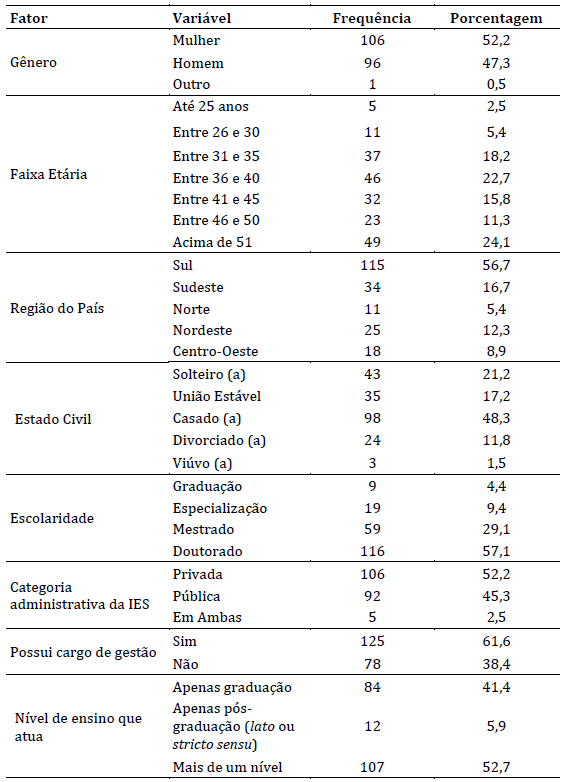
Nota: Dados coletados no questionário de dados socioprofissionais.
Procedimentos de análise de dados
Os dados foram analisados por meio de estatísticas descritivas e inferenciais, no software SPSS versão 23.0. Antes da realização das análises, procedeu-se a verificação dos pressupostos. Nesse sentido, o teste de Shapiro-Wilk indicou que a variável flexibilidade cognitiva não apresentou uma distribuição normal (W(203) = 0,97, p = 0,001). Logo, optou-se pela utilização de testes não paramétricos. Foi realizada a análise de correlação de Spearman, teste de Kruskal-Wallis, Qui-quadrado e regressão linear. A interpretação adotada para o tamanho do efeito dos coeficientes de correlação foi de ± 0,10 para efeito pequeno, ± 0,30 para efeito moderado e ± 0,50 para efeito grande (Cohen, 1988). Resultados foram considerados significativos quando p ≤ 0,05. Considerando-se que a CFS ainda não possui pontos de corte para a população brasileira, neste estudo calculou-se a média da amostra para classificar os participantes com alta ou baixa flexibilidade cognitiva, conforme orientação dos autores da escala (Martin & Anderson, 1998; Martin & Rubin, 1995). Dessa forma, classificou-se como flexibilidade cognitiva alta os escores ≥ 58 e como baixa, os escores ≤ 57.
Para a análise do ET conforme o modelo demanda-controle-apoio social, identificou-se a média de demandas (15,8) e de controle (20,7) da amostra e delimitou-se esta como o ponto de corte entre os quadrantes. Acima da média, considera-se uma alta demanda (≥ 16 pontos) e um alto controle (≥ 21 pontos), e abaixo, considerasse baixa demanda (≤ 15 pontos) e baixo controle (≤ 20 pontos). O mesmo processo foi realizado para a dimensão o apoio social (M = 19,6; Alto apoio ≥ 20 pontos; Baixo Apoio ≤ 19 pontos). Para categorizar os participantes nos quadrantes, aqueles com escore de demanda e de controle acima da média, foram inclusos no quadrante “ativo”, enquanto aqueles com a demanda acima da média, porém com controle abaixo, foram inclusos em “alto desgaste”. Já aqueles com controle e demanda abaixo da média da amostra são classificados no quadrante “passivo”. E, por fim, aqueles com baixos escores de demanda, mas com escore de controle acima da média são alocados no quadrante “baixo desgaste”.
Resultados
Relativo à FC, a amostra apresentou um escore médio (M = 57,54), afirma-se que cerca de 52 % (n = 106) da amostra possui alto nível de FC a partir dos parâmetros adotados. Os resultados descritivos da FC e das dimensões do ET podem ser observados na Tabela 2.
Tabela 2: Estatísticas Descritivas dos escores brutos (n = 203)

Nota: DP: Desvio Padrão; FC: Flexibilidade Cognitiva; CFS: Cognitive Flexibility Scale; JSS: Job Stress Scale.
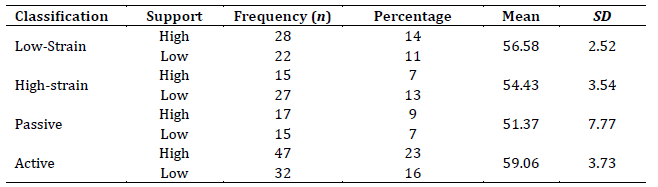
As análises descritivas do ET a partir da escala Job Stress Scale indicaram que a maioria dos participantes possui alta demanda (59,6 %, n = 121), alta percepção de controle/autonomia (63,5 %, n = 129) e alto apoio (52,7 %, n = 107), bem como, 39 % dos participantes encontram-se no quadrante ativo (n = 79; M = 59,06, DP = 3,73) (Tabela 3). Já o teste de Kruskal-Wallis indicou que existem diferenças significativas nos níveis de FC entre os quadrantes do modelo (H(3) = 9,742; p = 0,021).
Tabela 3: Classificação entre quadrantes nível de estresse e a variável apoio e estatísticas descritivas para os quadrantes da JSS
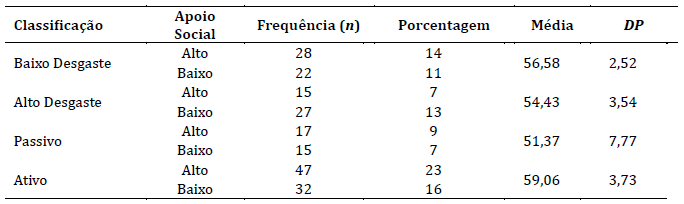
Nota: DP: Desvio Padrão.
A Tabela 4 apresenta os resultados da correlação de Spearman realizada entre FC e as dimensões de ET. O escore da escala de FC apresentou associação fraca e positiva com todas as dimensões da escala de ET, demonstrando que escores mais elevados de FC relacionam-se com maiores pontuações em controle no contexto laboral, demandas psicológicas e sensação de apoio social.
Tabela 4: Correlações de Spearman (n = 203)

Nota: FC: Flexibilidade Cognitiva.
*p < 0,05; **p < 0,01; ***p < 0,001
As comparações entre médias indicaram que os indivíduos localizados no quadrante ativo apresentaram níveis significativamente mais altos de FC em relação aos do quadrante passivo (p = 0,008), baixo desgaste (p = 0,034) e alto desgaste (p = 0,047). Entre os demais grupos não houve diferenças significativas.
Quanto às características sociodemográficas, não houve diferença para FC conforme gênero, mas verificou-se que mulheres indicaram sentir maiores demandas psicológicas (X2 = 5,997; p = 0,050) e de controle (X2 = 7,260; p = 0,027). Já os graduados, apresentaram maior prevalência de baixa demanda (X2 = 10,430; p = 0,012) e doutores maior frequência de alto controle (X2 = 11,242; p = 0,010). Não houve diferenças entre os níveis de escolaridade quanto ao apoio social e FC. Especificamente quanto às variáveis profissionais, na categoria administrativa houve maior prevalência de alto controle nas IES públicas (X2 = 9,757; p = 0,008). Houve maior frequência de alta FC entre os docentes que possuíam cargo de gestão (X2 = 6,358; p = 0,012), bem como maior prevalência de controle (X2 = 3,876; p = 0,049). Ao verificar os níveis de atuação, docentes que lecionavam tanto na graduação quanto na pós-graduação demonstraram maior prevalência de alta FC (X2 = 15,671; p ≤ 0,001).
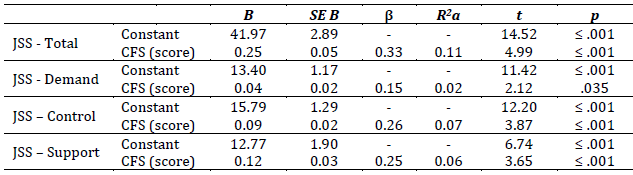
Por fim, realizou-se uma análise de regressão linear a fim de verificar o valor preditivo da flexibilidade cognitiva para o estresse no trabalho (Tabela 5). O modelo obtido para o escore total da JSS foi considerado moderado (F(1,201) = 24.86, R = 0,332), no qual a flexibilidade cognitiva (CFS) explicou, aproximadamente, 11% da variância. Os modelos obtidos para as dimensões Demanda (F(1,201) = 4.50, R = 0,148), Controle (F(1,201) = 14,96, R = 0,263) e Suporte (F(1,201) = 13,32, R = 0,249) da JSS foram considerados de efeito pequeno, sendo a maior variância explicada a apresentada para a dimensão controle (7 %), seguida por suporte (6 %) e demanda (2 %).
Tabela 5: Análises de regressão linear com FC como preditora para o ET
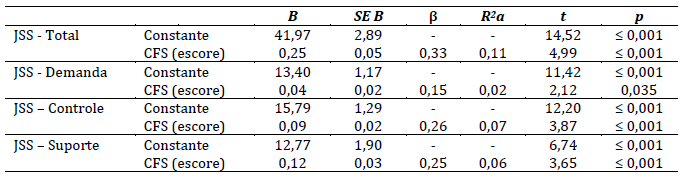
Nota: R2a = R2 ajustado.
Discussão
Este estudo investigou o papel preditor da FC no ET em docentes do ensino superior brasileiro. Relativo à FC, a amostra apresentou um escore médio (M = 57,54) semelhante aos achados de Martin e Anderson (1998), em estudo realizado com estudantes universitários (M = 57). Um estudo com adultos com mais de 60 anos (Johnco et al., 2014), também apresentou resultados semelhantes quanto ao escore médio (M = 58,13). Embora essas médias se aproximem, é necessário ter cautela na interpretação, não sendo possível, com base nesses dados, afirmar qualquer generalização sobre a medida ou o construto. Ainda assim, tais resultados permitem reflexões exploratórias sobre o desempenho da escala em diferentes populações, como a estabilidade de respostas.
Na amostra coletada há uma predominância de docentes com alta FC. A literatura indica que, além dos benefícios no bem-estar dos trabalhadores (Fernández-Sánchez et al., 2018; Yağan & Kaya, 2022; Yu et al. 2019), a FC pode desempenhar um importante papel na facilitação das relações interpessoais (Schwenke et al., 2020), uma vez que a rigidez cognitiva representa um obstáculo nos processos de socialização (Tariq & Adil, 2020). Esses dados são ainda mais relevantes quando se considera que uma relação harmoniosa entre docentes e discentes é fundamental para o bem-estar de ambos grupos e, por outro lado, a sobrecarga e a intensificação do trabalho podem resultar em sofrimento e adoecimento (Iriarte Redín & Erro-Garcés, 2020; Nicholls et al., 2022; Vivian et al., 2020). Considerando a FC como uma competência (Yu et al. 2019), e passível de treino (Archer et al., 2024; Buitenweg et al., 2017; Harel et al., 2023), é compreensível que a maior probabilidade de seleção de indivíduos cognitivamente flexíveis para cargos de docência (e de gestão) resulte em uma alta prevalência desses traços na amostra coletada.
Sobre o ET, os achados referentes aos altos níveis de demanda vão ao encontro de estudos que demonstraram que dentre as características do trabalho estão as cobranças excessivas por produtividade (Campos et al., 2020; Pinho et al., 2023) e a sobrecarga de atividades —quantidade e qualidade de produção científica e orientações de alunos— (Vivian et al., 2020), especialmente quando há um acúmulo de responsabilidades além da docência (Koetz et al., 2013). Já o alto nível de controle pode ser explicado pelas atividades realizadas por docentes, relacionadas ao cumprimento de regimentos e ao atendimento dos requisitos regulatórios do ensino superior, por exemplo, permitindo pouco espaço para criatividade (Li et al., 2018), apesar do crescente movimento de retirada de autoridade dos professores sobre decisões acadêmicas (Monteiro et al., 2022). Quanto ao fator apoio, observou-se uma distribuição quase equivalente, mas com mais pessoas assinalando alto apoio (52,7 %, n = 107), contrastando com a literatura, a qual aponta que uma das principais causas para o ET em docentes são problemas nas relações entre colegas (Nicholls et al., 2022; Vivian et al., 2020).
Verificou-se uma correlação positiva entre FC e as dimensões do ET, sugerindo que maiores níveis demandas e autonomia e apoio social percebidos, estão associados a níveis mais elevados de FC. Evidências na literatura apontam que estratégias organizacionais, como o empoderamento dos trabalhadores, a atribuição de tarefas mais complexas, o fornecimento de feedback contínuo e o estímulo ao uso da criatividade no ambiente laboral, podem favorecer o desenvolvimento da FC (Li et al., 2018), sendo essa uma possível hipótese para explicar a associação observada entre maiores demandas no trabalho e níveis superiores de FC. Entretanto, em um outro estudo que investigou a relação entre burnout e funções cognitivas, os autores encontraram uma correlação positiva entre a presença de burnout e níveis de FC (Fernández-Sánchez et al., 2018), o que contrasta com o entendimento usual de que o esgotamento tende a prejudicar o funcionamento cognitivo. Um ponto importante a ser considerado é que a Síndrome de Burnout —um dos possíveis agravamentos da vivência crônica do ET (Fernández-Sánchez et al., 2018; Prado, 2016)— tende a impactar negativamente o desempenho profissional, incluindo a redução na capacidade de aplicação da FC (Lemonaki et al., 2021). Assim, apesar da correlação positiva observada no presente estudo e na literatura, é fundamental considerar a possibilidade que a exposição prolongada a estressores pode resultar no surgimento de outras dificuldades ao longo do tempo.
Especificamente, a relação entre FC e apoio social é explorada em outras pesquisas. Um estudo encontrou correlação positiva entre rigidez cognitiva e determinados temperamentos, sugerindo que níveis de FC elevado podem estar ligados a um melhor ajuste social (Tariq & Adil, 2020). Outra pesquisa observou que uma percepção positiva de apoio social pode moderar os efeitos negativos do ET em trabalhos exigentes (Birolim et al., 2019). Além disso, um estudo realizado com 60 participantes também associou positivamente a FC e interações sociais (Schwenke et al., 2020).
Uma vez estabelecida a ligação entre a demanda e a FC, é pertinente explorar diversas características que podem influenciar essa relação. A proatividade, por exemplo, é reconhecida como um fator protetivo para os professores (Pyhältö et al., 2021), embora exija engajamento em um maior número de atividades. Além disso, a FC está correlacionada com a capacidade criativa (Li et al., 2018), o que também pode impactar o nível de atividade no trabalho. Acrescenta-se a isso o papel da estimulação no desenvolvimento da FC (Buitenweg et al., 2017; Li et al., 2018). Portanto, o contato contínuo com tarefas que demandam habilidades de resolução de problemas, pode resultar em uma maior percepção da própria FC.
A associação positiva fraca entre controle e FC, sugere que índices menores de FC interferem na percepção do controle no trabalho. Em um estudo com professores em Israel, foi verificado que níveis baixos de FC estão relacionados com uma maior presença de estratégias de enfrentamento desadaptativas ao estresse (Harel et al., 2023). Essas estratégias de enfrentamento, também chamadas de coping, são a forma que o sujeito age perante uma situação estressante (Pyhältö et al., 2021; Sousa et al., 2009). É plausível argumentar que docentes com menor FC possam enfrentar dificuldades na identificação de alternativas de comportamento, considerando que essa habilidade está intrinsecamente relacionada à flexibilidade mental (Martin & Anderson, 1998; Martin & Rubin, 1995). Consequentemente, podem sentir-se menos capacitados para lidar com as situações às quais são expostos (Keith et al., 2015). Por outro lado, aqueles com uma FC mais desenvolvida tendem a possuir um repertório mais amplo de alternativas percebidas, o que resulta em uma maior sensação de controle diante das circunstâncias.
A maioria de docentes foi classificada conforme o modelo no quadrante ativo, ou seja, esses trabalhadores percebem altas demandas psicológicas e alto controle sobre o trabalho, o que sugere um certo equilíbrio (Alves et al., 2004). Concomitantemente a isso, pessoas classificadas no quadrante ativo obtiveram níveis mais altos de FC quando comparadas às pessoas de outros quadrantes. É possível que pessoas neste quadrante, além de possuir autonomia para realizar as tarefas (alto controle), também são estimuladas (alta demanda) a desempenhar no trabalho, o que pode exercer um efeito de aprendizado, levando ao desenvolvimento da FC, como comentado anteriormente (Buitenweg et al., 2017; Li et al., 2018). Isso também explicaria o porquê das diferenças significativas com os outros quadrantes do modelo. Pessoas que se encontram nos outros quadrantes podem não vivenciar esse mesmo equilíbrio, pois podem não ter autonomia para aplicar a FC (quadrante de alto desgaste e passivo), ou não tendo demandas para uma estimulação efetiva (quadrante passivo e baixo desgaste).
O quadrante que representaria uma condição de melhor adaptação e menores riscos de desenvolvimento de problemas de saúde é o de baixo desgaste (Alves et al., 2004; Karasek, 1979), no qual apenas 28,57 % dos participantes deste estudo se encaixaram. Apesar disso, ter alta autonomia em seu trabalho, de forma isolada, não é preditor de saúde mental, pois os docentes seguem apresentando níveis de estresse mais elevados devido à alta demanda psicológica envolvida (Alves et al., 2004). Para além, as análises realizadas entre FC e os quadrantes de ET do modelo de Karasek indicaram que pessoas que se encontram nos quadrantes ativo e de baixo desgaste obtiveram maiores escores na CSF-B do que os enquadrados no quadrante passivo, reforçando que ter alta FC pode estar relacionado a menores índices de ET (Tomedi et al., 2023), podendo assumir um papel protetivo no enfrentamento de situações estressantes (Harel et al., 2023).
Na literatura encontram-se comparações entre grupos socioprofissionais e o ET, como diferenças entre os gêneros, entre categorias administrativas das IES, entre os vínculos à graduação e à pós-graduação, entre as cargas horárias e entre o tempo de trabalho. Ao se comparar os gêneros, os resultados de pesquisas indicam que docentes mulheres reportam maiores níveis de ET (Areias & Guimarães, 2004; Iriarte Redín & Erro-Garcés, 2020; OIT, 2016; Stefano et al., 2013) e estão mais propensas aos prejuízos causados pelo estresse, como adoecimento físico e mental, do que homens (Areias & Guimarães, 2004; Pinho et al., 2023), achados esses que são sustentados pelos resultados do presente estudo. Esses achados também podem estar relacionados, em parte, às expectativas sociais que recaem de forma diferenciada sobre mulheres, por exemplo, na expectativa de oferecer mais suporte aos alunos, além de barreiras adicionais relacionadas à raça e etnia, marcados por um acesso desigual a oportunidades (Nicholls et al., 2022), fatores esses, que podem interferir na percepção de ET.
Foi verificado que doutores apresentaram maior frequência de alto controle, sem diferenças significativas em outros fatores. Isso é corroborado com um estudo no qual quase 70 % dos especialistas apresentaram menor escore no domínio social em uma investigação sobre qualidade de vida do que mestres e doutores, podendo ser justificado pelo fato de mestres e doutores possuírem uma estabilidade maior em sua carga horária, por exemplo (Koetz et al., 2013). Simultaneamente, docentes em fase de graduação demonstraram níveis de demanda inferiores, possivelmente devido à menor carga de tarefas em comparação com os doutores.
Entre os professores da categoria administrativa de instituições públicas, também foi verificada uma maior prevalência de alto controle quando comparados aos de instituições privadas. Em diversos países como o Brasil, observa-se uma diminuição na capacidade dos professores de influenciar em decisões institucionais (Cong-Lem, 2024; Monteiro et al., 2022), porém, a estabilidade no cargo que instituições públicas podem oferecer —aspecto citado como um dos principais motivos para o ingresso no serviço público (Monteiro et al., 2022)—, pode contribuir com a manutenção de um senso de liberdade e autonomia em aspectos ligados ao trabalho, uma vez que há menor influência de movimentos do mercado e estratégias organizacional (Sousa et al., 2009). Também é importante mencionar que a liberdade de expressão e inovação que os docentes do ensino superior privado encontram em relação ao ensino público vem sendo questionada nos últimos anos (Oliveira, 2020).
A FC está relacionada com maior performance em tarefas que exigem a tomada de decisões (Fernández-Sánchez et al., 2018), também possuindo um papel importante no estabelecimento de relações interpessoais (Schwenke et al., 2020; Yağan & Kaya, 2022). Foi constatado que pessoas em cargo de gestão apresentaram índices maiores de FC, o que pode estar relacionado com essas considerações. Pessoas em cargos de gestão podem ter uma probabilidade maior de assumir essas funções de acordo com o seu desempenho em tarefas que exigem a aplicação da FC, o que pode explicar a prevalência de escores elevados nesses participantes. Somado a isso, como citado anteriormente, espera-se que certo aprendizado ocorra no decorrer da realização do trabalho, concomitantemente corroborando com a verificação de que docentes que lecionam em múltiplos níveis (graduação e pós-graduação) apresentam maior prevalência de alta FC –ao entrar em contato com tarefas de complexidade variada, isso contribui para o desenvolvimento da FC.
Destaca-se aqui, a importância de as instituições estarem atentas ao elevado percentual de docentes que demonstram maior nível de estresse e que demandam intervenções, afinal, os contextos de trabalho têm papel fundamental na redução desse estresse. O coping pode ser um dos recursos dos indivíduos para enfrentamento do ET, o que pressupõe a utilização de estratégias comportamentais e/ou cognitivas que possibilitem aos trabalhadores modelar seus comportamentos e funções cognitivas (Prado, 2016; Pyhältö et al., 2021; Sousa et al., 2009) para que, em interação com os estressores do seu ambiente de trabalho, este não seja afetado negativamente (Prado, 2016). Por exemplo, no uso de estratégias de coping evasivas —ou seja, se distraindo de estímulo estressantes— quando a carga de trabalho é elevada (Iriarte Redín & Erro-Garcés, 2020). Compreende-se, neste estudo, a FC além de uma função cognitiva (Reis et al., 2010) mas também uma competência (Harel et al., 2023; Yu et al., 2019), podendo seu desenvolvimento servir como estratégia de coping, tornando-se um fator protetivo ao ET.
A FC apresentou pequeno poder preditivo nas dimensões de forma individual, porém, explicou 11% da variância no escore total da Job Stress Scale. Sendo assim, indivíduos com maior FC tendem a perceber maior controle, demandas e apoio social no contexto laboral, o que corrobora o papel da FC na tendência a, respectivamente, identificar um número maior de alternativas na solução de problemas, engajar com mais atividades – o que pode ocasionar em uma percepção de maior estresse -, e possivelmente facilitando o estabelecimento de relações interpessoais (Schwenke et al., 2020). Somado a isso, é importante não negligenciar um possível efeito de aprendizado da FC, decorrente da estimulação imposta pelas demandas do trabalho (Buitenweg et al., 2017; Li et al., 2018). Outro aspecto a ser considerado, é referente a CFS enquanto ferramenta, que pode sofrer interferências de fatores como humor deprimido e ansiedade; mais especificamente, quanto maior o humor ansioso ou negativo, menor a pontuação nas escalas de FC (Johnco et al., 2014). Essa possibilidade deve ser considerada ao se interpretar os dados obtidos, uma vez que fatores emocionais podem interferir nos resultados da CFS, sobretudo considerando os elevados níveis de estresse observados na amostra da presente pesquisa.
A partir deste estudo, as IES podem construir ações de redução de fatores psicossociais de risco ou promoção de fatores protetivos, por meio de intervenções focadas no manejo do estresse e elaboração de estratégias de enfrentamento aos estressores (Archer, et al., 2024; Halat et al., 2024; Sousa et al., 2009), como o estabelecimento de metas claras e viáveis, maior quantidade e qualidade nos programas de capacitação (treinamento e desenvolvimento) e maior investimento em programas de qualidade de vida no trabalho (Prado, 2016). Ao mesmo tempo, ressalta-se que tais intervenções devem ser customizadas para a realidade da instituição (Halat et al., 2024). Outros fatores protetivos, de acordo com as principais causas do ET em docentes e com os resultados deste estudo, são o aumento da remuneração, a redução da carga horária, a melhor distribuição de tarefas entre cargos, o aprimoramento dos sistemas de comunicação e a maior participação nas políticas e planejamento institucional, permitindo aos docentes menos demandas psicológicas e maior controle e autonomia sobre seu trabalho (Prado, 2016).
Conclusões
Os resultados obtidos permitiram observar como diferentes dimensões do ET –controle/autonomia, demanda e apoio social–, conforme o modelo adotado, se relacionam com a FC. A análise de regressão sugere que a FC possui um fator preditivo no escore global do ET, que apesar de pequeno, deve ser levado em consideração quando em prisma a saúde mental de professores do ensino superior. Neste sentido, os resultados se mostram relevantes ao proporem uma integração entre funções cognitivas, especificamente a FC, ao modelo teórico de estresse, oferecendo aplicações práticas. A difusão desse conhecimento pode proporcionar espaço para o desenvolvimento de novos aportes teóricos e ferramentas, almejando uma melhoria na qualidade de vida e bem-estar de docentes.
É necessário reconhecer algumas limitações na presente pesquisa. Houve alta concentração de participantes residentes no Rio Grande do Sul, que somado a ausência da realização de um cálculo amostral para determinar o número de participantes, pode limitar a capacidade de generalização dos resultados. Outro fator a ser observado, é quanto as escalas utilizadas, por tratar-se de instrumentos de autorrelato podem trazer vieses, não discutidos nos resultados apresentados. Sugere-se, para as próximas pesquisas, que estas abranjam outras escolaridades, especifiquem as áreas de formação e atuação da amostra, bem como outras classes profissionais suscetíveis ao estresse no trabalho como bancários, profissionais da saúde e profissionais da área de segurança, por exemplo, uma vez que este estudo se focou exclusivamente em docentes do ensino superior.
Os resultados precipitam conclusões práticas. Ressalta-se a importância de reduzir as demandas psicológicas, e fortalecer a autonomia sobre as atividades laborais de docentes, almejando atingir o quadrante de baixo desgaste, o que representaria uma mudança para condições laborais mais saudáveis. Conclui-se também, que a FC pode ser protetiva nas dimensões de apoio social e controle, e sendo assim, a realização de treinamentos e atividades que estimulem o desenvolvimento dessa competência no contexto do ensino superior pode ser uma alternativa para mitigação dos fatores de risco ligados ao adoecimento no trabalho, sobretudo considerando o estresse laboral.
Referências
Archer, R., Lewis, R., Yarker, J., Zernerova, L., & Flaxman, P. E. (2024). Increasing workforce psychological flexibility through organization-wide training: Influence on stress resilience, job burnout, and performance. Journal of Contextual Behavioral Science, 33. https://doi.org/10.1016/j.jcbs.2024.100799
Areias, M. E. Q., & Guimarães, L. A. M. (2004). Gênero e estresse em trabalhadores de uma universidade pública do estado de São Paulo. Psicologia em Estudo, 9(2), 255-262. https://doi.org/10.1590/S1413-73722004000200011
Athayde, M., & Souza, W. F. de. (2019). Saúde do trabalhador. Em P. F. Bendassolli & J. E. Borges-Andrade (Eds.), Dicionário de psicologia do trabalho e das organizações (pp. 597-605). Artesã.
Birolim, M. M., Mesas, A. E., González, A. D., Santos, H. G. D., Haddad, M. D. C. F. L., & Andrade, S. M. D. (2019). Trabalho de alta exigência entre professores: associações com fatores ocupacionais conforme o apoio social. Ciência & Saúde Coletiva, 24(4), 1255-1264. https://doi.org/10.1590/1413-81232018244.08542017
Buitenweg, J. I. V., van de Ven, R. M., Prinssen, S., Murre, J. M. J., & Ridderinkhof, K. R. (2017). Cognitive Flexibility Training: A Large-Scale Multimodal Adaptive Active-Control Intervention Study in Healthy Older Adults. Frontiers in Human Neuroscience, 11. https://doi.org/10.3389/fnhum.2017.00529
Campos, T. C., Véras, R. M., & Araújo, T. M. de. (2020). Trabalho docente em universidades públicas brasileiras e adoecimento mental: Uma revisão bibliográfica. Revista Docência do Ensino Superior, 10, e015193, 1-19. https://doi.org/10.35699/2237-5864.2020.15193
Cohen, J. (1988). Statistical power analysis for the behavioral sciences. Lawrence Erlbaum. https://doi.org/10.4324/9780203771587
Cong-Lem, N. (2024). Teacher agency for change and development in higher education: A scoping literature review. International Journal of Educational Reform, 0(0). https://doi.org/10.1177/10567879231224744
Fernández-Sánchez, J. C., Pérez-Mármol, J. M., Santos-Ruiz, A. M., Pérez-García, M., & Peralta-Ramírez, M. I. (2018). Burnout y funciones ejecutivas em personal sanitário de Cuidados Paliativos: influencia del desgaste professional sobre la toma de decisiones. Anales del Sistema Sanitario de Navarra, 41(2), 171-180. https://doi.org/10.23938/assn.0308
Halat, D. H., Sami, W., Soltani, A., & Malki, A. (2024). Mental health interventions affecting university faculty: a systematic review and meta-analysis. BMC Public Health, 24. https://doi.org/10.1186/s12889-024-20402-2
Harel, O., Hemi, A., & Levy-Gigi, E. (2023). The role of cognitive flexibility in moderating the effect of school-related stress exposure. Scientific Reports, 13(1), 5241. https://doi.org/10.1038/s41598-023-31743-0
Iriarte Redín, C., & Erro-Garcés, A. (2020). Stress in teaching professionals across Europe. International Journal of Educational Research, 103. https://doi.org/10.1016/j.ijer.2020.101623
Johnco, C., Wuthrich, V. M., & Rapee, R. M. (2014). Reliability and validity of two self-report measures of cognitive flexibility. Psychological Assessment, 26(4), 1381-1387. https://doi.org/10.1037/a0038009
Johnson, J. V., & Hall, E. M. (1988). Job strain, work place social support, and cardiovascular disease: a cross-sectional study of a random sample of the Swedish working population. American Journal of Public Health, 78(10), 1336-1342. https://doi.org/10.2105/ajph.78.10.1336
Karasek, R. A. (1979). Job demands, job decision latitude, and mental strain: Implications for job redesign. Administrative Science Quarterly, 24(2), 285-308. https://doi.org/10.2307/2392498
Keith, J., Velezmoro, R., & O’Brien, C. (2015). Correlates of cognitive flexibility in veterans seeking treatment for posttraumatic stress disorder. The Journal of Nervous and Mental Disease, 203(4), 287-293. https://doi.org/10.1097/nmd.0000000000000280
Koetz, L., Rempel, C., & Périco, E. (2013). Qualidade de vida de professores de Instituições de Ensino Superior Comunitárias do Rio Grande do Sul. Ciência & Saúde Coletiva, 18(4), 1019-1028. https://doi.org/10.1590/S1413-81232013000400015
Lemonaki, R., Xanthopoulou, D., Bardos, A. N., Karademas, E. C., & Simos, P. G. (2021). Burnout and job performance: a two-wave study on the mediating role of employee cognitive functioning. European Journal of Work and Organizational Psychology, 30(5), 692-704. https://doi.org/10.1080/1359432x.2021.18
Li, H., Li, F., & Chen, T. (2018). A motivational–cognitive model of creativity and the role of autonomy. Journal of Business Research, 92, 179-188. https://doi.org/10.1016/j.jbusres.2018.07.025
Liu, Y., Yi, S., & Siwatu, K. O. (2023). Mediating roles of college teaching self-efficacy in job stress and job satisfaction among Chinese university teachers. Frontiers in Education, 7. https://doi.org/10.3389/feduc.2022.1073454
Malik, A., Javaid, F., & Gardezi, S. B. B. (2024). Impact of job stress on mental health and work-life balance: Cross-sectional study. Journal of Professional & Applied Psychology, 5(4), 640-652. https://doi.org/10.52053/jpap.v5i4.322
Martin, M. M., & Anderson, C. M. (1998). The cognitive flexibility scale: Three validity studies. Communication Reports, 11(1), 1-9. https://doi.org/10.1080/08934219809367680
Martin, M. M., & Rubin, R. B. (1995). A new measure of cognitive flexibility. Psychological Reports, 76(2), 623-626. https://doi.org/10.2466/pr0.1995.76.2.623
Monteiro, A. N. P., Vaz, B. R. G., & Mota, R. S. de. (2022). Desvalorização profissional dos professores. Revista Latino-Americana de Estudos Científicos, 3(13). https://doi.org/10.55470/relaec.37379
Munusamy, S., Ramasamy, S., & Sukir, N. I. (2024). A systematic review on mental health and its associated factors among educators in Malaysia. BMC Public Health, 24. https://doi.org/10.1186/s12889-024-19855-2
Nicholls, H., Nicholls, M., Tekin, S., Lamb, D., & Billings, J. (2022). The impact of working in academia on researchers’ mental health and well-being: A systematic review and qualitative meta-synthesis. PLOS ONE, 17(5). https://doi.org/10.1371/journal.pone.0268890
Oliveira, D. A. (2020). Políticas conservadoras no contexto escolar e autonomia docente. Práxis Educativa (Brasil), 15, 1-18. https://doi.org/10.5212/PraxEduc.v.15.15335.069
Organização Internacional do Trabalho. (2016). Workplace Stress: A Collective Challenge. https://www.ilo.org/safework/info/publications/WCMS_466547/lang--en/index.htm
Pinheiro, F. P. H. A., Santana, A. R., Melo, L. A. de, Rodrigues, C. S. D., Camelo, E., Cunha, E. S., Aguiar, H. M. T., & Alves, J. J. P. (2023). Trabalho docente no contexto da expansão universitária. Estudos e Pesquisas em Psicologia, 23(1), 92-114. https://doi.org/10.12957/epp.2023.75303
Pinho, P. de S., Freitas, A. M. C., Patrão, A. L., & Aquino, E. M. L. (2023). Estresse ocupacional, saúde mental e gênero entre docentes do ensino superior: revisão integrativa. Saúde E Sociedade, 32(4). https://doi.org/10.1590/S0104-12902023210604pt
Prado, C. E. P. (2016). Estresse ocupacional: causas e consequências. Revista Brasileira de Medicina do Trabalho, 14(3), 285-289. https://doi.org/10.5327/Z1679-443520163515
Pyhältö, K., Pietarinen, J., Haverinen, K., Tikkanen, L., & Soini, T. (2021). Teacher burnout profiles and proactive strategies. European Journal of Psychology of Education, 36(1), 219-242. https://doi.org/10.1007/s10212-020-00465-6
Reis, A. L. P. P. D., Fernandes, S. R. P., & Gomes, A. F. (2010). Estresse e fatores psicossociais. Psicologia: ciência e profissão, 30(4), 712-725. https://doi.org/10.1590/S1414-98932010000400004
Rodrigues, C. M. L., Faiad, C., & Facas, E. P. (2020). Fatores de risco e riscos psicossociais no trabalho: definição e implicações. Psicologia: Teoria e Pesquisa, 36, 1-9. https://doi.org/10.1590/0102.3772e36nspe19
Schwenke, D., Goregliad Fjaellingsdal, T., Bleichner, M. G., Grage, T., & Scherbaum, S. (2020). An approach to social flexibility: Congruency effects during spontaneous word-by-word interaction. PLOS ONE, 15(6), e0235083. https://doi.org/10.1371/journal.pone.0235083
Sousa, I. F., Mendonça, H., Zanini, D. S., & Nazareno, E. (2009). Estresse ocupacional, coping e burnout. Revista EVS-Revista de Ciências Ambientais e Saúde, 36(1), 57-74. https://doi.org/10.18224/est.v36i1.1018
Stefano, S. R., Bonanato, F. M., & Raifur, L. (2013). Estresse em funcionários de uma instituição de ensino superior: Diferenças entre gênero. Revista Economia e Gestão, 13(31), 73-92. https://doi.org/10.5752/p.1984-6606.2013v13n31p73
Tariq, S., & Adil, A. (2020). Rigidity as mediator between temperaments and social adjustment: A comparative study of teachers of madaris and schools of Pakistan. Archive for the Psychology of Religion, 42(2), 194-210. https://doi.org/10.1177/0084672420921956
Tolfo, S. R., Monteiro, J. K., Heloani, J. R. M. (2023). Processos psicossociais e saúde no trabalho: Perspectivas teóricas, instrumentos e gerenciamento. Revista de Psicologia da IMED (RPI), 15(2), 76-94. https://doi.org/10.18256/2175-5027.2023.v15i2.4941
Tomedi, J. M., Oliveira, C. R., & Gonçalves, J. (2023). Tradução e adaptação transcultural da Cognitive Flexibility Scale para o português brasileiro [Manuscrito não publicado].
Vazquez, A. C. S., Pianezolla, M., & Hutz, C. S. (2018). Assessment of psychosocial factors at work: A systematic review. Estudos de Psicologia (Campinas), 35(1). https://doi.org/10.1590/1982-02752018000100002
Vivian, C., Trindade, L. D. L., & Vendruscolo, C. (2020). Prazer e sofrimento docente: estudo na pós-graduação stricto sensu. Revista Psicologia Organizações e Trabalho, 20(3), 1064-1071. http://doi.org/10.17652/rpot/2020.3.18949
Yağan, F., & Kaya, Z. (2025). The relationship between psychological resilience and job stress in academicians: The mediating role of cognitive flexibility. Current Psychology, 44(7), 5609-5626. https://doi.org/10.1007/s12144-025-07599-0
Yousaf, H. Q., Naseer, M., Ahmed, M., & Rehman, S. (2025). Navigating job demands: The relationship of psychological well-being, anxiety, depression, and social support in university teachers’ job performance. Current Psychology, 44(7), 5609-5626. https://doi.org/10.1007/s12144-025-07599-0
Yu, C., Beckmann, J. F., & Birney, D. P. (2019). Cognitive flexibility as a meta-competency. Estudios de Psicología, 40(3), 563-584. https://doi.org/10.1080/02109395.2019.1656463
Zhao, W., Liao, X., Li, Q., Jiang, W., & Ding, W. (2022). The relationship between teacher job stress and burnout: A moderated mediation model. Frontiers in Psychology, 12. https://doi.org/10.3389/fpsyg.2021.784243
Disponibilidade de dados: O conjunto de dados que embasa os resultados deste estudo não está disponível.
Financiamento: Este estudo não recebeu nenhum financiamento externo ou apoio financeiro.
Conflito de interesse: Os autores declaram não ter conflito de interesse.
Como citar: Tomedi Martins, J., Brandão, L., De Oliveira, C. R., Gonçalves, J. (2025). Flexibilidade cognitiva e estresse no trabalho em docentes do ensino superior brasileiro. Ciencias Psicológicas, 19(2), e-4237. https://doi.org/10.22235/cp.v19i2.4237
Contribuição de autores (Taxonomia CRediT): 1. Conceitualização; 2. Curadoria de dados; 3. Análise formal; 4. Aquisição de financiamento; 5. Pesquisa; 6. Metodologia; 7. Administração do projeto; 8. Recursos; 9. Software; 10. Supervisão; 11. Validação; 12. Visualização; 13. Redação: esboço original; 14. Redação: revisão e edição.
J. T. M. contribuiu em 1, 2, 3, 4, 5, 6, 9, 13; L. B. em 9, 11, 12, 14; De Oliveira, C. R. de O. em 6, 10, 12, 14; J. G. em 1, 2, 6, 7, 10, 11, 12, 14.
Editora científica responsável: Dra. Cecilia Cracco.
Ciencias Psicológicas; v19(2)
July-December 2025
10.22235/cp.v18i2.4030
Original Articles
Cognitive Flexibility and Stress at Work in Brazilian Higher Education Professors
Flexibilidade cognitiva e estresse no trabalho em docentes do ensino superior brasileiro
Flexibilidad cognitiva y estrés en el trabajo en profesores de educación superior brasileños
Júlia Tomedi Martins1, ORCID 0000-0002-5193-655X
Lucas Brandão2, ORCID 0009-0001-9828-6363
Camila Rosa de Oliveira3, ORCID 0000-0003-2115-604X
Júlia Gonçalves4, ORCID 0000-0002-2804-1045
1 Atitus Educação, Brazil
2 Atitus Educação, Brazil
3 Atitus Educação; Universidade do Estado de Minas Gerais, Brazil
4 Atitus Educação, Brazil, [email protected]
Abstract:
This study investigated the predictive role of Cognitive Flexibility (CF) in Job Stress (JS) in a sample of 203 Brazilian higher education faculty members. A socio-professional questionnaire, the Cognitive Flexibility Scale-Brazil (CFS-B), and the Job Stress Scale (JSS) were applied. Data collection was conducted individually and online, aiming for sample heterogeneity, composed of 52.2 % women, 56.7 % residents of the southern region of the country, 61.6 % in management positions, and 52.2 % working in private institutions. Descriptive, correlation, and regression analyses were conducted. Most participants reported high demand (59.6 %), high control/autonomy (63.5 %), and high support (52.7 %) at work, and indicated a high level of CF (52 %). Weak and positive correlations were found between CF and the evaluated dimensions of JS. The greater the autonomy and social support, and the lower the work demands, the lower the levels of stress experienced. CF presented a small predictive value for JS; nevertheless, it may be protective in the dimensions of social support and control, although it was also related to higher levels of assumed work demands. Organizational Psychology interventions that develop CF may mitigate risk factors associated with the development of work-related illnesses.
Keywords: cognitive flexibility; occupational stress; work psychology; higher education; teachers.
Resumo:
Este estudo investigou o papel preditor da Flexibilidade Cognitiva (FC) no Estresse no Trabalho (ET) em uma amostra de 203 docentes do ensino superior brasileiro. Foi aplicado um questionário socioprofissional, a Cognitive Flexibility Scale-Brasil (CFS-B) e a Job Stress Scale (JSS). A coleta ocorreu de forma individual e online, buscando heterogeneidade da amostra, composta por 52,2 % de mulheres, 56,7 % residentes na região sul do país, 61,6 % com cargos de gestão e 52,2 % atuantes em instituições privadas. Foram realizadas análises descritivas, de correlação e regressão. A maioria dos participantes da pesquisa percebeu alta demanda (59,6 %), alto controle/autonomia (63,5 %) e alto apoio (52,7 %) no trabalho e indicou alto nível de FC (52 %). Verificou-se correlações fracas e positivas entre FC e as dimensões avaliadas do ET. Quanto maior a autonomia e apoio social, e menores demandas no trabalho, menores níveis de estresse são experienciados. A FC apresentou pequeno valor preditivo para o ET, apesar disso, pode ser protetiva nas dimensões de apoio social e controle, embora mostrou-se relacionada à níveis maiores de demandas assumidas no trabalho. Intervenções em Psicologia Organizacional que desenvolvam FC podem mitigar fatores de risco associados ao desenvolvimento de adoecimentos no trabalho.
Palavras-chave: flexibilidade cognitiva; estresse ocupacional; psicologia do trabalho; ensino superior; docentes.
Resumen:
Este estudio investigó el papel predictivo de la flexibilidad cognitiva (FC) sobre el estrés laboral (EL) en una muestra de 203 profesores brasileños de enseñanza superior. Se aplicó un cuestionario socioprofesional, la Escala de Flexibilidad Cognitiva-Brasil (CFS-B) y la Escala de Estrés Laboral (JSS, por su sigla en inglés). El cuestionario se recogió de forma individual y en línea, buscando la heterogeneidad de la muestra, compuesta por 52.2 % de mujeres, 56.7 % residentes en el sur del país, 61.6 % en cargos directivos y 52.2 % que trabajan en instituciones privadas. Se realizaron análisis descriptivos, de correlación y de regresión. La mayoría de los participantes percibió una alta demanda (59.6 %), alto control/autonomía (63.5 %) y alto apoyo (52.7 %) en el trabajo e indicaron un alto nivel de FC (52 %). Se encontraron correlaciones débiles y positivas entre la FC y las dimensiones del EL evaluadas. Cuanto mayores eran la autonomía y el apoyo social, y menores las exigencias en el trabajo, menores eran los niveles de estrés experimentados. La FC mostró poco valor predictivo para el EL; aunque puede ser protectora en las dimensiones de apoyo social y control, si bien se relacionó con mayores niveles de exigencias asumidas en el trabajo. Las intervenciones de psicología del trabajo que desarrollan FC pueden mitigar los factores de riesgo asociados al desarrollo de enfermedades laborales.
Palabras clave: flexibilidad cognitiva; estrés laboral; psicología del trabajo; educación superior; profesores.
Received: 03/09/2024
Accepted: 30/05/2025
The beginning of the 21st century has been marked by an increase in work-related health issues, especially those associated with behavioral and mental disorders (International Labour Organization [ILO], 2016). These pathologies are primarily the result of psychosocial risk factors present in the workplace, including the content, workload, pace, and excessive working hours, the organizational culture, and/or inadequate or violent interpersonal relationships, as well as a lack of autonomy and control over one’s own professional activity (Tolfo et al., 2023).
The increase in illnesses resulting from factors present in the work environment takes on particular importance in the context of higher education professors. Among the main contributors are rising institutional demands (Pinheiro et al., 2023), heightened pressure for academic productivity, limited control over working conditions, and the increasing precariousness of academic work (Campos et al., 2020; Pinho et al., 2023). In addition, career insecurity, the ways in which faculty cope with stressful situations, and the normalization of chronic stress in academic settings also stand out (Nicholls et al., 2022), elements that, although linked to individual experience, can also contribute to the deterioration of these professionals’ mental health.
In this sense, workers' health can be understood as the result of the interaction among organizational, environmental, and psychosocial factors, and its promotion depends on investing in protective factors and reducing risk factors (ILO, 2016; Reis et al., 2010; Rodrigues et al., 2020; Vazquez et al., 2018). One possible definition of psychosocial risk factors refers to aspects present in the social and psychological context of work that have the potential to positively or negatively influence individuals through their interaction with the environment. Alternatively, it can be understood as the interaction between working conditions, environmental characteristics, and the worker’s capacities, needs, and personal circumstances, whose perceptions and experiences can impact their health and performance (Tolfo et al., 2023). In this research, the second definition was adopted.
When an element of the work environment contributes to health promotion and the prevention of illness, it is considered a psychosocial protective factor (Vazquez et al., 2018), conversely, when it has the potential to harm a worker’s physical or psychological health, it is classified as a psychosocial risk factor (Rodrigues et al., 2020). The outcomes of this interaction are varied and depend on the individual in question, their emotional competencies and psychological needs, as well as the nature of their interaction with the organization, the organizational context, and the broader society in which they are embedded (Reis et al., 2010; Rodrigues et al., 2020; Tolfo et al., 2023).
Among the most widely studied psychosocial risks is Job Stress (JS) (Athayde & Souza, 2019; Tolfo et al., 2023), defined as a pattern of responses (emotional, cognitive, behavioral, and physiological) that an individual exhibits in reaction to the various stressors they are exposed to daily in the workplace (Prado, 2016). In this sense, JS, or occupational stress, can be understood as resulting from a work environment characterized by the presence of risk factors and the absence of adequate health promotion policies and practices (Alves et al., 2013; Athayde & Souza, 2019; Karasek, 1979; Prado, 2016). However, JS can itself act as a psychosocial risk factor for the development of chronic illnesses, including cardiovascular and musculoskeletal conditions, as well as mental health disorders such as Burnout Syndrome (Alves et al., 2013; Fernández-Sánchez et al., 2018; Prado, 2016)
JS among higher education faculty has been the subject of study from multiple perspectives. Research shows that high levels of stress in this population are associated with increased family conflict, the development of burnout syndrome (Zhao et al., 2022), symptoms of anxiety and depression (Yousaf, 2025), as well as difficulties in maintaining a balance between personal and professional life (Malik et al., 2024). At the same time, investigations have focused on identifying protective psychosocial factors that may mitigate the effects of stress, such as social support (Yousaf, 2025), job satisfaction, and even the reinterpretation of stress as an effort aimed at achieving better performance, which can generate positive feelings (Iriarte Rédin & Erro-Garcés, 2020).
One way to conceptualize JS is through the Demand-Control Model developed by Karasek (1979). This model defines JS as a consequence of the imbalance between psychological demands and the level of control the worker has over their own work. Psychological demands refer to everything that is mentally required to perform work activities — such as time pressure, required levels of concentration, interruptions to activities, and the need to wait for tasks to be completed by other workers (Karasek, 1979; Reis et al., 2010; Vazquez et al., 2018). The concept of control is understood as the worker’s assessment of how much autonomy and how many resources they have within the organizational environment to make decisions about their work, as well as how much influence they have over the creation and modification of organizational policies and practices that affect them (Karasek, 1979; Reis et al., 2010).
Four quadrants emerge from this model, based on the levels of psychological demands and control/autonomy perceived by the individual in the workplace. Low demands and low autonomy result in the “passive” quadrant, which reflects a tedious, monotonous, and stress-inducing job, as it requires little effort to complete. At the opposite end is the “active” quadrant, where both demands and control are high; however, this does not necessarily guarantee mental health, as the work still requires significant time and effort. High demands combined with low control define the “high-strain” quadrant, considered the most harmful to mental health because it requires intense daily effort and offers little room for creativity or originality. In contrast, high control/autonomy and low psychological demands characterize the “low-strain” quadrant, which poses the least risk to workers’ mental health (Karasek, 1979).
In 1986, the social support factor was added to the model by Jeffrey V. Johnson. It is defined as the social and psychological climate of the work environment, encompassing both emotional and instrumental support (Reis et al., 2010). This element is considered essential for promoting health, and its absence may contribute to the development of pathological conditions in workers (Vazquez et al., 2018). As a result, the model came to be known as the Demand-Control-Support model (Karasek, 1979; Reis et al., 2010).
With the expansion of the demand-control model to include the social support factor, the importance of considering both contextual and personal resources available to individuals has been highlighted. This reinforces the need to understand not only external stressors but also internal resources that may mediate or moderate the impact of JS. For example, self-efficacy (Liu et al., 2023) and individual personality traits (Munusamy et al., 2024) can, even in the presence of risk factors, exert a protective effect against the development of work-related mental disorders. This perspective broadens the understanding of JS by incorporating individual elements into the equation, opening the way for research into psychological competencies that facilitate adaptation to adverse conditions.
Among the individual protective factors is Cognitive Flexibility (CF), cited as a rising competency in the digital organizational era (Yu et al., 2019), and one that can be trained (Archer et al., 2024; Buitenweg et al., 2017; Harel et al., 2023; Keith et al., 2015). This study adopts the definition of CF proposed by Martin and Rubin (1995), which includes three components: (1) awareness that there are behavioral alternatives in any given situation, (2) willingness to be flexible, and (3) self-efficacy in being flexible. A review of the literature on CF indicates that its potential relationship with job stress (JS) remains underexplored. Existing studies have investigated CF as an independent variable, associating it with factors in the treatment of post-traumatic stress disorder in war veterans (Keith et al., 2015), and as a protective factor against stress in educators (Harel et al., 2023). However, studies that consider CF as a dependent variable are less common (Fernández-Sánchez et al., 2018).
In this context, the present study was designed to investigate the predictive role of CF in JS among Brazilian higher education professors. It also aimed to explore the relationships between CF and JS in relation to sociodemographic characteristics such as gender, educational level, and administrative category of the higher education institution (HEI), as well as socioprofessional factors such as the teaching level at which professors work and whether they hold management positions.
Method
Participants
This quantitative, descriptive, and correlational study included 203 professors affiliated with various HEIs in Brazil, as detailed in Table 1. The sample was collected through convenience sampling, based on the researchers' proximity to participants and the interest and availability of those invited, using the snowball technique. Inclusion criteria were: professors working in public or private Brazilian HEIs; with at least one year of experience in higher education; and a minimum teaching workload of 20 hours per week. Exclusion criteria included professors who were on vacation or any type of leave during the data collection period, as well as incomplete questionnaires.
Table 1: Characterization of the sample's socioprofessional characteristics
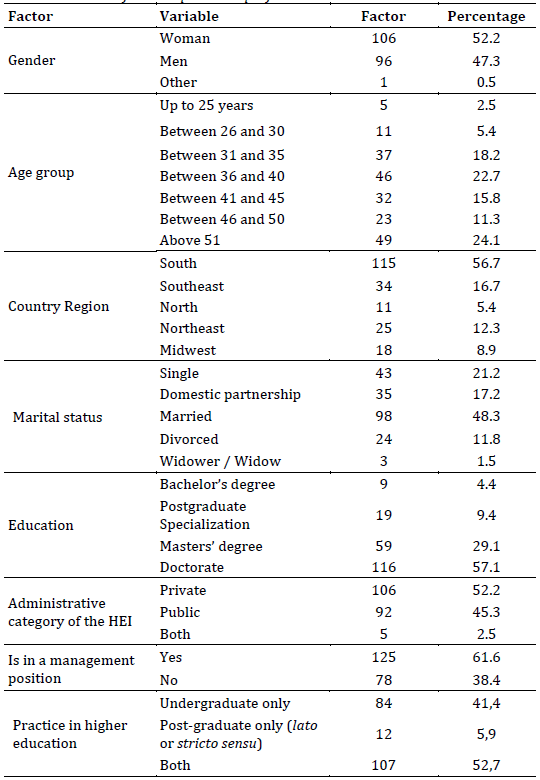
Note: Data was collected in the socioprofessional questionnaire.
Instruments
Socioprofessional questionnaire contains questions about personal, social and professional aspects of the professors
Cognitive Flexibility Scale (CFS) (Martin & Rubin, 1995; adapted to the Brazilian context by Tomedi et al., 2023) consists of 12 items answered on a 6-point Likert scale (in which 1 = highly disagree and 6 = highly agree) it is a unidimensional scale with reliability of α = .78 (example item: “I can convey an idea in more than one way”).
Job Stress Scale (Alves et al., 2004) consists of 17 items answered in a 4-point Likert scale (in which 1 = never or almost never and 4 = frequently), assessing three dimensions linked to JS, derived from the Demand-Control theory, initially conceptualized by Karasek (1979): (1) Psychological demand (5 items, α = .72, example item: “Does your job require too great a work effort?”), (2) control/autonomy (6 items, α = .63, example item: “Do you have the possibility to decide for yourself how to carry out your work?”), subdivided into skill discretion (α = .56) and decision authority (α = .67), and (3) support (6 items, α = .86, example item: “My co-workers are there for me”), variable introduced by Johnson et al. (1988).
Data collection procedure and ethical concerns
Initial contact with participants was made individually and online (via e-mail and social media) through the researchers’ network. After agreeing to participate, respondents were asked to share the study with their contacts who met the inclusion criteria. Due to the low initial response rate, direct contact was made with academic coordinators of HEIs across different regions of Brazil and with unions via e-mail, WhatsApp, and social media platforms (Facebook and Instagram), requesting dissemination of the study among faculty members or union associates. Additionally, invitation posts were published in Facebook groups related to faculty job openings and official HEI groups.
The project was reviewed and approved by the Research Ethics Committee of the Meridional Faculty under approval number 40501820.9.0000.5319. Furthermore, all requirements of the National Health Council (Conselho Nacional de Saúde [CNS]), and resolutions 466/2012 and 510/2016 were followed. Participants were provided with a link to the research instruments via an online Google Forms questionnaire, where they were directed to the scales only after agreeing to the Informed Consent Form (ICF), which was available on the first page of the online form, and after confirming they met the inclusion and exclusion criteria.
Data analysis procedure
Data were analyzed using descriptive and inferential statistics in SPSS version 23.0. Before conducting the analyses, assumptions were checked. The Shapiro-Wilk test indicated that the Cognitive Flexibility variable was not normally distributed (W(203) = 0.97, p = .001). Therefore, non-parametric tests were used. Spearman correlation, Kruskal-Wallis test, Chi-square test, and linear regression were performed. The interpretation of effect size for correlation coefficients was ± 0.10 for small effect, ± 0.30 for moderate effect, and ± 0.50 for large effect (Cohen, 1988). Results were considered statistically significant when p ≤ .05. Since the CFS does not yet have established cutoff points for the Brazilian population, the sample mean was calculated to classify participants as having high or low CF, following the scale authors’ guidelines (Martin & Anderson, 1998; Martin & Rubin, 1995). Accordingly, scores ≥ 58 were classified as high cognitive flexibility, and scores ≤ 57 as low.
For the analysis of JS according to the demand-control-support model, the sample’s mean scores for demands (15.8) and control (20.7) were identified and used as cutoff points between quadrants. Scores above the mean were considered high demand (≥ 16 points) and high control (≥ 21 points), while scores below the mean were classified as low demand (≤ 15 points) and low control (≤ 20 points). The same procedure was applied to the social support dimension (M = 19.6; high support ≥ 20 points; low support ≤ 19 points). To categorize participants into the quadrants, those with demand and control scores above the mean were placed in the “active” quadrant; those with demand above the mean but control below the mean were classified in the “high-strain” quadrant. Participants with both demand and control scores below the sample mean were classified in the “passive” quadrant, while those with low demand but control above the mean were assigned to the “low-strain” quadrant.
Results
Regarding CF, the sample had a mean score of (M = 57.54), with approximately 52 % (n = 106) of the sample classified as having high levels of CF based on the adopted parameters. The descriptive results of CF and the dimensions of JS are presented in Table 2.
Table 2: Descriptive statistics of brute scores (n = 203)

Note: SD: Standard Deviation; CF: Cognitive Flexibility; CFS: Cognitive Flexibility Scale; JSS: Job Stress Scale.
The descriptive analysis of JS using the JSS indicated that most participants reported high psychological demand (59.6 %, n = 121), high perceived control/autonomy (63.5 %, n = 129), and high support (52.7 %, n = 107). Additionally, 39 % of participants were classified within the active quadrant (n = 79; M = 59.06, SD = 3.73) (Table 3). The Kruskal-Wallis test revealed significant differences in levels of CF among the quadrants in the model (H(3) = 9.742; p = .021).
Table 3: Classification between stress level quadrants and the social support variable, and descriptive statistics for the JSS quadrants
Note: SD: Standard Deviation.
Table 4 presents the results of the Spearman correlations conducted between CF and the dimensions of JS. Scores on the CFS showed a weak but positive correlation with all dimensions of JS, indicating that higher levels of CF were associated with higher levels of perceived control/autonomy, psychological demands, and social support in the workplace.
Table 4: Spearman Correlations (n = 203)

Note: CF: Cognitive Flexibility.
*p < .05; **p < .01; ***p < .001
Comparisons between means indicated that individuals located in the active quadrant presented significantly higher levels of CF compared to those in the passive (p = .008), low-strain (p = .034), and high-strain (p = .047) quadrants. No significant differences were found among the remaining groups.
Regarding sociodemographic characteristics, no differences in CF were observed by gender; however, women reported experiencing higher psychological demands (X2 = 5.997; p = .050) and higher levels of control (X2 = 7.260; p = .027). Among educational levels, graduates showed a higher prevalence of low demand (X2 = 10.430; p = .012), while individuals with doctoral degrees were more frequently associated with high control (X2 = 11.242; p = .010). No differences were found across educational levels regarding support or CF. As for professional variables, a higher prevalence of high control was observed among professors in public HEIs (X2 = 9.757; p = .008). Faculty members holding management positions showed a higher frequency of high CF (X2 = 6.358; p = .012), as well as a greater prevalence of high control (X2 = 3.876; p = .049). When analyzing levels of teaching, faculty members who taught at both undergraduate and graduate levels demonstrated a greater prevalence of high CF (X2 = 15.671; p ≤ .001).
Finally, a linear regression analysis was conducted to examine the predictive value of cognitive flexibility for job stress (see Table 5). The model obtained for the total JSS score was considered moderate (F(1.201) = 24.86, R = 0.332), with cognitive flexibility (CFS) explaining approximately 11 % of the variance. The models for the JSS dimensions —Demand (F(1.201) = 4.50, R = 0.148), Control (F(1.201) = 14.96, R = 0.263), and Support (F(1.201) = 13.32, R = 0.249)— were considered to have small effect sizes, and the greatest explained variance was found for the control dimension (7 %), followed by support (6 %) and demand (2 %).
Table 5: Linear regression analyses with CF as a predictor for JS
Note: R2a = R2 adjusted.
Discussion
This study investigated the predictive role of CF in JS among faculty members in HEIs. Regarding CF, the sample presented a mean score (M = 57.54), similar to that found by Martin and Anderson (1998) in a study conducted with university students (M = 57). A study with adults over the age of 60 (Johnco et al., 2014) also reported similar mean scores (M = 58.13). Although these averages are close, caution is required in their interpretation, as it is not possible, based on this dataset, to make generalizations about the measure or the construct. Nevertheless, these results allow for exploratory considerations regarding the scale’s performance across different populations, such as the stability of responses.
In the collected sample, there was a predominance of faculty members with high CF. The literature indicates that, beyond its benefits for workers' well-being (Fernández-Sánchez et al., 2018; Yağan & Kaya, 2022; Yu et al., 2019), CF may play an important role in facilitating interpersonal relationships (Schwenke et al., 2020), as cognitive rigidity can be a barrier to socialization processes (Tariq & Adil, 2020). These findings are even more relevant when considering that a harmonious relationship between faculty and students is fundamental to the well-being of both groups, and conversely, work overload and intensification can result in suffering and occupational illness (Iriarte Redín & Erro-Garcés, 2020; Nicholls et al., 2022; Vivian et al., 2020). Considering CF as a competency (Yu et al., 2019) and one that can be trained (Archer et al., 2024; Buitenweg et al., 2017; Harel et al., 2023), it is plausible that a higher likelihood of selecting cognitively flexible individuals for academic (and management) positions results in a greater prevalence of such traits in the sample.
Regarding JS, the findings related to high levels of demand are consistent with previous studies that highlight excessive pressure for productivity (Campos et al., 2020; Pinho et al., 2023) and work overload—particularly in terms of the quantity and quality of scientific production and student supervision (Hungulo, 2019; Vivian et al., 2020). These demands are especially pronounced when responsibilities extend beyond teaching duties (Koetz et al., 2013). The high level of control reported may be explained by the nature of faculty work, which is often tied to compliance with institutional regulations and the fulfillment of HEI requirements. These obligations can limit opportunities for creativity (Li et al., 2018), despite an increasing trend of diminishing faculty autonomy in academic decision-making (Monteiro et al., 2022). As for the support factor, responses were relatively evenly distributed, with a slight majority perceiving high levels of support (52.7 %, n = 107). This finding contrasts with the literature, which often identifies strained collegial relationships as a major contributor to high levels of JS among faculty (Nicholls et al., 2022; Vivian et al., 2020).
A positive correlation was observed between CF and the dimensions of JS, suggesting that higher levels of perceived demands, autonomy, and support are associated with higher levels of CF. Evidence in the literature indicates that organizational strategies—such as employee empowerment, the assignment of complex tasks, the provision of continuous feedback, and the encouragement of creativity in the workplace—can foster the development of CF (Li et al., 2018). This may offer a possible explanation for the observed association between higher job demands and elevated levels of CF. However, in another study that investigated the relationship between burnout and CF, the authors reported a positive correlation between burnout and CF (Fernández-Sánchez et al., 2018), which contrasts with the commonly held view that exhaustion tends to impair cognitive functioning. An important consideration is that Burnout Syndrome—one of the potential consequences of chronic exposure to JS (Fernández-Sánchez et al., 2018; Prado, 2016)—can negatively impact professional performance, including a reduced capacity to apply CF (Lemonaki et al., 2021). Therefore, although a positive correlation was found in the present study and is echoed in some findings in the literature, it is essential to consider that prolonged exposure to stressors may lead to the emergence of other difficulties over time.
Specifically, the relationship between CF and social support has been explored in other studies. One study found a positive correlation between cognitive rigidity and certain temperaments, suggesting that higher levels of CF may be associated with better social adjustment (Tariq & Adil, 2020). Another study observed that a positive perception of social support can moderate the negative effects of JS in highly demanding jobs (Birolim et al., 2019). Additionally, a study involving 60 participants also found a positive association between CF and social interactions (Schwenke et al., 2020).
Once a link between demand and CF was established, it is pertinent to explore the various characteristics that may influence this relationship. Proactivity, for example, is recognized as a protective factor for professors (Pyhältö et al., 2021), although it often requires engagement in a greater number of activities. Moreover, CF has been found to correlate with creative capacity (Li et al., 2018), which may also influence the level of activity in the workplace. Added to this is the role of stimulation in the development of CF (Buitenweg et al., 2017; Li et al., 2018). Therefore, frequent engagement with tasks that demand advanced problem-solving skills may contribute to a higher self-perception of one’s CF.
The weak but positive association between control and CF suggests that lower levels of CF may interfere with one’s perception of control at work. A study conducted with professors in Israel found that lower levels of CF were associated with a greater presence of maladaptive coping strategies in response to stress (Harel et al., 2023). Coping strategies refer to the ways in which individuals respond to stressful situations (Pyhältö et al., 2021; Sousa et al., 2009). It is plausible to argue that professors with lower CF may struggle to identify behavioral alternatives, as this ability is intrinsically linked to mental flexibility (Martin & Anderson, 1998; Martin & Rubin, 1995). As a result, they may feel less capable of managing the situations to which they are exposed (Keith et al., 2015). Conversely, individuals with more developed CF are likely to possess a broader repertoire of perceived alternatives, which may contribute to a stronger sense of control in the face of work-related demands.
Most of the professors were classified within the active quadrant of the model, meaning they perceived both high psychological demands and high control over their work, a combination that suggests a certain level of balance (Alves et al., 2004). Notably, individuals in the active quadrant demonstrated higher levels of CF compared to those in other quadrants. It is possible that individuals in this group, in addition to having greater autonomy to manage their tasks (high control), are also stimulated by the demands of their work (high demand), which may contribute to the development of CF through continuous learning and adaptation, as previously discussed (Buitenweg et al., 2017; Li et al., 2018). This dynamic could help explain the significant differences observed between the quadrants. Individuals in other quadrants may not experience the same balance, either due to a lack of autonomy to apply CF (as in the high-strain and passive quadrants), or insufficient demands to stimulate its use (as in the passive and low-strain quadrants).
The quadrant representing the most adaptive condition and the lowest risk for the development of health problems is the low-strain quadrant (Alves et al., 2004; Karasek, 1979), in which only 28.57 % of participants in this study were classified. However, having high autonomy at work, in isolation, is not a predictor of mental health, as faculty members still reported elevated stress levels due to the high psychological demands involved (Alves et al., 2004). Moreover, the analyses between CF and the JS quadrants of the Karasek model indicated that individuals in the active and low-strain quadrants obtained higher scores on the CSF-B compared to those in the passive quadrant, reinforcing the idea that higher CF may be related to lower JS (Tomedi et al., 2023) and may play a protective role in coping with stressful situations (Harel et al., 2023).
The literature reports comparisons between socio-professional groups and JS, such as differences between genders, administrative categories in HEIs, undergraduate versus graduate teaching assignments, workloads, and length of employment. When comparing genders, studies have shown that female faculty report higher levels of JS (Areias & Guimarães, 2004; Iriarte Redín & Erro-Garcés, 2020; ILO, 2016; Stefano et al., 2013) and are more vulnerable to the negative impacts of stress, including physical and mental illness, than their male counterparts (Areias & Guimarães, 2004; Pinho et al., 2023). These findings are consistent with the results of the present study. Such outcomes may also be partly explained by social expectations placed disproportionately on women—for example, the expectation to provide more support to students—along with additional barriers related to race and ethnicity, reflected in unequal access to opportunities (Nicholls et al., 2022). These factors may influence the perception of JS.
It was found that doctorate degree professors showed a higher frequency of high control, although no significant differences were found for other factors. This finding is supported by a study in which nearly 70 % of specialists showed lower scores in the social domain of a quality of life assessment when compared to master’s and doctoral degree holders, which may be explained by the greater workload stability often enjoyed by those with graduate-level qualifications (Koetz et al., 2013). Simultaneously, faculty members still pursuing undergraduate degrees demonstrated lower demand levels, possibly due to a lighter workload compared to those with doctorates.
Among teachers in public institutions, a higher prevalence of high control was observed compared to their counterparts in private institutions. In several countries, including Brazil, there has been a reduction in teachers’ ability to influence institutional decisions (Cong-Lem, 2024; Monteiro et al., 2022). However, the job stability provided by public institutions—often cited as a primary motivation for entering the public sector (Monteiro et al., 2022)—may contribute to maintaining a sense of freedom and autonomy in work-related aspects, as public roles tend to be less influenced by market fluctuations and organizational strategies (Sousa et al., 2009). It is also important to note that the freedom for expression and innovation often associated with faculty members in private higher education has been increasingly questioned in recent years (Oliveira, 2020).
CF is associated with higher performance in tasks that require decision-making (Fernández-Sánchez et al., 2018), and it also plays an important role in establishing interpersonal relationships (Schwenke et al., 2020; Yağan & Kaya, 2022). It was found that individuals in management positions presented higher levels of CF, which may be related to these considerations. People in management roles may be more likely to assume such positions due to their performance in tasks that require the application of CF, which could explain the prevalence of higher scores among these participants. In addition, as previously mentioned, it is expected that some learning occurs in the course of carrying out work-related tasks, which aligns with the finding that faculty members who teach at multiple levels (undergraduate and graduate) showed a higher prevalence of high CF—suggesting that exposure to tasks of varying complexity contributes to the development of CF.
This highlights the importance of institutions remaining attentive to the high proportion of faculty members experiencing elevated levels of stress and who may require interventions. After all, work environments play a key role in reducing such stress. Coping can be one of the resources individuals use to deal with JS, which presupposes the use of behavioral and/or cognitive strategies that enable workers to adjust their behaviors and cognitive functions (Prado, 2016; Pyhältö et al., 2021; Sousa et al., 2009) so that, through interaction with environmental stressors, their functioning is not negatively affected (Prado, 2016). For example, evasive coping strategies—such as distracting oneself from stressful stimuli—may be used when workload is high (Iriarte Redín & Erro-Garcés, 2020). In this study, CF is understood not only as a cognitive function (Reis et al., 2010) but also as a competence (Harel et al., 2023; Yu et al., 2019), and its development may serve as a coping strategy, becoming a protective factor against JS.
CF demonstrated a small predictive power when considering individual dimensions but explained 11 % of the variance in the total score of the JSS. Thus, individuals with higher CF tend to perceive higher levels of control, demands, and social support in the work context, which reinforces the role of CF in the tendency to identify a greater number of problem-solving alternatives, engage in more activities—which may result in a higher perception of stress—and possibly facilitate the establishment of interpersonal relationships (Schwenke et al., 2020). Moreover, it is important not to overlook the potential learning effect of CF stemming from the stimulation imposed by work demands (Buitenweg et al., 2017; Li et al., 2018). Another relevant aspect concerns the CFS as a tool, which can be influenced by factors such as depressed mood and anxiety; specifically, the more anxious or negative the mood, the lower the CF scores (Johnco et al., 2014). This possibility must be taken into account when interpreting the data obtained, since emotional factors may affect CFS results—particularly considering the high levels of stress observed in the sample of the present study.
Based on this study, HEIs may develop actions to reduce psychosocial risk factors or to promote protective factors through interventions focused on stress management and the development of strategies to cope with stressors (Archer et al., 2024; Halat et al., 2024; Sousa et al., 2009). Examples include the establishment of clear and achievable goals, improvements in the quantity and quality of training and development programs, and greater investment in workplace quality-of-life initiatives (Prado, 2016). At the same time, it is emphasized that such interventions should be customized to the institution’s context (Halat et al., 2024). Other protective factors—aligned with the main causes of JS among faculty and with the findings of this study—include increasing salaries, reducing working hours, improving the distribution of tasks across roles, enhancing communication systems, and encouraging greater participation in institutional policy and planning, as these actions would allow faculty members to face fewer psychological demands and have greater control and autonomy over their work (Hungulo, 2019; Prado, 2016).
Conclusions
The results obtained allowed for the observation of how different dimensions of JS—control/autonomy, demand, and support—according to the adopted model, relate to CF. Regression analysis suggests that CF plays a predictive role in overall job stress scores. Although the effect is small, it should be considered in light of the mental health of higher education faculty. In this sense, the findings are relevant as they propose an integration between cognitive functions—specifically CF—and the theoretical model of stress, offering practical applications. The dissemination of this knowledge may provide a foundation for the development of new theoretical frameworks and tools aimed at improving professors’ quality of life and well-being.
It is important to acknowledge some limitations of the present study. There was a high concentration of participants residing in the state of Rio Grande do Sul, which, combined with the absence of a sample size calculation, may limit the generalizability of the findings. Another aspect to consider is the use of self-report measures, which are subject to potential response biases that were not addressed in the presented results. For future research, it is recommended to include participants with varying levels of education, specifying their fields of training and professional practice, as well as examining other occupational groups that may be vulnerable to workplace stress—such as banking, healthcare, and security professionals, as this study focused exclusively on higher education faculty.
The results also lead to practical conclusions. Emphasis is placed on the importance of reducing psychological demands and strengthening autonomy over the work-related activities of faculty members, with the aim of reaching the low-strain quadrant—which would provide healthier working conditions. It is also concluded that CF may serve a protective role in the dimensions of social support and control. Therefore, implementing training and activities that foster the development of this competency within the context of higher education may serve as a viable strategy for mitigating risk factors associated with work-related illnesses, particularly in relation to occupational stress.
References
Alves, M. G. M., Chor, D., Faersteinc, E., de S Lopes, C., & Werneck, G. L. (2004). Versão resumida da “job stress scale”: adaptação para o português. Revista de Saúde Pública, 38(2), 164-171. https://doi.org/10.3233/WOR-2012-0549-2963
Archer, R., Lewis, R., Yarker, J., Zernerova, L., & Flaxman, P. E. (2024). Increasing workforce psychological flexibility through organization-wide training: Influence on stress resilience, job burnout, and performance. Journal of Contextual Behavioral Science, 33. https://doi.org/10.1016/j.jcbs.2024.100799
Areias, M. E. Q., & Guimarães, L. A. M. (2004). Gênero e estresse em trabalhadores de uma universidade pública do estado de São Paulo. Psicologia em Estudo, 9(2), 255-262. https://doi.org/10.1590/S1413-73722004000200011
Athayde, M., & Souza, W. F. de. (2019). Saúde do trabalhador. In P. F. Bendassolli & J. E. Borges-Andrade (Eds.), Dicionário de psicologia do trabalho e das organizações (pp. 597-605). Artesã.
Birolim, M. M., Mesas, A. E., González, A. D., Santos, H. G. D., Haddad, M. D. C. F. L., & Andrade, S. M. D. (2019). Trabalho de alta exigência entre professores: associações com fatores ocupacionais conforme o apoio social. Ciência & Saúde Coletiva, 24(4), 1255-1264. https://doi.org/10.1590/1413-81232018244.08542017
Buitenweg, J. I. V., van de Ven, R. M., Prinssen, S., Murre, J. M. J., & Ridderinkhof, K. R. (2017). Cognitive Flexibility Training: A Large-Scale Multimodal Adaptive Active-Control Intervention Study in Healthy Older Adults. Frontiers in Human Neuroscience, 11. https://doi.org/10.3389/fnhum.2017.00529
Campos, T. C., Véras, R. M., & Araújo, T. M. de. (2020). Trabalho docente em universidades públicas brasileiras e adoecimento mental: Uma revisão bibliográfica. Revista Docência do Ensino Superior, 10, e015193, 1-19. https://doi.org/10.35699/2237-5864.2020.15193
Cohen, J. (1988). Statistical power analysis for the behavioral sciences. Lawrence Erlbaum. https://doi.org/10.4324/9780203771587
Cong-Lem, N. (2024). Teacher agency for change and development in higher education: A scoping literature review. International Journal of Educational Reform, 0(0). https://doi.org/10.1177/10567879231224744
Fernández-Sánchez, J. C., Pérez-Mármol, J. M., Santos-Ruiz, A. M., Pérez-García, M., & Peralta-Ramírez, M. I. (2018). Burnout y funciones ejecutivas em personal sanitário de Cuidados Paliativos: influencia del desgaste professional sobre la toma de decisiones. Anales del Sistema Sanitario de Navarra, 41(2), 171-180. https://doi.org/10.23938/assn.0308
Halat, D. H., Sami, W., Soltani, A., & Malki, A. (2024). Mental health interventions affecting university faculty: a systematic review and meta-analysis. BMC Public Health, 24. https://doi.org/10.1186/s12889-024-20402-2
Harel, O., Hemi, A., & Levy-Gigi, E. (2023). The role of cognitive flexibility in moderating the effect of school-related stress exposure. Scientific Reports, 13(1), 5241. https://doi.org/10.1038/s41598-023-31743-0
International Labour Organization. (2016). Workplace Stress: A Collective Challenge. https://www.ilo.org/safework/info/publications/WCMS_466547/lang--en/index.htm
Iriarte Redín, C., & Erro-Garcés, A. (2020). Stress in teaching professionals across Europe. International Journal of Educational Research, 103. https://doi.org/10.1016/j.ijer.2020.101623
Johnco, C., Wuthrich, V. M., & Rapee, R. M. (2014). Reliability and validity of two self-report measures of cognitive flexibility. Psychological Assessment, 26(4), 1381-1387. https://doi.org/10.1037/a0038009
Johnson, J. V., & Hall, E. M. (1988). Job strain, work place social support, and cardiovascular disease: a cross-sectional study of a random sample of the Swedish working population. American Journal of Public Health, 78(10), 1336-1342. https://doi.org/10.2105/ajph.78.10.1336
Karasek, R. A. (1979). Job demands, job decision latitude, and mental strain: Implications for job redesign. Administrative Science Quarterly, 24(2), 285-308. https://doi.org/10.2307/2392498
Keith, J., Velezmoro, R., & O’Brien, C. (2015). Correlates of cognitive flexibility in veterans seeking treatment for posttraumatic stress disorder. The Journal of Nervous and Mental Disease, 203(4), 287-293. https://doi.org/10.1097/nmd.0000000000000280
Koetz, L., Rempel, C., & Périco, E. (2013). Qualidade de vida de professores de Instituições de Ensino Superior Comunitárias do Rio Grande do Sul. Ciência & Saúde Coletiva, 18(4), 1019-1028. https://doi.org/10.1590/S1413-81232013000400015
Lemonaki, R., Xanthopoulou, D., Bardos, A. N., Karademas, E. C., & Simos, P. G. (2021). Burnout and job performance: a two-wave study on the mediating role of employee cognitive functioning. European Journal of Work and Organizational Psychology, 30(5), 692-704. https://doi.org/10.1080/1359432x.2021.18
Li, H., Li, F., & Chen, T. (2018). A motivational–cognitive model of creativity and the role of autonomy. Journal of Business Research, 92, 179-188. https://doi.org/10.1016/j.jbusres.2018.07.025
Liu, Y., Yi, S., & Siwatu, K. O. (2023). Mediating roles of college teaching self-efficacy in job stress and job satisfaction among Chinese university teachers. Frontiers in Education, 7. https://doi.org/10.3389/feduc.2022.1073454
Malik, A., Javaid, F., & Gardezi, S. B. B. (2024). Impact of job stress on mental health and work-life balance: Cross-sectional study. Journal of Professional & Applied Psychology, 5(4), 640-652. https://doi.org/10.52053/jpap.v5i4.322
Martin, M. M., & Anderson, C. M. (1998). The cognitive flexibility scale: Three validity studies. Communication Reports, 11(1), 1-9. https://doi.org/10.1080/08934219809367680
Martin, M. M., & Rubin, R. B. (1995). A new measure of cognitive flexibility. Psychological Reports, 76(2), 623-626. https://doi.org/10.2466/pr0.1995.76.2.623
Monteiro, A. N. P., Vaz, B. R. G., & Mota, R. S. de. (2022). Desvalorização profissional dos professores. Revista Latino-Americana de Estudos Científicos, 3(13). https://doi.org/10.55470/relaec.37379
Munusamy, S., Ramasamy, S., & Sukir, N. I. (2024). A systematic review on mental health and its associated factors among educators in Malaysia. BMC Public Health, 24. https://doi.org/10.1186/s12889-024-19855-2
Nicholls, H., Nicholls, M., Tekin, S., Lamb, D., & Billings, J. (2022). The impact of working in academia on researchers’ mental health and well-being: A systematic review and qualitative meta-synthesis. PLOS ONE, 17(5). https://doi.org/10.1371/journal.pone.0268890
Oliveira, D. A. (2020). Políticas conservadoras no contexto escolar e autonomia docente. Práxis Educativa (Brasil), 15, 1-18. https://doi.org/10.5212/PraxEduc.v.15.15335.069
Pinheiro, F. P. H. A., Santana, A. R., Melo, L. A. de, Rodrigues, C. S. D., Camelo, E., Cunha, E. S., Aguiar, H. M. T., & Alves, J. J. P. (2023). Trabalho docente no contexto da expansão universitária. Estudos e Pesquisas em Psicologia, 23(1), 92-114. https://doi.org/10.12957/epp.2023.75303
Pinho, P. de S., Freitas, A. M. C., Patrão, A. L., & Aquino, E. M. L. (2023). Estresse ocupacional, saúde mental e gênero entre docentes do ensino superior: revisão integrativa. Saúde E Sociedade, 32(4). https://doi.org/10.1590/S0104-12902023210604pt
Prado, C. E. P. (2016). Estresse ocupacional: causas e consequências. Revista Brasileira de Medicina do Trabalho, 14(3), 285-289. https://doi.org/10.5327/Z1679-443520163515
Pyhältö, K., Pietarinen, J., Haverinen, K., Tikkanen, L., & Soini, T. (2021). Teacher burnout profiles and proactive strategies. European Journal of Psychology of Education, 36(1), 219-242. https://doi.org/10.1007/s10212-020-00465-6
Reis, A. L. P. P. D., Fernandes, S. R. P., & Gomes, A. F. (2010). Estresse e fatores psicossociais. Psicologia: ciência e profissão, 30(4), 712-725. https://doi.org/10.1590/S1414-98932010000400004
Rodrigues, C. M. L., Faiad, C., & Facas, E. P. (2020). Fatores de risco e riscos psicossociais no trabalho: definição e implicações. Psicologia: Teoria e Pesquisa, 36, 1-9. https://doi.org/10.1590/0102.3772e36nspe19
Schwenke, D., Goregliad Fjaellingsdal, T., Bleichner, M. G., Grage, T., & Scherbaum, S. (2020). An approach to social flexibility: Congruency effects during spontaneous word-by-word interaction. PLOS ONE, 15(6), e0235083. https://doi.org/10.1371/journal.pone.0235083
Sousa, I. F., Mendonça, H., Zanini, D. S., & Nazareno, E. (2009). Estresse ocupacional, coping e burnout. Revista EVS-Revista de Ciências Ambientais e Saúde, 36(1), 57-74. https://doi.org/10.18224/est.v36i1.1018
Stefano, S. R., Bonanato, F. M., & Raifur, L. (2013). Estresse em funcionários de uma instituição de ensino superior: Diferenças entre gênero. Revista Economia e Gestão, 13(31), 73-92. https://doi.org/10.5752/p.1984-6606.2013v13n31p73
Tariq, S., & Adil, A. (2020). Rigidity as mediator between temperaments and social adjustment: A comparative study of teachers of madaris and schools of Pakistan. Archive for the Psychology of Religion, 42(2), 194-210. https://doi.org/10.1177/0084672420921956
Tolfo, S. R., Monteiro, J. K., Heloani, J. R. M. (2023). Processos psicossociais e saúde no trabalho: Perspectivas teóricas, instrumentos e gerenciamento. Revista de Psicologia da IMED (RPI), 15(2), 76-94. https://doi.org/10.18256/2175-5027.2023.v15i2.4941
Tomedi, J. M., Oliveira, C. R., & Gonçalves, J. (2023). Tradução e adaptação transcultural da Cognitive Flexibility Scale para o português brasileiro [Unpublished manuscript].
Vazquez, A. C. S., Pianezolla, M., & Hutz, C. S. (2018). Assessment of psychosocial factors at work: A systematic review. Estudos de Psicologia (Campinas), 35(1). https://doi.org/10.1590/1982-02752018000100002
Vivian, C., Trindade, L. D. L., & Vendruscolo, C. (2020). Prazer e sofrimento docente: estudo na pós-graduação stricto sensu. Revista Psicologia Organizações e Trabalho, 20(3), 1064-1071. http://doi.org/10.17652/rpot/2020.3.18949
Yağan, F., & Kaya, Z. (2025). The relationship between psychological resilience and job stress in academicians: The mediating role of cognitive flexibility. Current Psychology, 44(7), 5609-5626. https://doi.org/10.1007/s12144-025-07599-0
Yousaf, H. Q., Naseer, M., Ahmed, M., & Rehman, S. (2025). Navigating job demands: The relationship of psychological well-being, anxiety, depression, and social support in university teachers’ job performance. Current Psychology, 44(7), 5609-5626. https://doi.org/10.1007/s12144-025-07599-0
Yu, C., Beckmann, J. F., & Birney, D. P. (2019). Cognitive flexibility as a meta-competency. Estudios de Psicología, 40(3), 563-584. https://doi.org/10.1080/02109395.2019.1656463
Zhao, W., Liao, X., Li, Q., Jiang, W., & Ding, W. (2022). The relationship between teacher job stress and burnout: A moderated mediation model. Frontiers in Psychology, 12. https://doi.org/10.3389/fpsyg.2021.784243
Data Availability: The data set supporting the results of this study is not available.
Funding: This study did not receive any external funding or financial support.
Conflict of interest: The authors declare that they have no conflicts of interest.
How to cite: Tomedi Martins, J., Brandão, L., De Oliveira, C. R., Gonçalves, J. (2025). Cognitive Flexibility and Stress at Work in Brazilian Higher Education Professors. Ciencias Psicológicas, 19(2), e-4237. https://doi.org/10.22235/cp.v19i2.4237
Authors’ contribution (CRediT Taxonomy): 1. Conceptualization; 2. Data curation; 3. Formal Analysis; 4. Funding acquisition; 5. Investigation; 6. Methodology; 7. Project administration; 8. Resources; 9. Software; 10. Supervision; 11. Validation; 12. Visualization; 13. Writing: original draft; 14. Writing: review & editing.
J. T. M. has contributed in 1, 2, 3, 4, 5, 6, 9, 13; L. B. in 9, 11, 12, 14; De Oliveira, C. R. de O. in 6, 10, 12, 14; J. G. in 1, 2, 6, 7, 10, 11, 12, 14.
Scientific editor in-charge: Dra. Cecilia Cracco.
Ciencias Psicológicas; v19(2)
Julho-dezembro 2025
10.22235/cp.v19i1.4237
Artigos Originais