Ciencias Psicológicas; v18(2)
Julio-Diciembre 2024
10.22235/cp.v18i2.3849
Efeitos emocionais elicitados por imagens de futebol: Um estudo sobre o fanatismo
Emotional effects elicited by football images: A study on fanaticism
Efectos emocionales desencadenados por imágenes de fútbol: Un estudio sobre el fanatismo
Monick Leonora Inês Kort-Kamp1, ORCID 0000-0001-8019-6215
Thauan Rocha Porto2, ORCID 0000-0002-3360-5271
Roberdson Silveira de Oliveira3, ORCID 0000-0001-9142-8851
Erick Francisco Conde4, ORCID 0000-0002-7130-2888
1 Universidade Federal Fluminense, Brasil
2 Universidade Federal Fluminense, Brasil
3 Universidade Federal Fluminense, Brasil
4 Universidade Federal Fluminense, Brasil, [email protected]
Resumo:
O presente estudo investigou os efeitos da visualização de imagens de times favoritos e rivais nos indicadores de valência e ativação emocional, averiguando possíveis interações com os níveis de fanatismo em torcedores de futebol. Participaram deste experimento 27 voluntários (M = 22 anos; DP = 3,25), que avaliaram a agradabilidade (valência hedônica) e a excitação emocional (ativação) desencadeada por um conjunto de imagens neutras, positivas e negativas do Sistema Internacional de Figuras Afetivas (IAPS), acrescido de 30 imagens experimentais pareadas, sendo 15 do time favorito e 15 do time rival. As avaliações foram realizadas através da escala Self Assessment Manikin (SAM) e da Escala de Fanatismo em Torcedores de Futebol (EFTF). Análises comparativas demonstraram que o nível de fanatismo não influenciou na atribuição da valência hedônica às imagens. Contudo, o grupo com níveis mais altos de fanatismo apresentou maior excitação emocional em resposta a imagens neutras (p < 0,01; d = 0,914), do time favorito (p < 0,01; d = 1,49) e do time rival (p < 0,01; d = 0,83). A análise de dispersão sugeriu o envolvimento dos sistemas motivacionais apetitivo e aversivo em reação às imagens do time favorito e rival, respectivamente. Os resultados do estudo auxiliam na compreensão do fenômeno do fanatismo no futebol.
Palavras-chave: f fanatismo; futebol; valência afetiva; ativação emocional; psicologia do esporte.
Abstract:
The present study investigated the effects of the favorite and rival team visualization on valence and emotional arousal indicators, verifying for possible interactions with the fanaticism level in soccer fans. Twenty-seven volunteers (Mage = 22; SD = 3.25) participated in this experiment, who evaluated the pleasantness (hedonic valence) and the emotional arousal (activation) triggered by a set of neutral, positive and negative images of the International System of Affective Pictures (IAPS) plus 30 experimental images of the favorite and rival team. Evaluations were performed using the Self Assessment Manikin (SAM) scale and the Football Supporter Fanatism Scale (FSFS). Comparative analysis revealed that fanaticism did not influence the assignment of hedonic valence to the images. However, individuals with higher levels of fanaticism exhibited greater arousal in response to neutral (p < .01; d = 0.914), favorite (p < .01; d = 1.49), and rival images (p < .01; d = 0.83). The dispersion analysis suggested the involvement of appetitive and aversive motivational systems in response to images of the favorite and rival teams, respectively. The study findings lead to a better understanding of the fanaticism in soccer.
Keywords: fanaticism; soccer; affective valence; emotional arousal; sport psychology.
Resumen:
El presente estudio investigó los efectos de la visualización de imágenes de equipos favoritos y rivales en los indicadores de valencia y activación emocional para averiguar la interacción con los niveles de fanatismo de los hinchas de fútbol. Veintisiete voluntarios (M = 22 años; DE = 3.25) participaron en este experimento, quienes evaluaron la agradabilidad (valencia hedónica) y la excitación emocional (activación) desencadenada por un conjunto de imágenes neutrales, positivas y negativas del International System of Affective Pictures (IAPS), con más de 30 imágenes experimentales del equipo favorito y el rival. Las evaluaciones se realizaron utilizando la escala Self Assessment Manikin (SAM) y la Escala de Fanatismo en Hinchas de Fútbol (EFHF). Análisis comparativos demostraron que el nivel de fanatismo no influyó en la atribución de la valencia hedónica de las imágenes. Sin embargo, las personas con niveles más altos de fanatismo presentaron una excitación superior ante imágenes neutras (p < .01; d = 0.914), imágenes del equipo favorito (p < .01; d = 1.49) e imágenes del equipo rival (p < .01; d = 0.83). El análisis de dispersión sugirió la implicación de los sistemas motivacionales apetitivos y aversivos en respuesta a las imágenes del equipo favorito y rival, respectivamente. Los resultados del estudio ayudan a comprender el fanatismo en el fútbol.
Palabras clave: fanatismo; fútbol; valencia afectiva; excitación emocional; psicología del deporte.
Recebido: 22/01/2024
Aceito: 17/10/2024
O futebol é um esporte popularizado em todo o mundo, se consolidando como um fenômeno transcultural capaz de gerar impactos relevantes em nossa sociedade (Wann & James, 2018). Para além da dimensão econômica e outros impactos sociais, os conflitos entre torcedores vêm requisitando a adoção de políticas públicas nas áreas de seguridade social e mobilidade urbana, com relevantes implicações socioeconômicas (Louis, 2023). Quando se fala em violência no futebol, pode-se dizer que o Brasil apresenta índices alarmantes. Evidências sugerem que o Brasil pode ser considerado como um dos principais países no mundo onde mais se mata por motivos relacionados ao futebol (Brandão et al., 2020; Murad, 2017). Dados demonstram também uma tendência de aumento no número de julgamentos realizados pelo Supremo Tribunal de Justiça Desportiva referentes a processos relacionados à violência nos estádios (Castro, 2014).
A literatura tem demonstrado que o simples processamento visual de estímulos afetivos já é capaz de influenciar parâmetros como a fisiologia e o comportamento humano (Mulckhuyse, 2018; Polo et al., 2024; Zsidó, 2024). Mas especificamente tratando do futebol, pesquisas já demonstraram que a simples observação de imagens relacionadas a esse esporte é capaz de desencadear a ativação de circuitos emocionais no cérebro de torcedores (Duarte et al., 2017; Kelly et al., 2009; Park et al., 2009). Park et al. (2009) demonstraram que a percepção do time favorito em circunstâncias de vitórias, pode desencadear ativação assimétrica de estruturas límbicas, como a amígdala, predominantemente no hemisfério esquerdo. Para as derrotas, os pesquisadores detectaram um padrão de ativação cerebral indicadora de supressão emocional.
Estudos comportamentais já verificaram que estímulos de futebol também podem modular a cognição e o comportamento motor (Conde et al., 2011; Conde et al., 2018; Oliveira et al., 2021). Através de um protocolo de medida do tempo de reação, conhecido como tarefa de compatibilidade estímulo-resposta, é possível verificar diferenças temporais significativas nas respostas aos times favorito e rival. Mais especificamente, utilizando como estímulos-alvo imagens representando jogadores de futebol dos principais times do Rio de Janeiro, Conde et al. (2011) adaptaram a tarefa atencional de compatibilidade estímulo-resposta para estudar se a variável “preferência” poderia modular os tempos de resposta a estímulos representando o time favorito e o principal rival de cada participante. Os estímulos poderiam aparecer à esquerda ou à direita do ponto de fixação e as respostas deveriam ser realizadas com teclas de resposta posicionadas ipsi ou contralateralmente. De forma balanceada, os participantes foram orientados a responderem com a tecla do mesmo lado em resposta ao time preferido (condição compatível) e com a tecla do lado oposto (condição incompatível) em resposta ao time rival. No segundo bloco realizavam o pareamento oposto. Os pesquisadores reportaram um efeito clássico de compatibilidade espacial para os estímulos do time favorito, sendo as respostas espacialmente correspondentes aos estímulos mais rápidas do que as respostas espacialmente incompatíveis. Enquanto, para o time rival, fora verificado uma inversão do efeito de compatibilidade, sendo as respostas manuais mais rápidas quando pressionadas do lado oposto ao aparecimento do estímulo representando o time rival. Tais resultados foram interpretados como uma evidência de que as respostas aos times favorito e rival eram mediadas por mecanismos de aproximação e afastamento, respectivamente.
Estudos adicionais (Conde et al., 2014; Oliveira et al, 2021; Proctor, 2013) demonstraram que também existem diferenças temporais entre os dois blocos de prática. Mais especificamente, no bloco em que se responde ipsilateralmente às imagens do time preferido e contralateralmente às do time rival, as respostas são mais rápidas do que as respostas ao pareamento oposto (condição incompatível para o time preferido e resposta compatível para o time rival).
Oliveira et al. (2021) adaptaram o protocolo para verificar se os efeitos emocionais desencadeados pelos estímulos de futebol também são capazes de influenciar os padrões de resposta em outro teste atencional, conhecido como tarefa de Simon. Na tarefa de Simon, os participantes precisam selecionar a resposta correta, o mais rápido possível, com base no processamento de um atributo intrínseco ao estímulo (como forma ou cor). Mesmo que a localização do estímulo não seja considerada para seleção da resposta, os códigos espaciais parecem requerer processamento automático, chegando a afetar as respostas motoras. Neste sentido, são observadas respostas mais rápidas na condição espacialmente compatível, em comparação à incompatível. Essa diferença temporal entre as duas condições é denominada efeito Simon. No estudo de Oliveira et al. (2021), fora demonstrado que o efeito Simon varia em função da preferência por times de futebol, sendo maior para o time favorito. Os autores deste trabalho interpretaram os resultados da pesquisa indicando que as valências dos estímulos positivos e negativos provocam facilitações e/ou inibições nas respostas motoras. Também estimaram que o efeito ampliado para o time favorito poderia ser um indicador que a valência afetiva do estímulo facilita a resposta espacialmente correspondente ao time favorito e as respostas contralaterais ao time rival.
Apesar dos estudos supracitados terem oferecido importantes indícios sobre como imagens específicas de futebol podem influenciar o afeto, a cognição e o comportamento de torcedores, outras variáveis precisam de maior compreensão neste contexto, como o fanatismo, por exemplo. Embora existam diferentes perspectivas teóricas e filosóficas sobre o fanatismo (Battaly, 2023; Cassam, 2023; Katsafanas, 2024), este construto tem sido amplamente compreendido como fenômeno psicossocial disfuncional, caracterizado por um envolvimento intenso e devocional a ideologias, instituições, doutrinas, objetos, e/ou até mesmo a outras pessoas (como ídolos ou mártires), que os representem ou que possuam valores/ideais compartilhados (Tietjen, 2023a). Atualmente, o estudo do fanatismo apresenta grande relevância social por este fenômeno ter sido implicado com coercitividade, comportamentos violentos e hostis e até mesmo, com guerras e extremismo, nos mais variados contextos (Tietjen, 2023b).
Especificamente no contexto dos esportes, o fanatismo também tem sido amplamente associado a episódios de agressão, hostilidade, violência generalizada, assassinatos e desordem pública (Bandeira & Ramos, 2020; Conde & Coriolano, 2019; Coriolano & Conde, 2017; Louis, 2023; Zeferino et al., 2021). Diante de inúmeras lacunas ainda existentes para compreensão plena deste fenômeno, o presente estudo se configurou com o objetivo de investigar como a visualização de imagens de times de futebol, com valência afetiva antagônica (favorito e rival) podem influenciar indicadores emocionais. O desenho de pesquisa adotado também se delineou de modo a investigar se os diferentes níveis de fanatismo são capazes de influenciar a pontuação atribuída às dimensões de valência (seja de prazer ou desprazer) e ativação emocional (alertante ou relaxantes), diante imagens apresentadas.
Método
A presente pesquisa pode ser caracterizada como uma abordagem quase experimental, delineada com o controle de variável independente e adotando procedimentos validados para investigar parâmetros emocionais decorrentes da visualização de imagens do time favorito e do time rival. O estudo utilizou como variáveis dependentes, as medidas de valência hedônica e ativação emocional, atribuídas a diferentes categorias de imagens. Adotando uma perspectiva comparativa, foram considerados dois níveis de fanatismo, como variável categórica intergrupos, permitindo a análise das diferenças entre torcedores classificados em alto e baixo fanatismo. As variáveis intragrupos foram estabelecidas em 5 categorias de imagens que englobaram não apenas os times favorito e rival, mas também estímulos do Sistema Internacional de Figuras Afetivas Positivas, Negativas e Neutras, proporcionando parâmetros importantes de valência e ativação na comparação com as imagens experimentais.
Participantes
Participaram deste estudo 27 pessoas, sendo 22 mulheres e 5 homens, (M idade = 22 anos, DP = 3,25). O estudo foi divulgado em redes sociais e através de panfletos dispostos em áreas públicas do Instituto de Ciências da Sociedade e Desenvolvimento Regional (Universidade Federal Fluminense), em Campos dos Goytacazes (Rio de Janeiro, Brasil). As pessoas também foram convidadas presencialmente durante o intervalo das aulas e enquanto transitavam pelo Instituto, caracterizando uma amostragem por conveniência que foi composta por discentes de diferentes períodos e cursos de graduação, bem como prestadores de serviço e servidores do quadro técnico da Universidade. Para as análises, os participantes foram divididos em dois grupos distintos conforme os níveis de fanatismo verificados na escala de Fanatismo de Torcedores de Futebol. Mais especificamente, o grupo de alto fanatismo ficou composto por 13 pessoas (10 mulheres, 3 homens) e o grupo de baixo fanatismo por 14 pessoas (12 mulheres, 2 homens). Os voluntários não receberam remuneração ou vantagem em conceitos acadêmicos pela sua participação. Todos assinaram o Termo de Consentimento Livre e Esclarecido (TCLE). A pesquisa foi aprovada pelo Comitê de ética e Pesquisa da Universidade Federal de Pernambuco (Parecer No 2.140.159).
Instrumentos
Escala de Fanatismo de Torcedores de Futebol (EFTF). O instrumento permite avaliar o nível de fanatismo em torcedores de futebol (Wachelke et al., 2008). Os 11 itens da escala avaliam comportamentos, crenças e situações que podem refletir como a pessoa torce pelo seu time de futebol. O instrumento demonstrou indicadores psicométricos aceitáveis em estudo sobre validade fatorial e consistência interna no Brasil (Wachelke et al., 2008), como KMO = 0,94, teste de esfericidade de Bartlett significativo (𝑝 < 0,001), eigenvalue = 6,14 e alfa de Cronbach (α = 0,91). A escala unidimensional apresenta formato tipo Likert com 7 pontos, variando entre 1 (discordo fortemente) a 7 (concordo fortemente).
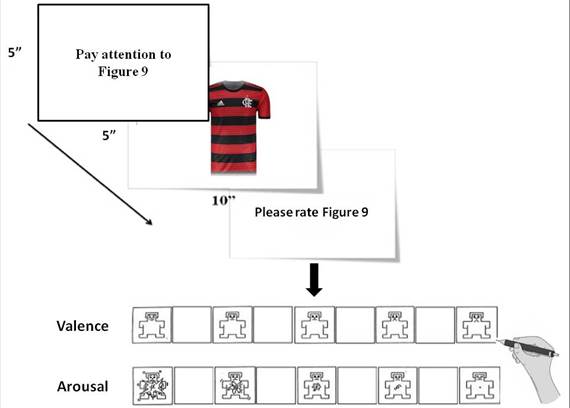
Escala Self Asessement Manekins (SAM). O instrumento utiliza uma perspectiva pictográfica não verbal de fácil e rápida aplicação para avaliar imagens com conteúdo emocional (Bradley & Lang, 1994; Bynion & Feldner, 2020). Com o uso deste instrumento, é possível obter informações sobre duas dimensões emocionais: valência e ativação. A primeira dimensão mede o grau de agradabilidade da figura apresentada, enquanto a segunda indica o nível de alerta, ativação ou excitação emocional, vivenciada pelo voluntário ao observar a imagem apresentada. Na escala, o participante deve assinalar o quanto uma imagem é positiva ou negativa (valência emocional) e qual o nível de excitação psicofisiológica (ativação emocional) desencadeado pela observação das figuras. Para isso, são apresentados manequins organizados horizontalmente, que servem como indicadores gráficos dos estados emocionais, com 9 níveis de respostas (Figura 1). Seguindo as normas para avaliação do IAPS no Brasil (Lasaitis et al., 2008), cada voluntário recebeu um caderno de instruções para classificar as imagens e também recebeu uma caneta para preenchimento. Os participantes devem ser informados que também podem utilizar os espaços entre os manequins e que estes representam opções intermediárias. Desta maneira, os participantes respondem classificando as imagens apresentadas através do SAM, assinalando um X nos cinco manequins ou entre dois destes manequins.
Sistema Internacional de Figuras Afetivas (IAPS) e estímulos experimentais. O banco de imagens utilizado para avaliação foi composto, de forma balanceada, por imagens positivas, negativas e neutras do IAPS. O IAPS é um banco de dados contendo 960 imagens, divididas em 16 conjuntos de 60 itens (Branco et al., 2023). Estas centenas de fotografias possuem alta resolução e representam vários aspectos da vida real (esportes, moda, paisagens, violência etc.) (Lang et al., 2005). Muitos estudos já demonstraram que as imagens do IAPS são capazes de induzir uma gama de estados emocionais que podem ser facilmente apresentados no contexto experimental do laboratório. O presente estudo utilizou 60 imagens do IAPS, sendo sorteadas 15 imagens negativas, igualmente distribuídas entre as subcategorias de mutilação, animais peçonhentos e violência; 15 imagens positivas, igualmente distribuídas entre eróticas, esportivas e relacionamento familiar com bebês; e 30 imagens neutras, igualmente distribuídas entre objetos domésticos, artes abstratas e faces indiferentes. Além das imagens do IAPS, cada bloco de avaliação possuía 30 imagens experimentais pareadas, compostas por 15 do time favorito e 15 do time rival. Foram utilizadas imagens dos quatro principais times de futebol do Rio de Janeiro (Fluminense, Flamengo, Vasco da Gama e Botafogo). As imagens experimentais foram criteriosamente selecionadas da internet considerando a demanda pelo pareamento contextual, das cores de fundo, situacional e simbólico para ambos os times. Logo, as imagens de cada time englobaram, de forma balanceada, as categorias bandeira, mascote, torcida, uniforme, objetos com símbolos dos times e jogadores populares.
Procedimentos
Logo após a assinatura do TCLE, os participantes preencheram um documento com seus dados pessoais, onde foram coletados dados como data de nascimento, identidade de gênero, escolaridade, informações sobre patologias diagnosticadas por médico, uso de drogas e/ou de medicamentos com ação psicotrópica, sobre possíveis alterações oftalmológicas e se ocorre uso de óculos para correção.
Após o preenchimento de informações sociodemográficas, os participantes foram convidados a responderem a EFTF (Wachelke et al., 2008). Os participantes também foram solicitados a realizarem a classificação, em ordem de preferência, dos quatro principais times de futebol do Rio de Janeiro (Fluminense, Flamengo, Vasco da Gama e Botafogo). Este procedimento foi usado para seleção dos estímulos visuais a serem utilizados como condições experimentais, considerando o primeiro e o quarto time como os times preferido e rival, especificamente.
Logo a seguir, as pessoas foram encaminhadas a uma sala com temperatura controlada e iluminação adequada para assistirem a um vídeo com instruções para participação no experimento sendo, logo depois, direcionados para avaliação das figuras e preenchimento do SAM. O vídeo informativo conteve instruções e exemplos sobre como responder a escala SAM, para cada dimensão estudada (valência e ativação). Os participantes também foram instruídos para marcar apenas uma dentre as 9 respostas possíveis para cada figura, em cada uma das dimensões estudadas, começando pela valência e em seguida, ativação. Os participantes também foram orientados a olharem atentamente para as imagens que fossem apresentadas durante todo o tempo em que elas estivessem na tela e que, apenas depois, deveriam marcar suas respostas na escala SAM, indicando como classificariam e como haviam se sentido ao visualizar a imagem anterior. Também tiveram orientações para não falar durante a pesquisa, não copiar respostas de outros voluntários, e foram solicitados a desligarem seus aparelhos eletrônicos.
A seguir, a avaliação começou com a apresentação de um slide que mostrava o número da imagem e informava que esta seria apresentada por 5 segundos. Em seguida, a imagem a ser avaliada era projetada na tela por mais 5 segundos e posteriormente, nenhum slide era projetado por 10 segundos, tempo destinado então para classificação da imagem visualizada nas dimensões estudadas, primeiramente a dimensão valência e posteriormente a ativação (Figura1). Os participantes foram instruídos para avaliar a valência afetiva de cada imagem, considerando que a extremidade esquerda do caderno de respostas, representava a valência positiva máxima (agradável) e na extremidade direita, a valência negativa máxima (desagradável). E para avaliar a ativação, devia-se considerar a extremidade à esquerda como nível máximo de ativação e à direita, o nível mínimo de ativação.
Figura 1: Procedimento de avaliação da imagem nas dimensões de valência e ativação emocional

Nota: Figura ilustrativa. Os espaços em branco na escala SAM também podem ser utilizados, caracterizando 9 níveis possíveis para resposta.
Análise estatística
As respostas obtidas na avaliação de cada imagem (categorias positiva, negativa e neutra do IAPS, bem como imagens experimentais do time favorito e do time rival) foram tabuladas e organizadas para cálculo da média e desvio padrão dos valores atribuídos às duas dimensões mensuradas pelo SAM (ativação e valência emocional). O nível de fanatismo foi estimado através da pontuação obtida na EFTF. Para definir os dois grupos com níveis distintos de fanatismo (alto e baixo) como variável categórica, foi estabelecida a mediana da pontuação obtida na EFTF como ponto de corte. Tal modelo para definição de grupos de fanatismo distintos através da EFTF segue protocolos já adotados anteriormente (Conde et al., 2018; Coriolano & Conde, 2017).
A seguir, os dados foram analisados através de uma análise de variância (ANOVA) com medidas repetidas utilizando o software Statistica® (StatSoft, versão 6.0). O delineamento da ANOVA teve como variável intergrupo o nível de fanatismo (alto e baixo fanatismo) e como intragrupo, as categorias de imagem: (a) do time favorito; (b) do time rival; (c) imagens com valência emocional negativas do IAPS; (d) imagens com valência emocional neutra do IAPS; (e) imagem com valência emocional positiva do IAPS.
Comparações planejadas por contraste foram utilizadas como análises adicionais para minimizar os riscos de erro tipo I na investigação das hipóteses previamente formuladas e também para permitir análises específicas comparando as variáveis de interesse de forma isolada. O valor de significância para as comparações entre os grupos foi estabelecido em p ≤ 0,05. O eta quadrado (n2) foi utilizado para estimar o tamanho do efeito indicado pela ANOVA e o d de Cohen nas comparações planejadas.
Por fim, uma análise de dispersão foi realizada com o objetivo de examinar a disposição dos dados nas dimensões de valência e ativação emocional. Os dados foram organizados de forma a representar a valência hedónica no eixo Y e a ativação emocional no eixo X. Para cada categoria de imagens experimentais, foi ajustada uma linha de regressão linear, de modo a verificar a presença do padrão descrito na literatura como "padrão bumerangue" (Branco et al., 2023; Lemos et al., 2024). Esse padrão é caracterizado pela disposição dos dados em duas direções opostas, refletindo a distribuição não linear entre valência e ativação (Versace et al., 2023). O padrão bumerangue é comumente observado em análises de dispersão com as figuras do IAPS, uma vez que imagens de valência positiva e negativa estão associadas a altos níveis de ativação, enquanto aquelas com valência neutra tendem a apresentar baixos níveis de ativação (Branco et al., 2023; Lemos et al., 2024). Assim, este modelo de análise define um espaço afetivo bidimensional no plano cartesiano, que captura padrões motivacionais organizados em dois ramos principais da distribuição. A partir desse modelo, evidências comportamentais e psicofisiológicas têm permitido identificar e validar quais imagens são capazes de evocar os sistemas motivacionais apetitivo e aversivo, correspondentes às duas hastes do padrão bumerangue (Bradley et al., 2001; Branco et al., 2023; Lemos et al., 2024; Versace et al., 2023).
Resultados
Com os dados da EFTF organizados de forma crescente, foi possível adotar a mediana como ponto de corte para distinção entre os grupos de alto (pontuação média de 27,93, DP = 9,80) e baixo fanatismo (M = 15,77, DP = 3,03), sendo seus escores estatisticamente diferentes entre si (p < 0,001; d = 1,67) (Figura 2).
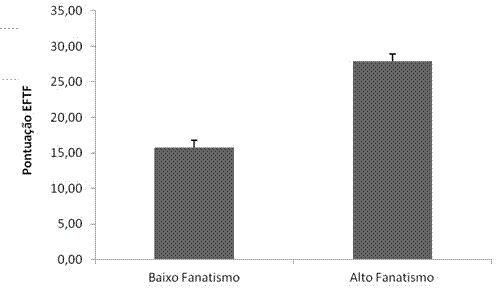 |
Figura 2: Média dos grupos de alto e baixo fanatismo, considerando a pontuação na escala EFTF
Nota: Barras representam o desvio padrão.
Análise de valência
A ANOVA revelou um efeito significativo para a variável “Imagens” indicando que as categorias (time favorito; time rival; imagens positivas, neutras e negativas do IAPS) distinguiram entre si (F4,104=4,127; p < 0,001; η2=0,746) independentemente do nível de fanatismo. Comparações planejadas adicionais indicaram diferenças significativas para a dimensão entre todas as categorias de imagens, exceto entre as imagens neutras do IAPS e do time rival (p = 0,08; d = 0,34). Os valores obtidos em cada comparação estão especificados na Tabela 1.
Tabela 1: Comparação da valência hedônica entre as diferentes categorias de imagen

Nota: A tabela apresenta média (M) e desvio padrão (DP) das diferentes categorias de imagens, bem como os resultados das comparações estatísticas (p) e tamanhos de efeito (d), * identifica as diferenças estatisticamente significativas.
A ANOVA não apresentou interações significativas entre o nível de fanatismo e as categorias de imagens (F4,104=0,315; p < 0,867; η2=0,003), indicando que a valência atribuída as imagens não variaram em função do nível de fanatismo. Análises planejadas adicionais confirmaram a ausência de diferenças significativas entre os dois grupos (Tabela 2).
Tabela 2: Comparação das valências atribuídas entre as diferentes categorias de imagens
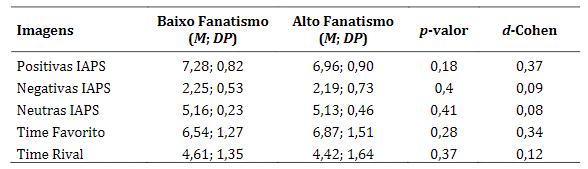
Nota: A tabela apresenta média (M) e desvio padrão (DP) das diferentes categorias de imagens, bem como os resultados das comparações estatísticas (p) e tamanhos de efeito (d) nas comparações entre os grupos de baixo e alto fanatismo.
Análise da ativação
Na análise da ativação emocional, a ANOVA apresentou um efeito significativo para a variável “Imagens” ao revelar que as diferentes categorias (time favorito; time rival; imagens positivas, neutras e negativas do IAPS) distinguiram entre si (F4,104= 27,12; p < 0,01; η2=0,303) quanto à ativação emocional. Comparações planejadas adicionais demonstraram que tais diferenças ocorreram na maioria das comparações, exceto entre imagens do time rival e figuras Neutras do IAPS (p = 0,29; d = 1,84). Os resultados detalhados podem ser observados na Tabela 3.
Tabela 3. Comparação do nível de ativação atribuído às Imagens entre as diferentes categorias de imagens
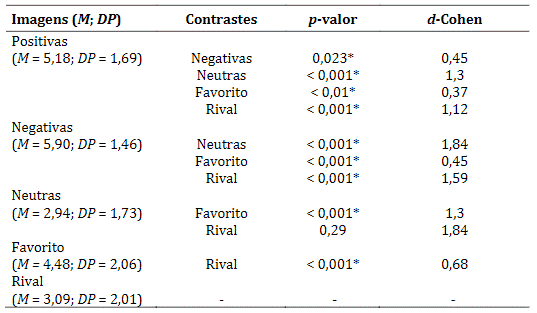
Nota: A tabela apresenta média (M) e desvio padrão (DP) das diferentes categorias de imagens, bem como os resultados das comparações estatísticas (p) e tamanhos de efeito (d), * identifica as diferenças estatisticamente significativas.
Embora não tenha sido verificada nenhuma interação do nível de fanatismo com a ativação emocional atribuída às categorias de imagem (F4,104=1,92; p = 0,113; η2=0,021), comparações planejadas por contraste revelaram padrões distintos em comparações específicas dentro e entre grupos de alto e baixo fanatismo. Ao analisar os resultados obtidos nas comparações dentro dos grupos, isolando o fator Fanatismo, observou-se que os dois grupos demonstraram que imagens positivas não diferem das negativas quanto à excitação emocional. Tal padrão também fora verificado entre imagens neutras e do time rival. Ainda em ambos os grupos, foi possível identificar que, tanto as imagens positivas quanto as negativas, apresentaram maior ativação quando comparadas às imagens neutras.
Contudo, diferenças importantes também foram identificadas analisando os padrões de resposta dentro dos grupos. De forma mais detalhada, observou-se que, apenas no grupo de alto fanatismo, a excitação emocional desencadeada pelo time favorito se equipara a de figuras positivas e negativas do IAPS, bem como à excitação elicitada por imagens do time rival (Tabela 4).
Tabela 4: Comparação do nível de ativação às diferentes categorias de imagens entre os Grupos de Baixo e Alto Fanatismo
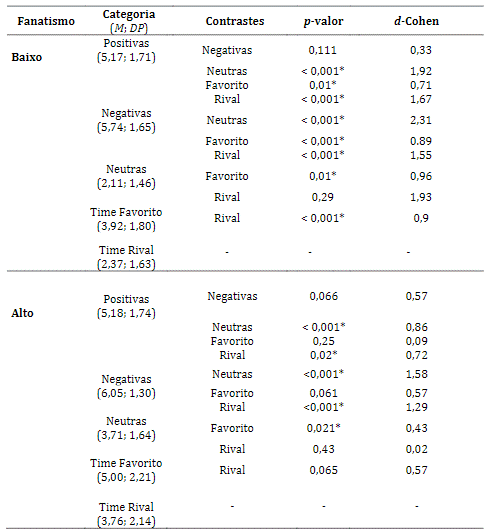
Nota: A tabela apresenta média (M) e desvio padrão (DP) das diferentes categorias de imagens, bem como os resultados das comparações estatísticas (p) e tamanhos de efeito (d) isolando os grupos de alto e baixo fanatismo. * identifica as diferenças estatisticamente significativas.
As análises planejadas também revelaram a existência de diferenças significativas entre os grupos quanto aos níveis de ativação emocional. Mais especificamente, o grupo com alto fanatismo apresentou níveis de ativação superiores às imagens neutras (p < 0,01; d = 0,914), em comparação ao grupo de baixo fanatismo. Também foram encontrados maiores valores de ativação emocional para o grupo de alto fanatismo frente às imagens de ambos os times, rival (p < 0,01; d = 0,83) e favorito (p < 0,01; d = 1,49). As demais comparações entre grupos não demonstraram significância estatística.
Por fim, a análise de dispersão com a aplicação da regressão linear apresentou um padrão consistente com a teoria dos vetores motivacionais (Figura 3). Esta teoria sugere que as imagens relacionadas ao time favorito seguem um padrão de dispersão semelhante ao dos estímulos altamente apetitivos, enquanto as imagens do time rival se assemelham ao padrão das imagens negativas. O padrão bumerangue foi identificado por meio de uma inspeção visual do gráfico de dispersão, que foi estabelecido com base na valência e ativação das imagens do IAPS.
Figura 3: Dispersão da valência em função da ativação para as diferentes categorias de imagens

Nota: As linhas de tendência representam a regressão linear para os dados atribuídos ao time favorito (acima) e rival (abaixo), independentemente do nível de fanatismo.
Discussão
As emoções são elementos fundamentais para a compreensão dos fenômenos esportivos e dos seus impactos na nossa sociedade. Os processos emocionais não influenciam apenas os atletas e equipes, mas também têm um efeito considerável sobre torcedores e entusiastas (Furley et al., 2023). O contexto da competição parece facilitar a manifestação catártica de emoções intensas e coletivas, obviamente moduladas pela representação simbólica da vitória, da derrota, pela identificação com o time favorito e aversão ao rival. Logo, entender as variáveis psicológicas implicadas com fenômenos psicossociais como o fanatismo, a mobilização em massa e o comportamento de manada nos grandes eventos desportivos se torna um desafio importante para ciências humanas e sociais.
Diante de variadas condições emocionais elicitadas ao torcer por um time, a valência atribuída por torcedores (positiva ou negativa) parece ter implicação com o envolvimento harmonioso ou obsessivo com seu time (Schellenberg et al., 2024). Tais aspectos podem auxiliar na compreensão do comportamento emocional, tanto de celebração quanto de hostilidade entre torcedores (Furley et al., 2023; Schellenberg et al., 2024).
Alguns estudos propõem que a classificação da valência no SAM pode refletir a ativação de sistemas motivacionais básicos, seja de recompensa ou de aversão (Bradley et al., 2001; Versace et al., 2023). Tal modelo se ampara na compreensão de que o comportamento emocional envolve esses dois subsistemas motivacionais básicos (Bradley et al., 2001; Lemos et al., 2014). No presente estudo, as medidas obtidas para valência afetiva nas figuras referências do IAPS, demonstraram padrão compatível com a literatura (Bradley et al., 2001; Branco et al., 2023), tendo sido as imagens positivas avaliadas como agradáveis, neutras e as negativas como desagradáveis, com diferenças significativas entre estas categorias. As figuras do IAPS serviram como referências essenciais para melhor contextualização acerca dos valores indicados para as imagens experimentais dos times favorito e rival. Fora verificado que as imagens do time favorito se destacaram por apresentarem alto índice de agradabilidade, enquanto as imagens do time rival foram avaliadas como desagradáveis.
Modelos de estudo na perspectiva dimensional das emoções consideram que as medidas de excitação emocional complementam indicadores de valência afetiva por representarem o nível de ativação motivacional (Bradley et al., 2001; Branco et al., 2023). Considerando essas duas dimensões emocionais, valência e ativação, seria possível a representação gráfica em plano cartesiano dos vetores motivacionais, variando em intensidade (Lemos et al., 2024; Versace et al., 2023). Os resultados aqui reportados demonstraram o padrão esperado para as imagens padronizadas do IAPS, com altos índices de ativação emocional para as figuras positivas e negativas, em comparação com as neutras (Bradley et al., 2001; Branco et al., 2023; Lemos et al., 2024; Versace et al., 2023). As imagens negativas do IAPS foram emocionalmente ainda mais alertantes do que as positivas. Quanto às imagens experimentais, ainda sem considerar o nível de fanatismo, observou-se que as imagens do time favorito despertaram menor ativação do que as imagens positivas e negativas do IAPS e maior ativação do que as imagens neutras e do time rival. Enquanto as imagens do time rival demonstraram um padrão de ativação semelhante às imagens neutras, sendo menos excitante do que todas as outras categorias.
Contudo, considerando as influências do nível de fanatismo, foram identificados padrões distintos de excitação emocional entre os dois grupos. Mais especificamente, o fato do grupo de alto fanatismo ter apresentado níveis maiores de ativação emocional decorrentes da observação de imagens neutras e das imagens experimentais, seja do time rival ou favorito, pode ser interpretado como uma evidência de que este grupo talvez esteja mais propenso à excitação emocional e/ou tenha menor capacidade de regulação emocional.
Muitas pesquisas têm indicado que estímulos visuais com componentes emocionais ou afetivos podem desencadear aumento significativo da atividade cerebral em circuitos visuais, emocionais e motores (Bradley et al., 2001; Carretié et al., 2022; Lin et al., 2020; Onigata & Bunno, 2020; Pereira et al., 2010; Zsidó, 2024). Nesta linha de raciocínio, os resultados obtidos suscitam a reflexão sobre a possibilidade destes circuitos primitivos, apetitivos e aversivos, atuarem mediando a interação de torcedores com estímulos representando o time favorito e o time rival, respectivamente. Afinal, pode-se observar a ocorrência do padrão bumerangue na análise de dispersão, sendo possível verificar que a linha de tendência estabelecida pela regressão linear para os valores de ativação e valência ao time favorito se estabelece na parte superior do gráfico, na mesma direção dos parâmetros de vetores motivacionais estabelecidos para o sistema apetitivo. Enquanto a linha de regressão linear verificada para as imagens do time rival, se delineou em um vetor motivacional compatível com parâmetros observados para sistema motivacional aversivo. Importante enfatizar que o padrão Bumerangue fica ainda mais definido para torcedores com maiores níveis de fanatismo, devido aos níveis mais altos atribuídos à ativação emocional para as imagens dos times favorito e rival.
Os resultados obtidos nas análises do nível de fanatismo, junto com indicadores de reação emocional às imagens de times favoritos e rivais, reforçam a compreensão de que as pessoas mais fanáticas estão mais propensas à excitação emocional. Na tentativa de compreender as implicações práticas deste estudo, convém considerar evidências complementares que demonstram que o aumento da atividade nos circuitos emocionais compete por recursos de processamento com redes neurais responsáveis pela cognição e comportamentos ditos racionais (Dolcos & Mccarthy, 2006). Tal condição pode ser propícia para desencadear o contágio emocional e o comportamento de manada, ambos fenômenos muito presentes no contexto do esporte competitivo (Neuman, 2024).
Adicionalmente, devemos considerar que imagens dos times favorito e rival ativam regiões límbicas, filogeneticamente antigas, estabelecidas como moduladoras do comportamento afetivo e motivacional e ainda, que o fanatismo se correlaciona positivamente com a ativação desses circuitos (Duarte et al., 2017). Apesar de algumas evidências terem sugerido que a interação com estímulos visuais representando o time favorito e rival recrutam respectivamente os sistemas motivacionais apetitivo e aversivo (Conde et al., 2011; Conde et al., 2018; Oliveira et al., 2021), até o momento tal compreensão não é consensual (Proctor, 2013; Yamaguchi & Chen, 2019). Neste sentido, a caracterização dos vetores motivacionais para as imagens do time favorito e rival no presente estudo serve como mais uma evidência que indica o envolvimento dos sistemas apetitivo e aversivo diante do processamento de estímulos de times de futebol.
Embora a presente investigação propicie contribuições relevantes, é importante analisar cuidadosamente os resultados aqui apresentados, considerando algumas limitações do estudo. Como primeira e principal limitação, deve-se destacar que a amostra foi composta por conveniência, resultando na predominância de mulheres em ambos os grupos. Embora a adoção da mediana para a formação dos grupos de alto e baixo fanatismo encontre algum respaldo na literatura (Conde et al., 2018; Coriolano & Conde, 2017), tal procedimento dificultou a distribuição igualitária de gêneros em cada grupo, o que refletiu em um desequilíbrio ainda mais acentuado no grupo de baixo fanatismo. Embora o delineamento amostral ideal não tenha sido implementado, tal condição não compromete os resultados aqui reportados, uma vez que os objetivos da pesquisa se estabeleceram justamente na comparação de diferentes perfis de fanatismo e não na comparação entre gêneros. Adicionalmente, o estudo de Zeferino et al. (2021) não identificou diferenças entre gêneros quanto ao nível de fanatismo e agressividade em um estudo que avaliou 210 torcedores com a EFTF e com a escala de Agressividade (Buss & Perry, 1992). Ainda assim, se faz importante reconhecer que novos estudos são fundamentais para melhor compreensão das diferenças entre os gêneros quanto aos construtos aqui mensurados, principalmente sobre a atribuição da valência hedônica e ativação emocional diante de imagens de futebol do time favorito e rival. Por fim, o presente estudo também não investigou possíveis efeitos moduladores decorrentes de outras variáveis sociodemográficas, tais como filiação à torcida organizada e idade, as quais também parecem interferir significativamente no comportamento de torcedores (Zeferino et al., 2021).
Conclusões
A torcida tem sido considerada como uma variável importante à sustentação da cultura e da economia do futebol. Grupos conhecidos como “torcidas organizadas” foram historicamente instaurados no Brasil por torcedores com o objetivo de criar e desenvolver laços, comemorar além de fortalecer sentimentos de rivalidade e oposição. Contudo, alguns destes torcedores são apontados, por parte da literatura, como mais propensos a se envolverem em episódios de violência no futebol brasileiro (Louis, 2023; Ribeiro & Fernandes, 2021). Neste contexto, ressalta-se que os impactos do fanatismo por futebol possuem implicações de cunho socioeconômico, à mobilidade urbana, causando impactos na área de segurança pública e em processos psicossociais. Além disso, segundo Brandão et al. (2020), a violência nos estádios se estabelece como fenômeno complexo e multivariado.
Os resultados da pesquisa oferecem uma compreensão pioneira sobre o fanatismo e suas implicações emocionais, sendo os principais achados caracterizados pela identificação de diferenças significativas nos níveis de ativação emocional entre torcedores de alto e baixo fanatismo. Pela primeira vez, fora verificado de que forma imagens de times de futebol, com valência afetiva antagônica, são percebidas por seus torcedores e rivais, principalmente no que se refere à agradabilidade (dimensão da valência) e ativação emocional. Adicionalmente, foram verificados padrões motivacionais que suscitam o envolvimento dos sistemas motivacionais apetitivo e aversivo, em consequência da simples observação de imagens representando o time favorito e o principal rival, respectivamente. Tal verificação garante suporte para melhor entendimento sobre os motivos das competições mobilizarem milhares de pessoas, além de movimentarem elevados valores financeiros (Oliveira et al., 2021). Complementariamente, considerar o envolvimento do sistema emocional aversivo em resposta à representação do time rival parece uma possibilidade plausível para compreender a hostilidade e rivalidade entre times favoritos e rivais.
Tendo em vista os fatos supracitados, o presente estudo sugere que as abordagens de seguridade em jogos de futebol considerem também os processos psicossociais e singularidades da expressão emocional do torcedor na relação que estabelece com o seu time e com seus principais rivais. Neste sentido, observa-se a demanda por novos modelos de planejamento e também pela implementação de políticas públicas para a segurança de torcedores nos estádios de futebol e transeuntes nos arredores das partidas, considerando que as medidas mais adotadas têm se restringido a ações de inteligência policial somadas ao policiamento ostensivo como prevenção durante os jogos (Barbosa & Bueno, 2023; Rodrigues & Santos, 2024). A aplicação da força policial também tem sido verificada em situações de conflitos entre torcedores. Ainda que não existam modelos interventivos validados com efetividade comprovada em condições de conduta agressiva de torcedores, a obra de Neuman (2024) proporciona reflexões e ideias inovadoras que inspiram abordagens comportamentais alternativas para se compreender e lidar com dinâmicas das multidões. Essa abordagem alternativa à policial, talvez possa permitir estratégias mais eficazes de prevenção e gestão de comportamentos violentos. Vislumbra-se, com parcimônia, que através de campanhas psicoeducativas seja possível conscientizar torcedores sobre como o fanatismo se manifesta em suas vidas, tratando de suas implicações emocionais, comportamentais e consequências às interações sociais, bem como para auxiliá-los a desenvolver reações emocionais mais funcionais e comportamentos não violentos nos ambientes esportivos como propõe alguns trabalhos (Galily et al., 2024; Neuman, 2024; Newson et al., 2023). Seria também importante considerar abordagens mais humanizadas, considerando procedimentos como avaliação e atendimento psicológico àqueles que se envolvem em episódios de violência, uma vez que simples estímulos visuais, seja de imagens neutras ou, principalmente, do time rival, parecem capazes de desencadear ativação emocional mais alta em torcedores mais fanáticos. Tal proposição se ampara no fato que a violência entre torcedores não acontece apenas dentro dos estádios, mas também em praças públicas, metrôs, ruas movimentadas, entre muitos outros locais públicos. Por ser um tema multifacetado, novas pesquisas, em perspectiva multidisciplinar, talvez possam ajudar a compreender e complementar o conhecimento que se tem sobre o fanatismo por futebol e suas implicações psicossociais. Os resultados do presente estudo contribuem para ampliar a compreensão sobre como o fanatismo pode influenciar na maneira pela qual se percebe os estímulos emocionais provenientes do contexto do futebol, representando a polaridade afetiva favorito-rival, inerente aos embates esportivos.
Referências:
Bandeira, V. F., & Ramos, D. G. (2020). Aspectos sociodemográficos relacionados à agressividade e ao fanatismo em uma torcida de futebol. Psicologia Revista, 29(1), 246-272. https://doi.org/10.23925/2594-3871.2020v29i1p246-272
Barbosa, D. S., & Bueno, V. L. A. (2023). Inteligência da Polícia Militar do Paraná como ferramenta na diminuição de confrontos violentos entre torcidas organizadas de futebol em estádios paranaenses. Brazilian Journal of Development, 9(1), 4973-4988. https://doi.org/10.34117/bjdv9n1-341
Battaly, H. (2023). Can fanaticism be a liberatory virtue? Synthese, 201(6), 1-27. https://doi.org/10.1007/s11229-023-04174-7
Bradley, M., & Lang, P. (1994). Measuring emotion: The self-assessment manikin and the semantic differential. Journal of Behavioral Therapy and Experimental Psychiatry, 25, 49-59. https://doi.org/10.1016/0005-7916(94)90063-9
Bradley, M., Codispoti, Cuthbert B., & Lang(2001). Emotion and motivation I: defensive and appetitive reactions in picture processing. Emotion, 1, 276-298. https://doi.org/10.1037//1528-3542.1.3.276
Branco, D., Goncalves, O. F., & Badia, S. B. I. (2023). A systematic review of international affective picture system (IAPS) around the world. Sensors, 23(8), 3866. https://doi.org/10.3390/s23083866
Brandão, T., Murad, M., Belmot, R., & Dos Santos, R. (2020). Álcool e violência: Torcidas organizadas de futebol no brasil. Movimento, 26, e26001. https://doi.org/10.22456/1982-8918.90431
Buss, A. H., & Perry, M. (1992). The aggression questionnaire. Journal of Personality and Social Psychology, 63(3), 452-459. https://doi.org/10.1037/0022-3514.63.3.452
Bynion, T. M., & Feldner, M. T. (2020). Self-assessment manikin. Encyclopedia of Personality and Individual Differences, 4654-4656. https://doi.org/10.1007/978-3-319-24612-3_77
Carretié, L., Fernández-Folgueiras, U., Álvarez, F., Cipriani, G. A., Tapia, M., & Kessel, D. (2022). Fast unconscious processing of emotional stimuli in early stages of the visual cortex. Cerebral Cortex, 32(19), 4331-4344. https://doi.org/10.1093/cercor/bhab486
Cassam, Q. (2023). Fanaticism: for and against. Em L. Townsend, R. Tietjen, H. Schmid, & M. Staudigl (Eds.), The Philosophy of Fanaticism. Epistemic, Affective, and Political Dimensions (pp. 19-38). Routledge. https://doi.org/10.4324/9781003119371
Castro, C. O. (2014). Morte organizada: os bárbaros. O Globo.
Conde, E. F. Q., Cavallet, M., Torro-Alves, N., Matsushima, E. H., Fraga-Filho, R. S., Jazenko, F., Busatto, G. & Gawryszewski, L. G. (2014). Effects of affective valence on a mixed spatial correspondence task: A reply to Proctor (2013). Psychology & Neuroscience, 7(2), 83. https://doi.org/10.3922/j.psns.2014.021
Conde, E. F. Q., & Coriolano, A. M. (2019). O fanatismo no contexto do esporte. Em K. Rubio & J. Camilo (Orgs.), Psicologia social do esporte (pp. 169-182). Képos.
Conde, E. F. Q., Jazenko, F., Fraga Filho, R. S., Costa, D. H. D., Torro-Alves, N., Cavallet, M., & Gawryszewski, L. G. (2011). Stimulus affective valence reverses spatial compatibility effect. Psychology & Neuroscience, 4, 81-87. https://doi.org/10.3922/j.psns.2011.1.010
Conde, E. F. Q., Lucena, A. O. D. S., da Silva, R. M., Filgueiras, A., Lameira, A. P., Torro-Alves, N., Gawryszewski, L. G., & Machado-Pinheiro, W. (2018). Hemispheric specialization for processing soccer related pictures: The role of supporter fanaticism. Psychology & Neuroscience, 11(4), 329. https://doi.org/10.1037/pne0000147
Coriolano, A. M., & Conde, E. F. Q. (2017). Fanatismo e agressividade em torcedores de futebol. Revista Brasileira de Psicologia do Esporte, 6(2). https://doi.org/10.31501/rbpe.v6i2.7092
Dolcos, F., & Mccarthy, G. (2006). Brain Systems Mediating Cognitive Interference by Emotional Distraction. The Journal of Neuroscience, 26(7), 2072-2079. https://doi.org/10.1523/jneurosci.5042-05.2006
Duarte, I. C., Afonso, S., Jorge, H., Cayolla, R., Ferreira, C., & Castelo-Branco, M. (2017). Tribal love: the neural correlates of passionate engagement in football fans. Social Cognitive and Affective Neuroscience, 12(5), 718-728. https://doi.org/10.1093/scan/nsx003
Furley, P., Laborde, S., Robazza, C., & Lane, A. (2023). Emotions in sport. Em J. Schüler, M. Wegner, H. Plessner, & R. Eklund (Eds.), Sport and exercise psychology: theory and application (pp. 247-279). Springer International Publishing.
Galily, Y., Pack, S., & Tamir, I. (2024). Spectator sport and fan behavior: a sequel. Frontiers in Psychology, 15, 1414407. https://doi.org/10.3389/fpsyg.2024.1414407
Katsafanas, P. (2024). What’s so bad about fanaticism? Synthese, 203(6), 205. https://doi.org/10.1007/s11229-024-04647-3
Kelly, K. J., Murray, E., Barrios, V., Gorman, J., Ganis, G., & Keenan, J. P. (2009). The effect of deception on motor cortex excitability. Social Neuroscience, 4(6), 570-574. https://doi.org/10.1080/17470910802424445
Lang, B., Bradley, M., & Cuthbert, B. (2005). International affective picture system (IAPS): Digitized photographs, instruction manual and affective ratings (Technical report N0 A-6). University of Florida, Center for Research in Psychophysiology.
Lasaitis, C., Ribeiro, R. L., & Bueno, O. F. A. (2008). Brazilian norms for the International Affective Picture System (IAPS): comparison of the affective ratings for new stimuli between Brazilian and North-American subjects. Jornal Brasileiro de Psiquiatria, 57, 270-275. https://doi.org/10.1590/s0047-20852008000400008
Lemos, T. C., Silva, L. A., Gaspar, S. D., Coutinho, G. M., Stariolo, J. B., Oliveira, P. G., Conceição, L., Volchan, E., & David, I. A. (2024). Adaptation of the normative rating procedure for the International Affective Picture System to a remote format. Psicologia: Reflexão e Crítica, 37(1), 41. https://doi.org/10.1186/s41155-024-00326-x
Lin, H., Müller-Bardorff, M., Gathmann, B., Brieke, J., Mothes-Lasch, M., Bruchmann, M., Miltner, W. H. R. & Straube, T. (2020). Stimulus arousal drives amygdalar responses to emotional expressions across sensory modalities. Scientific Reports, 10(1). https://doi.org/10.1038/s41598-020-58839-1
Louis, S. (2023). Football fandom in France and Italy. Em B. Buarque de Hollanda & T. Busset (Eds.), Football Fandom in Europe and Latin America: Culture, Politics, and Violence in the 21st Century (pp. 59-80). Springer International Publishing.
Mulckhuyse, M. (2018). The influence of emotional stimuli on the oculomotor system: A review of the literature. Cognitive, Affective, & Behavioral Neuroscience, 18, 411-425. https://doi.org/10.3758/s13415-018-0590-8
Murad, M. (2017). A violência no futebol: novas pesquisas, novas ideias, novas propostas (Rev. ampliada). Selo Benvirá.
Neuman, Y. (2024). Betting Against the Crowd. Springer.
Newson, M., White, F., & Whitehouse, H. (2023). Does loving a group mean hating its rivals? Exploring the relationship between ingroup cohesion and outgroup hostility among soccer fans. International Journal of Sport and Exercise Psychology, 21(4), 706-724. https://doi.org/10.1080/1612197x.2022.2084140
Oliveira, L. F. D., Antunes, F. C. C. S., Jazenko, F., Conde, E. F. Q., Fraga-Filho, R. S., & Gawryszewski, L. (2021). Interaction between affective and spatial polarities: soccer preferences and stimulus-response compatibility. Psicologia em Pesquisa, 15(3), 1-17.
Onigata, C., & Bunno, Y. (2020). Unpleasant visual stimuli increase the excitability of spinal motor neurons. Somatosensory & Motor Research, 37(2), 59-62. https://doi.org/10.1080/08990220.2020.1724087
Park, H. J., Kim, J., Kim, S., Moon, D., Know, M. H., & Kim, W. (2009). Neural correlates of winning and losing while watching soccer matches. International Journal of Neuroscience, 119(1), 76-87. https://doi.org/10.1080/00207450802480069
Pereira, M., Oliveira, L., Erthal, F., Jofilly, M., Mocaiber, I., Volchan, E., & Pessoa, L. (2010). Emotion affects action: Midcingulate cortex as a pivotal node of interaction between negative emotion and motor signals. Cognitive And Affective Behavioral Neuroscience, 1(10), 94-106. https://doi.org/10.3758/CABN.10.1.94
Polo, E. M., Farabbi, A., Mollura, M., Mainardi, L., & Barbieri, R. (2024). Understanding the role of emotion in decision making process: using machine learning to analyze physiological responses to visual, auditory, and combined stimulation. Frontiers in Human Neuroscience, 17, 1286621. https://doi.org/10.3389/fnhum.2023.1286621
Proctor, R. W. (2013). Stimulus affect valence may influence mapping-rule selection but does not reverse the spatial compatibility effect: Reinterpretation of Conde et al. (2011). Psychology & Neuroscience, 6, 3-6. https://doi.org/10.3922/j.psns.2013.1.02
Ribeiro, M. J., & Fernandes, P. H. C. (2021). A violência no futebol brasileiro: da emoção no gol ao luto pelas vítimas. Revista GeoPantanal, 16(30), 245-257.
Rodrigues, J., & Dos Santos, C. P. (2024). Uma revisão de literatura acerca da inteligência da polícia militar no âmbito da violência das torcidas organizadas no futebol profissional. Revista Científica Multidisciplinar, 5(2), e514857. https://doi.org/10.47820/recima21.v5i2.4857
Schellenberg, B. J., Verner-Filion, J., & Gaudreau, P. (2024). How do passionate sport fans feel? An examination using a quadripartite approach. Motivation and Emotion, 48(5), 684-699. https://doi.org/10.1007/s11031-024-10087-w
Tietjen, R. R. (2023a). On the social constitution of fanatical feelings. Em L. Townsend, R. Tietjen, H. Schmid, & M. Staudigl (Eds.), The Philosophy of Fanaticism Epistemic, Affective, and Political Dimensions (pp. 111-129). Routledge.
Tietjen, R. R. (2023b). Fear, fanaticism, and fragile identities. The Journal of Ethics, 27(2), 211-230. https://doi.org/10.1007/s10892-023-09418-9
Versace, F., Sambuco, N., Deweese, M. M., & Cinciripini, P. M. (2023). Electrophysiological normative responses to emotional, neutral, and cigarette-related images. Psychophysiology, 60(3), e14196. https://doi.org/10.1111/psyp.14196
Wachelke, J., Andrade, A., Tavares, L., & Neves, J. (2008). Mensuração da identificação com times de futebol: evidências de validade fatorial e consistência interna de duas escalas. Arquivos Brasileiros de Psicologia, 60(1), 96-111.
Wann, D., & James, J. (2018). Sport fans: The psychology and social impact of fandom. Routledge.
Yamaguchi, M., & Chen, J. (2019). Affective influences without approach-avoidance actions: On the congruence between valence and stimulus-response mappings. Psychonomic Bulletin & Review, 26, 545-551. https://doi.org/10.3758/s13423-018-1547-1
Zeferino, G. G., Silva, M. A., & Alvarenga, M. A. S. (2021). Associations between sociodemographic and behavioural variables, fanaticism and aggressiveness of soccer fans. Ciencias Psicológicas, 15(2), e-2390. https://doi.org/10.22235/cp.v15i2.2390
Zsidó, A. N. (2024). The effect of emotional arousal on visual attentional performance: A systematic review. Psychological Research, 88(1), 1-24. https://doi.org/10.1007/s00426-023-01852-6
Disponibilidade de dados: O conjunto de dados que embasa os resultados deste estudo não está disponível.
Como citar: Kort-Kamp, M. L. I., Rocha Porto, T., Silveira de Oliveira, R., & Conde, E. F. (2024). Efeitos emocionais elicitados por imagens de futebol: Um estudo sobre o fanatismo. Ciencias Psicológicas, 18(2), e-3849. https://doi.org/10.22235/cp.v18i2.3849
Contribuição de autores (Taxonomia CRediT): 1. Conceitualização; 2. Curadoria de dados; 3. Análise formal; 4. Aquisição de financiamento; 5. Pesquisa; 6. Metodologia; 7. Administração do projeto; 8. Recursos; 9. Software; 10. Supervisão; 11. Validação; 12. Visualização; 13. Redação: esboço original; 14. Redação: revisão e edição.
M. L. I. K. K. contribuiu em 2, 3, 5, 6, 13; T. R. P. em 3, 13, 14; R. S. O. em 1, 2, 3, 5, 6, 9; E. F. C. em 1, 4, 5, 6, 7, 8, 10, 11, 12, 13, 14.
Editora científica responsável: Dra. Cecilia Cracco.
Ciencias Psicológicas; v18(2)
Julio-Diciembre 2024
10.22235/cp.v18i2.3849
Original Articles
Emotional effects elicited by football images: A study on fanaticism
Efeitos emocionais elicitados por imagens de futebol: Um estudo sobre o fanatismo
Efectos emocionales desencadenados por imágenes de fútbol: Un estudio sobre el fanatismo
Monick Leonora Inês Kort-Kamp1, ORCID 0000-0001-8019-6215
Thauan Rocha Porto2, ORCID 0000-0002-3360-5271
Roberdson Silveira de Oliveira3, ORCID 0000-0001-9142-8851
Erick Francisco Conde4, ORCID 0000-0002-7130-2888
1 Universidade Federal Fluminense, Brazil
2 Universidade Federal Fluminense, Brazil
3 Universidade Federal Fluminense, Brazil
4 Universidade Federal Fluminense, Brazil, [email protected]
Abstract:
The present study investigated the effects of the favorite and rival team visualization on valence and emotional arousal indicators, verifying for possible interactions with the fanaticism level in soccer fans. Twenty-seven volunteers (Mage = 22; SD = 3.25) participated in this experiment, who evaluated the pleasantness (hedonic valence) and the emotional arousal (activation) triggered by a set of neutral, positive and negative images of the International System of Affective Pictures (IAPS) plus 30 experimental images of the favorite and rival team. Evaluations were performed using the Self Assessment Manikin (SAM) scale and the Football Supporter Fanatism Scale (FSFS). Comparative analysis revealed that fanaticism did not influence the assignment of hedonic valence to the images. However, individuals with higher levels of fanaticism exhibited greater arousal in response to neutral (p < .01; d = 0.914), favorite (p < .01; d = 1.49), and rival images (p < .01; d = 0.83). The dispersion analysis suggested the involvement of appetitive and aversive motivational systems in response to images of the favorite and rival teams, respectively. The study findings lead to a better understanding of the fanaticism in soccer.
Keywords: fanaticism; soccer; affective valence; emotional arousal; sport psychology.
Resumo:
O presente estudo investigou os efeitos da visualização de imagens de times favoritos e rivais nos indicadores de valência e ativação emocional, averiguando possíveis interações com os níveis de fanatismo em torcedores de futebol. Participaram deste experimento 27 voluntários (M = 22 anos; DP = 3,25), que avaliaram a agradabilidade (valência hedônica) e a excitação emocional (ativação) desencadeada por um conjunto de imagens neutras, positivas e negativas do Sistema Internacional de Figuras Afetivas (IAPS), acrescido de 30 imagens experimentais pareadas, sendo 15 do time favorito e 15 do time rival. As avaliações foram realizadas através da escala Self Assessment Manikin (SAM) e da Escala de Fanatismo em Torcedores de Futebol (EFTF). Análises comparativas demonstraram que o nível de fanatismo não influenciou na atribuição da valência hedônica às imagens. Contudo, o grupo com níveis mais altos de fanatismo apresentou maior excitação emocional em resposta a imagens neutras (p < 0,01; d = 0,914), do time favorito (p < 0,01; d = 1,49) e do time rival (p < 0,01; d = 0,83). A análise de dispersão sugeriu o envolvimento dos sistemas motivacionais apetitivo e aversivo em reação às imagens do time favorito e rival, respectivamente. Os resultados do estudo auxiliam na compreensão do fenômeno do fanatismo no futebol.
Palavras-chave: f fanatismo; futebol; valência afetiva; ativação emocional; psicologia do esporte.
Resumen:
El presente estudio investigó los efectos de la visualización de imágenes de equipos favoritos y rivales en los indicadores de valencia y activación emocional para averiguar la interacción con los niveles de fanatismo de los hinchas de fútbol. Veintisiete voluntarios (M = 22 años; DE = 3.25) participaron en este experimento, quienes evaluaron la agradabilidad (valencia hedónica) y la excitación emocional (activación) desencadenada por un conjunto de imágenes neutrales, positivas y negativas del International System of Affective Pictures (IAPS), con más de 30 imágenes experimentales del equipo favorito y el rival. Las evaluaciones se realizaron utilizando la escala Self Assessment Manikin (SAM) y la Escala de Fanatismo en Hinchas de Fútbol (EFHF). Análisis comparativos demostraron que el nivel de fanatismo no influyó en la atribución de la valencia hedónica de las imágenes. Sin embargo, las personas con niveles más altos de fanatismo presentaron una excitación superior ante imágenes neutras (p < .01; d = 0.914), imágenes del equipo favorito (p < .01; d = 1.49) e imágenes del equipo rival (p < .01; d = 0.83). El análisis de dispersión sugirió la implicación de los sistemas motivacionales apetitivos y aversivos en respuesta a las imágenes del equipo favorito y rival, respectivamente. Los resultados del estudio ayudan a comprender el fanatismo en el fútbol.
Palabras clave: fanatismo; fútbol; valencia afectiva; excitación emocional; psicología del deporte.
Received: 22/01/2024
Accepted: 17/10/2024
Football is a globally popular sport, establishing itself as a transcultural phenomenon capable of generating significant impacts on our society (Wann & James, 2018). Beyond the economic dimension and other social impacts, conflicts between fans have required public policies in the areas of social security and urban mobility, with relevant socioeconomic implications (Louis, 2023). When it comes to violence in football, Brazil has alarming rates. Evidence suggests that Brazil may be considered one of the main countries in the world where the most people are killed for soccer-related reasons (Brandão et al., 2020; Murad, 2017). Data also show a trend of increasing trials held by the Supreme Court of Sports Justice regarding cases related to stadium violence (Castro, 2014).
The literature has shown that the mere visual processing of affective stimuli is already capable of influencing parameters such as human physiology and behavior (Mulckhuyse, 2018; Polo et al., 2024; Zsidó, 2024). More specifically regarding the football context, research has demonstrated that simply observing images related to this sport can trigger the activation of emotional circuits in the brains of fans (Duarte et al., 2017; Kelly et al., 2009; Park et al., 2009). Park et al. (2009) demonstrated that the perception of a favorite team in victory circumstances can trigger asymmetrical activation of limbic structures, such as the amygdala, predominantly in the left hemisphere. In defeats, the researchers detected a brain activation pattern indicative of emotional suppression.
Behavioral studies have already found that football stimuli can also modulate cognition and motor behavior (Conde et al., 2011; Conde et al., 2018; Oliveira et al., 2021). Through a reaction time measurement protocol, known as the stimulus-response compatibility task, it is possible to verify significant temporal differences in responses to the favorite and rival teams. More specifically, using images representing soccer players from the main teams in Rio de Janeiro as target stimuli, Conde et al. (2011) adapted the stimulus-response compatibility task to study whether the variable "preference" could modulate the response times to stimuli representing the participant’s favorite and rival teams. The stimuli could appear on either the left or right side of the fixation point, and the responses had to be made with response keys positioned ipsilaterally or contralaterally. In a balanced manner, participants were instructed to respond with the key on the same side for the preferred team (compatible condition) and with the opposite side key (incompatible condition) for the rival team. In the second block, they performed the opposite pairing. The researchers reported a classic spatial compatibility effect for the favorite team stimuli, with spatially corresponding responses being faster than spatially incompatible ones. Meanwhile, for the rival team, an inversion of the compatibility effect was observed, with manual responses being faster when pressed on the opposite side of the appearance of the stimulus representing the rival team. These results were interpreted as evidence that responses to the favorite and rival teams were mediated by approach and avoidance mechanisms, respectively.
Additional studies (Conde et al., 2014; Oliveira et al., 2021; Proctor, 2013) have demonstrated that there are also temporal differences between the two practice blocks. More specifically, in the block where responses are ipsilateral to the preferred team and contralateral to the rival team, responses are faster than those executed to the opposite pairing (incompatible condition for the preferred team and compatible response for the rival team).
Oliveira et al. (2021) adapted the task to verify whether emotional effects triggered by football stimuli could also influence response patterns in another attentional test, known as the Simon task. In the Simon task, participants need to select the correct response as quickly as possible, based on processing an intrinsic attribute of the stimulus (such as shape or color). Even though the stimulus location is not considered for response selection, spatial codes appear to require automatic processing, which can affect motor responses. In this sense, faster responses are observed in the spatially compatible condition compared to the incompatible condition. This temporal difference between the two conditions is called the Simon effect. In Oliveira et al.'s (2021) study, it was shown that the Simon effect varies according to the preference for football teams, being greater for the favorite team. The authors interpreted the research results by indicating that the valence of positive and negative stimuli facilitates and/or inhibits motor responses. They also estimated that the increased effect for the favorite team could be an indicator that the stimulus affective valence facilitates the spatially corresponding response for the favorite team and the contralateral responses for the rival team.
Despite the aforementioned studies providing important insights into how specific football images can influence the affect, cognition, and behavior of fans, other variables need further understanding in this context, such as fanaticism. Although there are different theoretical and philosophical perspectives on fanaticism (Battaly, 2023; Cassam, 2023; Katsafanas, 2024), this construct has been widely understood as a dysfunctional psychosocial phenomenon, characterized by intense and devotional involvement with ideologies, institutions, doctrines, objects, and/or even other people (such as idols or martyrs) who represent them or share their values/ideals (Tietjen, 2023a). Currently, the study of fanaticism holds great social relevance as this phenomenon has been implicated in coercive behavior, violent and hostile actions, and even wars and extremism in various contexts (Tietjen, 2023b).
Specifically in the context of sports, fanaticism has also been widely associated with episodes of aggression, hostility, widespread violence, murders, and public disorder (Bandeira & Ramos, 2020; Conde & Coriolano, 2019; Coriolano & Conde, 2017; Louis, 2023; Zeferino et al., 2021). Given the many gaps still existing in the full understanding of this phenomenon, the present study aimed to investigate how the visualization of football team images, with antagonistic affective valence (favorite and rival), can influence emotional indicators. The research design also aimed to investigate whether different levels of fanaticism can influence the scores attributed to the dimensions of valence (whether of pleasure or displeasure) and emotional arousal (alerting or relaxing) when presented with images.
Methods
The present research can be characterized as a quasi-experimental approach, designed with independent variable control and adopting validated procedures to investigate emotional parameters resulting from the visualization of images of the favorite and rival football teams. The study used as dependent variables the measures of hedonic valence and emotional arousal, attributed to different categories of images. Adopting a comparative perspective, two levels of fanaticism were considered as an intergroup categorical variable, allowing the analysis of differences between fans classified as high and low fanaticism. The intragroup variables were established in five image categories, which included not only the favorite and rival teams but also stimuli from the International Affective Picture System (IAPS), including positive, negative, and neutral images, providing important valence and arousal parameters in comparison with the experimental images.
Participants
This study included 27 participants, 22 women and 5 men (Mage = 22 years, SD = 3.25). The study was advertised on social media and through flyers placed in public areas of the Institute of Social Sciences and Regional Development (Fluminense Federal University) in Campos dos Goytacazes (Rio de Janeiro, Brazil). People were also invited in person during class breaks and while passing through the Institute, characterizing a convenience sample composed of students from various periods and undergraduate courses, as well as service providers and technical staff of the University. For the analysis, participants were divided into two distinct groups based on the levels of fanaticism verified using the Football Fanaticism Scale. More specifically, the high fanaticism group consisted of 13 people (10 women, 3 men), and the low fanaticism group consisted of 14 people (12 women, 2 men). Volunteers did not receive remuneration or academic benefits for their participation. All signed the Free and Informed Consent Form (FICF). The research was approved by the Ethics and Research Committee of the Federal University of Pernambuco (Opinion No. 2.140.159).
Instruments
Football Fanaticism Scale (FFS). This instrument allows the assessment of fanaticism levels in football/soccer fans (Wachelke et al., 2008). The 11 items of the scale evaluate behaviors, beliefs, and situations that may reflect how the person supports their football team. The instrument demonstrated acceptable psychometric indicators in a study on factorial validity and internal consistency in Brazil (Wachelke et al., 2008), such as KMO = 0.94, significant Bartlett’s test of sphericity (p < .001), eigenvalue = 6.14, and Cronbach's alpha (α = .91). The unidimensional scale has a Likert-type format with 7 points, ranging from 1 (strongly disagree) to 7 (strongly agree).
Self-Assessment Manikins Scale (SAM): This instrument uses a non-verbal pictorial perspective that is easy and quick to apply for evaluating images with emotional content (Bradley & Lang, 1994; Bynion & Feldner, 2020). With this instrument, it is possible to obtain information about two emotional dimensions: valence and arousal. The first dimension measures the degree of pleasantness of the figure presented, while the second indicates the level of alertness, arousal, or emotional excitement experienced by the volunteer when observing the image. In the scale, participants must indicate how positive or negative an image is (emotional valence) and the level of psychophysiological arousal (emotional activation) triggered by observing the images. To do so, horizontally arranged manikins are presented as graphical indicators of emotional states, with 9 response levels (Figure 1). Following the evaluation norms of the IAPS in Brazil (Lasaitis et al., 2008), each volunteer received an instruction booklet to classify the images and a pen for completion. Participants were informed that they could also use the spaces between the manikins, representing intermediate options. Thus, participants respond by classifying the images presented through SAM, marking an X on or between the five manikins.
International Affective Picture System (IAPS) and experimental stimuli: The image bank used for evaluation was composed, in a balanced manner, of positive, negative, and neutral images from the IAPS. The IAPS is a database containing 960 images, divided into 16 sets of 60 items (Branco et al., 2023). These hundreds of high-resolution photographs represent various aspects of real life (sports, fashion, landscapes, violence, etc.) (Lang et al., 2005). Many studies have already shown that IAPS images are capable of inducing a wide range of emotional states that can be easily presented in the experimental laboratory context. The present study used 60 IAPS images, with 15 negative images randomly selected, equally distributed among the subcategories of mutilation, venomous animals, and violence; 15 positive images equally distributed among erotic, sports, and family relationship with babies; and 30 neutral images equally distributed among household objects, abstract art, and indifferent faces. In addition to the IAPS images, each evaluation block included 30 paired experimental images, consisting of 15 of the favorite team and 15 of the rival team. Images from the four main football teams in Rio de Janeiro (Fluminense, Flamengo, Vasco da Gama, and Botafogo) were used. The experimental images were carefully selected from the internet considering the demand for contextual pairing, background colors, situational and symbolic for both teams. Thus, the images of each team included, in a balanced manner, categories such as flags, mascots, supporters, uniforms, objects with team symbols, and popular players.
Procedures
After signing the Free and Informed Consent Form (FICF), participants filled out a document with their personal information, where data such as date of birth, gender identity, education level, information on pathologies diagnosed by a doctor, drug and/or psychotropic medication use, possible ophthalmological issues, and whether they used corrective glasses were collected.
After filling out the sociodemographic information, participants were invited to complete the Football Fanaticism Scale (FFS) (Wachelke et al., 2008). They were also asked to rank, in order of preference, the four main football teams from Rio de Janeiro, Brazil (Fluminense, Flamengo, Vasco da Gama, and Botafogo). This procedure was used to select the visual stimuli to be used as experimental conditions, with the first and fourth teams being considered the preferred and rival teams, respectively.
Next, participants were directed to a room with controlled temperature and adequate lighting to watch a video with instructions on how to participate in the experiment. Afterward, they proceeded to the evaluation of the images and the completion of the SAM scale. The instructional video provided directions and examples on how to respond to the SAM scale for each studied dimension (valence and arousal). Participants were instructed to select only one of the nine possible responses for each image, for each of the studied dimensions, starting with valence and then arousal. They were also guided to carefully observe the images presented for the entire time they were displayed on the screen and, only afterward, mark their responses on the SAM scale, indicating how they would classify the image and how they felt while viewing the previous image. Instructions were also given not to speak during the research, not to copy other participants' responses, and to turn off electronic devices.
The evaluation began with the presentation of a slide showing the image number and informing participants that it would be displayed for 5 seconds. The image to be evaluated was then projected onto the screen for another 5 seconds. Subsequently, no slide was projected for 10 seconds, giving participants time to classify the viewed image according to the studied dimensions, starting with valence and then arousal (Figure 1). Participants were instructed to evaluate the affective valence of each image, considering that the left end of the response booklet represented the maximum positive valence (pleasant), and the right end represented the maximum negative valence (unpleasant). For the arousal evaluation, they were told to consider the left end as the maximum level of arousal and the right end as the minimum level of arousal.
Figure 1: Image assessment procedure in the dimensions of valence and emotional arousal
Note.: Illustrative figure. The blank spaces on the SAM scale can also be used, representing 9 possible response levels.
Statistical Analysis
The responses obtained from the evaluation of each image (positive, negative, and neutral categories from the IAPS, as well as experimental images of the favorite and rival teams) were tabulated and organized to calculate the mean and standard deviation of the values assigned to the two dimensions measured by the SAM (emotional arousal and valence). The level of fanaticism was estimated based on the scores obtained on the Football Fanaticism Scale (FFS). To define the two groups with distinct levels of fanaticism (high and low) as a categorical variable, the median score on the FFS was established as the cutoff point. This model for defining different fanaticism groups through the FFS follows protocols previously adopted (Conde et al., 2018; Coriolano & Conde, 2017).
Next, the data were analyzed using repeated measures analysis of variance (ANOVA) with the Statistica® software (StatSoft, version 6.0). The ANOVA design included the level of fanaticism (high and low fanaticism) as the intergroup variable and the image categories as the intragroup variables: (a) favorite team; (b) rival team; (c) IAPS images with negative emotional valence; (d) IAPS images with neutral emotional valence; (e) IAPS images with positive emotional valence.
Planned contrast comparisons were used as additional analyses to minimize the risk of type I error when investigating previously formulated hypotheses, and to allow specific analyses comparing the variables of interest in isolation. The significance level for comparisons between groups was set at p ≤ 0.05. Eta squared (η²) was used to estimate the effect size indicated by the ANOVA, and Cohen's d for planned comparisons.
Finally, a dispersion analysis was conducted to examine the distribution of data across the dimensions of valence and emotional arousal. The data were organized to represent hedonic valence on the Y-axis and emotional arousal on the X-axis. For each category of experimental images, a linear regression line was fitted to verify the presence of the pattern described in the literature as the "boomerang pattern" (Branco et al., 2023; Lemos et al., 2024). This pattern is characterized by the distribution of data in two opposing directions, reflecting the non-linear relationship between valence and arousal (Versace et al., 2023). The boomerang pattern is commonly observed in scatterplot analyses with IAPS images, as positive and negative valence images are associated with high levels of arousal, while neutral valence images tend to show low levels of arousal (Branco et al., 2023; Lemos et al., 2024). Thus, this model defines a bidimensional affective space on the Cartesian plane, capturing motivational patterns organized into two main branches of the distribution. Based on this model, behavioral and psychophysiological evidence has enabled the identification and validation of images that evoke appetitive and aversive motivational systems, corresponding to the two arms of the boomerang pattern (Bradley et al., 2001; Branco et al., 2023; Lemos et al., 2024; Versace et al., 2023).
Results
With the FFS data organized in ascending order, it was possible to use the median as a cutoff point to distinguish between the high (mean score of 27.93, SD = 9.80) and low fanaticism groups (M = 15.77, SD = 3.03), with their scores being statistically different from each other (p < .001; d = 1.67) (Figure 2).
Figure 2: Mean scores of the high and low fanaticism groups, considering the scores on the FFS scale
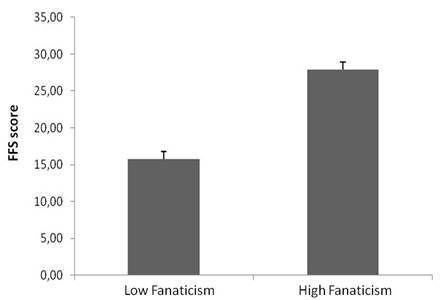
Note: Bars represent the standard deviation.
Valence Analysis
The ANOVA revealed a significant effect for the variable "Images," indicating that the categories (favorite team; rival team; positive, neutral, and negative IAPS images) differed from each other (F₄,₁₀₄ = 4.127; p < .001; η² = 0.746) regardless of the level of fanaticism. Additional planned comparisons indicated significant differences for the valence dimension between all image categories, except between the neutral IAPS images and rival team images (p = .08; d = .34). The values obtained in each comparison are specified in Table 1.
Table 1: Comparison of hedonic valence between the different image categories
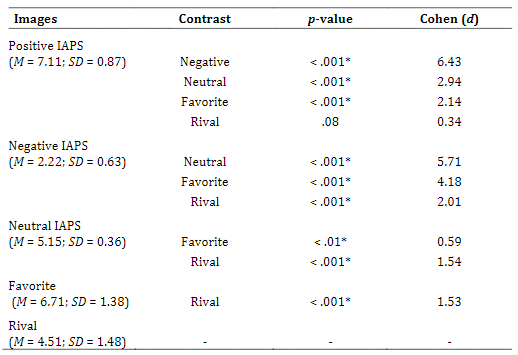
Note: The table presents the mean (M) and standard deviation (SD) of the different image categories, as well as the results of statistical comparisons (p) and effect sizes (d). *Identifies statistically significant differences.
The ANOVA did not show significant interactions between the level of fanaticism and the image categories (F₄,₁₀₄ = 0.315; p = .867; η² = 0.003), indicating that the valence attributed to the images did not vary according to the level of fanaticism. Additional planned analyses confirmed the absence of significant differences between the two groups (Table 2).
Table 2: Comparison of valences attributed to the different image categories

Note: The table presents the mean (M) and standard deviation (SD) of the different image categories, as well as the results of statistical comparisons (p) and effect sizes (d) in the comparisons between the low and high fanaticism groups.
Arousal Analysis
In the analysis of emotional arousal, the ANOVA revealed a significant effect for the variable "Images," showing that the different categories (favorite team; rival team; positive, neutral, and negative IAPS images) differed from each other (F₄,₁₀₄ = 27.12; p < .01; η² = 0.303) in terms of emotional arousal. Additional planned comparisons demonstrated that these differences occurred in most comparisons, except between the rival team images and neutral IAPS figures (p = .29; d = 1.84). The detailed results can be observed in Table 3.
Table 3: Comparison of the level of arousal attributed to the images among the different image categories
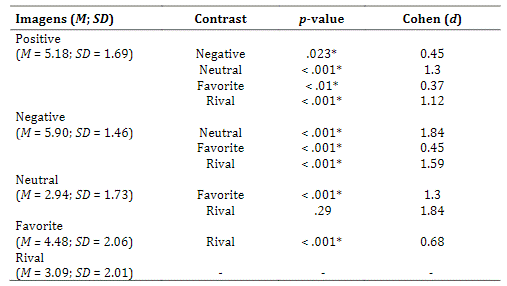
Note: The table presents the mean (M) and standard deviation (SD) of the different categories of images, as well as the results of statistical comparisons (p) and effect sizes (d). *Identifies statistically significant differences.
Although no interaction was found between the level of fanaticism and the emotional arousal attributed to the image categories (F4,104 = 1.92; p = .113; η2 = 0.021), planned contrast comparisons revealed distinct patterns in specific comparisons within and between high and low fanaticism groups. When analyzing the results obtained in within-group comparisons, isolating the Fanaticism factor, it was observed that both groups demonstrated that positive images do not differ from negative ones in terms of emotional arousal. This pattern was also observed between neutral images and those of the rival team. Additionally, in both groups, it was possible to identify that both positive and negative images elicited higher arousal when compared to neutral images.
However, important differences were also identified when analyzing response patterns within the groups. More specifically, it was observed that, only in the high fanaticism group, the emotional arousal triggered by the favorite team was comparable to that of positive and negative figures from the IAPS, as well as the arousal elicited by rival team images (Table 4).
Table 4: Comparison of arousal levels for different image categories between Low and High Fanaticism Groups

Note: The table presents the mean (M) and standard deviation (SD) of the different image categories, as well as the results of statistical comparisons (p) and effect sizes (d), isolating the high and low fanaticism groups. *Identifies statistically significant differences.
The planned analyses also revealed the existence of significant differences between the groups in terms of emotional arousal levels. More specifically, the high fanaticism group showed higher arousal levels in response to neutral images (p < .01; d = 0.914) compared to the low fanaticism group. Higher emotional arousal values were also found in the high fanaticism group in response to both rival (p < .01; d = 0.83) and favorite team images (p < .01; d = 1.49). Other between-group comparisons did not show statistical significance. Finally, the scatter plot analysis using linear regression showed a pattern consistent with the motivational vector theory (Figure 3). This theory suggests that images related to the favorite team follow a dispersion pattern similar to that of highly appetitive stimuli, while rival team images resemble the pattern of negative images. The boomerang pattern was identified through a visual inspection of the scatter plot, which was established based on the valence and arousal of the IAPS images.
Figure 3: Scatter plot of valence as a function of arousal for different image categories
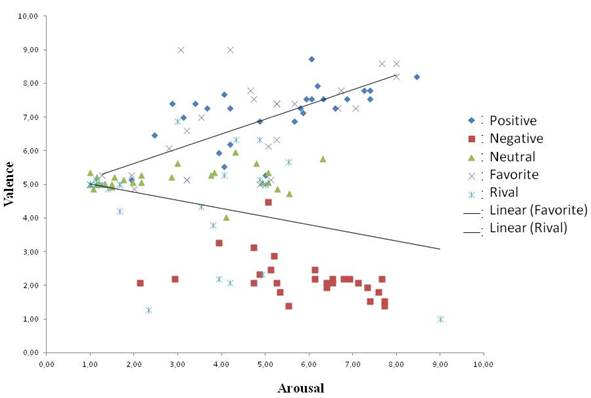
Note: Trend lines represent the linear regression for the data attributed to the favorite team (above) and rival team (below), regardless of the level of fanaticism.
Discussion
Emotions play a fundamental role in understanding sports phenomena and their impacts on society. Emotional processes not only influence athletes and teams but also have a considerable effect on fans and enthusiasts (Furley et al., 2023). The competition context seems to facilitate the cathartic expression of intense and collective emotions, which are obviously modulated by the symbolic representation of victory, defeat, identification with the favorite team, and aversion to the rival team. Therefore, understanding the psychological variables related to psychosocial phenomena such as fanaticism, mass mobilization, and herd behavior at major sporting events becomes an important challenge for the human and social sciences.
Given the various emotional conditions elicited when cheering for a team, the valence attributed by fans (positive or negative) seems to be linked to harmonious or obsessive involvement with their team (Schellenberg et al., 2024). These aspects can help in understanding emotional behavior, both celebratory and hostile, among fans (Furley et al., 2023; Schellenberg et al., 2024).
Some studies propose that valence classification in the SAM may reflect the activation of basic motivational systems, whether for reward or aversion (Bradley et al., 2001; Versace et al., 2023). This model is based on the understanding that emotional behavior involves these two basic motivational subsystems (Bradley et al., 2001; Lemos et al., 2014). In the present study, the measures obtained for affective valence in the reference figures from IAPS showed a pattern consistent with the literature (Bradley et al., 2001; Branco et al., 2023), with positive images rated as pleasant, neutral ones, and negative ones as unpleasant, with significant differences between these categories. The IAPS figures served as essential references for better contextualizing the values assigned to the experimental images of the favorite and rival teams. It was found that images of the favorite team stood out for presenting a high level of pleasantness, while images of the rival team were rated as unpleasant.
Study models from the dimensional perspective of emotions consider that measures of emotional arousal complement affective valence indicators by representing the level of motivational activation (Bradley et al., 2001; Branco et al., 2023). Considering these two emotional dimensions, valence and arousal, it would be possible to graphically represent motivational vectors on a Cartesian plane, varying in intensity (Lemos et al., 2024; Versace et al., 2023). The results reported here showed the expected pattern for the standardized IAPS images, with high levels of emotional arousal for positive and negative figures compared to neutral ones (Bradley et al., 2001; Branco et al., 2023; Lemos et al., 2024; Versace et al., 2023). The negative IAPS images were emotionally even more arousing than the positive ones. Regarding the experimental images, without considering the level of fanaticism, it was observed that the images of the favorite team elicited less arousal than the positive and negative IAPS images but more arousal than neutral and rival team images. Meanwhile, the rival team images showed a pattern of arousal similar to neutral images, being less exciting than all other categories.
However, when considering the influences of fanaticism levels, distinct patterns of emotional arousal were identified between the two groups. More specifically, the fact that the high fanaticism group showed higher levels of emotional arousal in response to neutral and experimental images, whether of the rival or favorite team, may be interpreted as evidence that this group may be more prone to emotional arousal and/or have a lower capacity for emotional regulation.
Many studies have indicated that visual stimuli with emotional or affective components can trigger significant increases in brain activity in visual, emotional, and motor circuits (Bradley et al., 2001; Carretié et al., 2022; Lin et al., 2020; Onigata & Bunno, 2020; Pereira et al., 2010; Zsidó, 2024). In line with this reasoning, the results obtained prompt reflection on the possibility that these primitive appetitive and aversive circuits may mediate fans' interactions with stimuli representing the favorite and rival teams, respectively. After all, the boomerang pattern can be observed in the scatter analysis, where it is possible to verify that the trend line established by linear regression for the arousal and valence values for the favorite team is positioned in the upper part of the graph, in the same direction as the motivational vectors for the appetitive system. Meanwhile, the linear regression line observed for the rival team images outlined a motivational vector consistent with parameters observed for the aversive motivational system. It is important to emphasize that the boomerang pattern becomes even more defined for fans with higher levels of fanaticism, due to the higher levels attributed to emotional arousal for the images of both the favorite and rival teams.
The results obtained from the analyses of fanaticism levels, along with indicators of emotional reactions to images of favorite and rival teams, reinforce the understanding that more fanatical individuals are more prone to emotional arousal. In attempting to understand the practical implications of this study, it is worth considering complementary evidence showing that increased activity in emotional circuits competes for processing resources with neural networks responsible for cognition and so-called rational behaviors (Dolcos & McCarthy, 2006). This condition may trigger emotional contagion and herd behavior, both of which are prevalent phenomena in competitive sports contexts (Neuman, 2024).
Additionally, we must consider that images of favorite and rival teams activate limbic regions, phylogenetically ancient areas known to modulate affective and motivational behavior, and that fanaticism is positively correlated with the activation of these circuits (Duarte et al., 2017). Although some evidence has suggested that interaction with visual stimuli representing favorite and rival teams recruits the appetitive and aversive motivational systems respectively (Conde et al., 2011; Conde et al., 2018; Oliveira et al., 2021), this understanding is not yet universally accepted (Proctor, 2013; Yamaguchi & Chen, 2019). In this regard, the characterization of motivational vectors for favorite and rival team images in the present study serves as further evidence indicating the involvement of appetitive and aversive systems when processing affective stimuli related to football teams.
While this investigation offers relevant contributions, it is important to carefully analyze the results presented here, considering some limitations of the study. The first and main limitation to highlight is that the sample was composed by convenience, resulting in a predominance of women in both groups. Although the use of the median to form high and low fanaticism groups has some support in the literature (Conde et al., 2018; Coriolano & Conde, 2017), this procedure made it difficult to distribute genders equally in each group, leading to an even more pronounced imbalance in the low-fanaticism group. Although the ideal sample design was not implemented, this condition does not compromise the results presented here, since the research objectives were focused on comparing different fanaticism profiles rather than gender comparisons. Additionally, Zeferino et al. (2021) did not identify gender differences in terms of fanaticism and aggression in a study that evaluated 210 fans using the FFS and the Aggression Scale (Buss & Perry, 1992). Nevertheless, it is important to recognize that further studies are needed to better understand gender differences regarding the constructs measured here, especially in terms of hedonic valence attribution and emotional arousal in response to soccer images of favorite and rival teams. Finally, this study also did not investigate potential moderating effects arising from other sociodemographic variables, such as affiliation with organized fan groups and age, which also appear to significantly influence fan behavior (Zeferino et al., 2021).
Conclusions
The crowd has been considered an important variable in supporting football culture and economy. Groups known as "organized supporters" were historically established in Brazil by fans with the aim of creating and developing bonds, celebrating, as well as strengthening feelings of rivalry and opposition. However, some of these fans are identified in the literature as more likely to be involved in violent incidents in Brazilian soccer (Louis, 2023; Ribeiro & Fernandes, 2021). In this context, it is highlighted that the impacts of soccer fanaticism have socioeconomic implications, affect urban mobility, and cause impacts on public safety and psychosocial processes. Furthermore, according to Brandão et al. (2020), violence in stadiums is established as a complex and multivariate phenomenon.
The research results provide a pioneering understanding of fanaticism and its emotional implications, with the main findings characterized by the identification of significant differences in emotional arousal levels between highly and less fanatic supporters. For the first time, it was observed how images of football teams with antagonistic affective valence are perceived by their fans and rivals, particularly regarding pleasantness (valence dimension) and emotional arousal. Additionally, motivational patterns were identified that stimulate the engagement of appetitive and aversive motivational systems, as a result of the mere observation of images representing the favorite team and the main rival, respectively. This verification supports a better understanding of why competitions mobilize thousands of people and move large amounts of money (Oliveira et al., 2021). Moreover, considering the involvement of the aversive emotional system in response to the representation of the rival team seems a plausible possibility for understanding hostility and rivalry between favorite teams and their rivals.
Given the aforementioned facts, the present study suggests that security approaches in football games should also consider the psychosocial processes and the singularities of emotional expression by fans in the relationship they establish with their team and their main rivals. In this sense, there is a demand for new planning models and the implementation of public policies to ensure the safety of fans in stadiums and pedestrians in the vicinity of the matches, considering that the most commonly adopted measures have been restricted to intelligence operations combined with visible policing as prevention during the games (Barbosa & Bueno, 2023; Rodrigues & Santos, 2024). The use of police force has also been observed in conflict situations between fans. Although there are no validated intervention models with proven effectiveness in aggressive fan behavior, Neuman's (2024) work offers reflections and innovative ideas that inspire alternative behavioral approaches to understand and deal with crowd dynamics. This alternative approach to policing might allow for more effective strategies for preventing and managing violent behaviors. It is cautiously envisioned that through psychoeducational campaigns, it may be possible to raise awareness among fans about how fanaticism manifests in their lives, addressing its emotional, behavioral implications, and its impact on social interactions, as well as helping them develop more functional emotional reactions and non-violent behaviors in sports environments, as proposed by some works (Galily et al., 2024; Neuman, 2024; Newson et al., 2023). It would also be important to consider more humanized approaches, such as psychological assessment and care for those involved in violent episodes, since simple visual stimuli, whether neutral images or especially images of the rival team, appear capable of triggering higher emotional arousal in more fanatic supporters. This proposition is based on the fact that violence among fans does not only occur inside stadiums but also in public squares, subways, busy streets, and many other public spaces. Being a multifaceted topic, new research, from a multidisciplinary perspective, may help to understand and complement the current knowledge of soccer fanaticism and its psychosocial implications. The results of the present study contribute to broadening the understanding of how fanaticism can influence the way emotional stimuli from the football context are perceived, representing the favorite-rival affective polarity inherent in sporting clashes.
References:
Bandeira, V. F., & Ramos, D. G. (2020). Aspectos sociodemográficos relacionados à agressividade e ao fanatismo em uma torcida de futebol. Psicologia Revista, 29(1), 246-272. https://doi.org/10.23925/2594-3871.2020v29i1p246-272
Barbosa, D. S., & Bueno, V. L. A. (2023). Inteligência da Polícia Militar do Paraná como ferramenta na diminuição de confrontos violentos entre torcidas organizadas de futebol em estádios paranaenses. Brazilian Journal of Development, 9(1), 4973-4988. https://doi.org/10.34117/bjdv9n1-341
Battaly, H. (2023). Can fanaticism be a liberatory virtue? Synthese, 201(6), 1-27. https://doi.org/10.1007/s11229-023-04174-7
Bradley, M., & Lang, P. (1994). Measuring emotion: The self-assessment manikin and the semantic differential. Journal of Behavioral Therapy and Experimental Psychiatry, 25, 49-59. https://doi.org/10.1016/0005-7916(94)90063-9
Bradley, M., Codispoti, Cuthbert B., & Lang(2001). Emotion and motivation I: defensive and appetitive reactions in picture processing. Emotion, 1, 276-298. https://doi.org/10.1037//1528-3542.1.3.276
Branco, D., Goncalves, O. F., & Badia, S. B. I. (2023). A systematic review of international affective picture system (IAPS) around the world. Sensors, 23(8), 3866. https://doi.org/10.3390/s23083866
Brandão, T., Murad, M., Belmot, R., & Dos Santos, R. (2020). Álcool e violência: Torcidas organizadas de futebol no brasil. Movimento, 26, e26001. https://doi.org/10.22456/1982-8918.90431
Buss, A. H., & Perry, M. (1992). The aggression questionnaire. Journal of Personality and Social Psychology, 63(3), 452-459. https://doi.org/10.1037/0022-3514.63.3.452
Bynion, T. M., & Feldner, M. T. (2020). Self-assessment manikin. Encyclopedia of Personality and Individual Differences, 4654-4656. https://doi.org/10.1007/978-3-319-24612-3_77
Carretié, L., Fernández-Folgueiras, U., Álvarez, F., Cipriani, G. A., Tapia, M., & Kessel, D. (2022). Fast unconscious processing of emotional stimuli in early stages of the visual cortex. Cerebral Cortex, 32(19), 4331-4344. https://doi.org/10.1093/cercor/bhab486
Cassam, Q. (2023). Fanaticism: for and against. In L. Townsend, R. Tietjen, H. Schmid, & M. Staudigl (Eds.), The Philosophy of Fanaticism. Epistemic, Affective, and Political Dimensions (pp. 19-38). Routledge. https://doi.org/10.4324/9781003119371
Castro, C. O. (2014). Morte organizada: os bárbaros. O Globo.
Conde, E. F. Q., Cavallet, M., Torro-Alves, N., Matsushima, E. H., Fraga-Filho, R. S., Jazenko, F., Busatto, G. & Gawryszewski, L. G. (2014). Effects of affective valence on a mixed spatial correspondence task: A reply to Proctor (2013). Psychology & Neuroscience, 7(2), 83. https://doi.org/10.3922/j.psns.2014.021
Conde, E. F. Q., & Coriolano, A. M. (2019). O fanatismo no contexto do esporte. In K. Rubio & J. Camilo (Orgs.), Psicologia social do esporte (pp. 169-182). Képos.
Conde, E. F. Q., Jazenko, F., Fraga Filho, R. S., Costa, D. H. D., Torro-Alves, N., Cavallet, M., & Gawryszewski, L. G. (2011). Stimulus affective valence reverses spatial compatibility effect. Psychology & Neuroscience, 4, 81-87. https://doi.org/10.3922/j.psns.2011.1.010
Conde, E. F. Q., Lucena, A. O. D. S., da Silva, R. M., Filgueiras, A., Lameira, A. P., Torro-Alves, N., Gawryszewski, L. G., & Machado-Pinheiro, W. (2018). Hemispheric specialization for processing soccer related pictures: The role of supporter fanaticism. Psychology & Neuroscience, 11(4), 329. https://doi.org/10.1037/pne0000147
Coriolano, A. M., & Conde, E. F. Q. (2017). Fanatismo e agressividade em torcedores de futebol. Revista Brasileira de Psicologia do Esporte, 6(2). https://doi.org/10.31501/rbpe.v6i2.7092
Dolcos, F., & Mccarthy, G. (2006). Brain Systems Mediating Cognitive Interference by Emotional Distraction. The Journal of Neuroscience, 26(7), 2072-2079. https://doi.org/10.1523/jneurosci.5042-05.2006
Duarte, I. C., Afonso, S., Jorge, H., Cayolla, R., Ferreira, C., & Castelo-Branco, M. (2017). Tribal love: the neural correlates of passionate engagement in football fans. Social Cognitive and Affective Neuroscience, 12(5), 718-728. https://doi.org/10.1093/scan/nsx003
Furley, P., Laborde, S., Robazza, C., & Lane, A. (2023). Emotions in sport. In J. Schüler, M. Wegner, H. Plessner, & R. Eklund (Eds.), Sport and exercise psychology: theory and application (pp. 247-279). Springer International Publishing.
Galily, Y., Pack, S., & Tamir, I. (2024). Spectator sport and fan behavior: a sequel. Frontiers in Psychology, 15, 1414407. https://doi.org/10.3389/fpsyg.2024.1414407
Katsafanas, P. (2024). What’s so bad about fanaticism? Synthese, 203(6), 205. https://doi.org/10.1007/s11229-024-04647-3
Kelly, K. J., Murray, E., Barrios, V., Gorman, J., Ganis, G., & Keenan, J. P. (2009). The effect of deception on motor cortex excitability. Social Neuroscience, 4(6), 570-574. https://doi.org/10.1080/17470910802424445
Lang, B., Bradley, M., & Cuthbert, B. (2005). International affective picture system (IAPS): Digitized photographs, instruction manual and affective ratings (Technical report N0 A-6). University of Florida, Center for Research in Psychophysiology.
Lasaitis, C., Ribeiro, R. L., & Bueno, O. F. A. (2008). Brazilian norms for the International Affective Picture System (IAPS): comparison of the affective ratings for new stimuli between Brazilian and North-American subjects. Jornal Brasileiro de Psiquiatria, 57, 270-275. https://doi.org/10.1590/s0047-20852008000400008
Lemos, T. C., Silva, L. A., Gaspar, S. D., Coutinho, G. M., Stariolo, J. B., Oliveira, P. G., Conceição, L., Volchan, E., & David, I. A. (2024). Adaptation of the normative rating procedure for the International Affective Picture System to a remote format. Psicologia: Reflexão e Crítica, 37(1), 41. https://doi.org/10.1186/s41155-024-00326-x
Lin, H., Müller-Bardorff, M., Gathmann, B., Brieke, J., Mothes-Lasch, M., Bruchmann, M., Miltner, W. H. R. & Straube, T. (2020). Stimulus arousal drives amygdalar responses to emotional expressions across sensory modalities. Scientific Reports, 10(1). https://doi.org/10.1038/s41598-020-58839-1
Louis, S. (2023). Football fandom in France and Italy. In B. Buarque de Hollanda & T. Busset (Eds.), Football Fandom in Europe and Latin America: Culture, Politics, and Violence in the 21st Century (pp. 59-80). Springer International Publishing.
Mulckhuyse, M. (2018). The influence of emotional stimuli on the oculomotor system: A review of the literature. Cognitive, Affective, & Behavioral Neuroscience, 18, 411-425. https://doi.org/10.3758/s13415-018-0590-8
Murad, M. (2017). A violência no futebol: novas pesquisas, novas ideias, novas propostas (Rev. ampliada). Selo Benvirá.
Neuman, Y. (2024). Betting Against the Crowd. Springer.
Newson, M., White, F., & Whitehouse, H. (2023). Does loving a group mean hating its rivals? Exploring the relationship between ingroup cohesion and outgroup hostility among soccer fans. International Journal of Sport and Exercise Psychology, 21(4), 706-724. https://doi.org/10.1080/1612197x.2022.2084140
Oliveira, L. F. D., Antunes, F. C. C. S., Jazenko, F., Conde, E. F. Q., Fraga-Filho, R. S., & Gawryszewski, L. (2021). Interaction between affective and spatial polarities: soccer preferences and stimulus-response compatibility. Psicologia em Pesquisa, 15(3), 1-17.
Onigata, C., & Bunno, Y. (2020). Unpleasant visual stimuli increase the excitability of spinal motor neurons. Somatosensory & Motor Research, 37(2), 59-62. https://doi.org/10.1080/08990220.2020.1724087
Park, H. J., Kim, J., Kim, S., Moon, D., Know, M. H., & Kim, W. (2009). Neural correlates of winning and losing while watching soccer matches. International Journal of Neuroscience, 119(1), 76-87. https://doi.org/10.1080/00207450802480069
Pereira, M., Oliveira, L., Erthal, F., Jofilly, M., Mocaiber, I., Volchan, E., & Pessoa, L. (2010). Emotion affects action: Midcingulate cortex as a pivotal node of interaction between negative emotion and motor signals. Cognitive And Affective Behavioral Neuroscience, 1(10), 94-106. https://doi.org/10.3758/CABN.10.1.94
Polo, E. M., Farabbi, A., Mollura, M., Mainardi, L., & Barbieri, R. (2024). Understanding the role of emotion in decision making process: using machine learning to analyze physiological responses to visual, auditory, and combined stimulation. Frontiers in Human Neuroscience, 17, 1286621. https://doi.org/10.3389/fnhum.2023.1286621
Proctor, R. W. (2013). Stimulus affect valence may influence mapping-rule selection but does not reverse the spatial compatibility effect: Reinterpretation of Conde et al. (2011). Psychology & Neuroscience, 6, 3-6. https://doi.org/10.3922/j.psns.2013.1.02
Ribeiro, M. J., & Fernandes, P. H. C. (2021). A violência no futebol brasileiro: da emoção no gol ao luto pelas vítimas. Revista GeoPantanal, 16(30), 245-257.
Rodrigues, J., & Dos Santos, C. P. (2024). Uma revisão de literatura acerca da inteligência da polícia militar no âmbito da violência das torcidas organizadas no futebol profissional. Revista Científica Multidisciplinar, 5(2), e514857. https://doi.org/10.47820/recima21.v5i2.4857
Schellenberg, B. J., Verner-Filion, J., & Gaudreau, P. (2024). How do passionate sport fans feel? An examination using a quadripartite approach. Motivation and Emotion, 48(5), 684-699. https://doi.org/10.1007/s11031-024-10087-w
Tietjen, R. R. (2023a). On the social constitution of fanatical feelings. In L. Townsend, R. Tietjen, H. Schmid, & M. Staudigl (Eds.), The Philosophy of Fanaticism Epistemic, Affective, and Political Dimensions (pp. 111-129). Routledge.
Tietjen, R. R. (2023b). Fear, fanaticism, and fragile identities. The Journal of Ethics, 27(2), 211-230. https://doi.org/10.1007/s10892-023-09418-9
Versace, F., Sambuco, N., Deweese, M. M., & Cinciripini, P. M. (2023). Electrophysiological normative responses to emotional, neutral, and cigarette-related images. Psychophysiology, 60(3), e14196. https://doi.org/10.1111/psyp.14196
Wachelke, J., Andrade, A., Tavares, L., & Neves, J. (2008). Mensuração da identificação com times de futebol: evidências de validade fatorial e consistência interna de duas escalas. Arquivos Brasileiros de Psicologia, 60(1), 96-111.
Wann, D., & James, J. (2018). Sport fans: The psychology and social impact of fandom. Routledge.
Yamaguchi, M., & Chen, J. (2019). Affective influences without approach-avoidance actions: On the congruence between valence and stimulus-response mappings. Psychonomic Bulletin & Review, 26, 545-551. https://doi.org/10.3758/s13423-018-1547-1
Zeferino, G. G., Silva, M. A., & Alvarenga, M. A. S. (2021). Associations between sociodemographic and behavioural variables, fanaticism and aggressiveness of soccer fans. Ciencias Psicológicas, 15(2), e-2390. https://doi.org/10.22235/cp.v15i2.2390
Zsidó, A. N. (2024). The effect of emotional arousal on visual attentional performance: A systematic review. Psychological Research, 88(1), 1-24. https://doi.org/10.1007/s00426-023-01852-6
Data availability: The dataset supporting the results of this study is not available.
How to cite: Kort-Kamp, M. L. I., Rocha Porto, T., Silveira de Oliveira, R., & Conde, E. F. (2024). Emotional effects elicited by football images: A study on fanaticism. Ciencias Psicológicas, 18(2), e-3849. https://doi.org/10.22235/cp.v18i2.3849
Authors’ contribution (CRediT Taxonomy): 1. Conceptualization; 2. Data curation; 3. Formal Analysis; 4. Funding acquisition; 5. Investigation; 6. Methodology; 7. Project administration; 8. Resources; 9. Software; 10. Supervision; 11. Validation; 12. Visualization; 13. Writing: original draft; 14. Writing: review & editing.
M. L. I. K. K. has contributed in 2, 3, 5, 6, 13; T. R. P. in 3, 13, 14; R. S. O. in 1, 2, 3, 5, 6, 9; E. F. C. in 1, 4, 5, 6, 7, 8, 10, 11, 12, 13, 14.
Scientific editor in-charge: Dra. Cecilia Cracco.
Ciencias Psicológicas; v18(2)
Julio-Diciembre 2024
DOI: 10.22235/cp.v18i2.3849