10.22235/cp.v17i1.2583
A coparentalidade como mediadora entre a desregulação emocional de mães
e a percepção da regulação emocional de seus filhos adolescentes
Coparenting as a mediator between mothers’ emotion dysregulation and the perception of adolescents’ emotion regulation
La coparentalidad como mediadora entre la desregulación emocional
de las madres y la percepción de la regulación emocional de sus hijos adolescentes
Luiza Dalla Corte Euzebio1, ORCID 0000-0003-0440-7177
Clarisse Pereira Mosmann2, ORCID 0000-0002-9275-1105
1 Universidade do Vale do Rio dos Sinos, Brasil, [email protected]
2 Universidade do Vale do Rio dos Sinos, Brasil
Resumo:
Pesquisas na área do desenvolvimento da regulação emocional sobre a infância e adolescência sugerem que a etiologia do fenômeno é multifatorial e que é necessário investigar aspectos contextuais relacionados. A coparentalidade é uma variável contextual que vem sendo associada a desfechos nos filhos, podendo ter relação com a regulação emocional. O objetivo desse estudo foi testar um modelo estrutural de relação direta e indireta entre desregulação emocional de mães e a percepção da regulação emocional de seus filhos adolescentes, avaliando o papel mediador da coparentalidade. Trata-se de um estudo quantitativo, transversal e explicativo realizado com 210 mães de adolescentes (M = 15,59, DP = 1,39 anos). Para isso foram utilizados o questionário sociodemográfico, o Difficulties in Emotion Regulation Scale (DERS), o Emotion Regulation Checklist (ERC) e o Coparenting Inventory for Parents and Adolescents (CI-PA) com aplicação online. Foram realizadas análises descritivas, análise correlacional e modelagem de equações estruturais. O modelo interacional aponta para o efeito mediador parcial da coparentalidade nessa relação, bem como efeito indireto da desregulação das mães para a regulação emocional dos adolescentes. Os resultados ainda apontaram que a desregulação emocional das mães parece ter um impacto prejudicial na cooperação coparental. Esses resultados indicam importantes fatores a serem considerados no âmbito clínico nas intervenções com adolescentes e suas famílias.
Palavras-chave: regulação emocional; desregulação emocional; coparentalidade; adolescentes; mães.
Abstract:
Research on the development of emotion regulation in childhood and adolescence suggests that the etiology of the phenomenon is multifactorial and that it is necessary to investigate the broader contextual aspects. Coparenting is a contextual variable that has been associated with outcomes in children and may be related to emotional regulation. The aim of this study was to test a structural model of direct and indirect relationship between mothers' emotional dysregulation and the perception of their adolescent children’s emotional regulation, evaluating the mediating role of coparenting. This is a quantitative, cross-sectional and explanatory study conducted with 210 mothers of adolescents (M = 15.59, SD = 1.39 years old). The sociodemographic questionnaire, the Difficulties in Emotion Regulation Scale (DERS), the Emotion Regulation Checklist (ERC) and the Coparenting Inventory for Parents and Adolescents (CI-PA) were administered online. Descriptive analyses, correlational analysis and structural modeling equations were conducted. The interactional model points to the partial mediating effect of coparenting in this relationship, as well as the indirect effect of the mothers' emotion dysregulation on the emotional regulation of the adolescents. The results also pointed out that the mothers' emotional dysregulation seems to have a detrimental impact on coparental cooperation. These results are important factors to be considered in the clinical context when working with adolescence and their families.
Keywords: emotional regulation; emotional dysregulation; coparenting; adolescents; mothers.
Resumen:
La investigación sobre el desarrollo de la regulación emocional en la infancia y la adolescencia sugiere que la etiología del fenómeno es multifactorial y que es necesario investigar aspectos contextuales relacionados. La crianza conjunta es una variable contextual que se ha asociado con los resultados en los niños y puede estar relacionada con la regulación emocional. El objetivo de este estudio fue probar un modelo estructural de relación directa e indirecta entre la desregulación emocional de las madres y la percepción de la regulación emocional de sus hijos adolescentes, evaluando el papel mediador de la coparentalidad. Se trata de un estudio cuantitativo, transversal y explicativo realizado con 210 madres de adolescentes (M = 15.59, DE = 1.39 años). Para ello se utilizó un cuestionario sociodemográfico, la Escala de Dificultades en la Regulación Emocional (DERS), la Lista de Verificación de Regulación Emocional (ERC) y el Inventario Coparental de Padres y Adolescentes (CI-PA) con aplicación en línea. Se realizaron análisis descriptivos, análisis correlacionales y modelado de ecuaciones estructurales. El modelo interaccional apunta al efecto mediador parcial de la coparentalidad en esta relación, así como el efecto indirecto de la desregulación de las madres para la regulación emocional de los adolescentes. Los resultados también señalaron que la desregulación emocional de las madres parece tener un impacto perjudicial en la cooperación coparental. Estos resultados indican factores importantes a considerar a nivel clínico en intervenciones con adolescentes y sus familias.
Palabras clave: regulación emocional; desregulación emocional; coparentalidad; adolescentes; madres.
Recebido: 26/5/2021
Aceito: 4/5/2023
Regulação emocional significa ter estratégias para manter, aumentar ou diminuir um ou mais componentes da resposta emocional. É um processo de modulação, ocorrência, duração e intensidade de estados internos (positivos e negativos) e processos fisiológicos relacionados à emoção (Morris et al., 2017). A habilidade de regular emoções implica em influenciar a experiência emocional, de acordo com a situação, tempo e valência emocional (McRae & Gross, 2020) para atingir os estados afetivos desejados e atingir resultados adaptativos para lidar com as situações cotidianas.
Por outro lado, a dificuldade de regulação emocional (déficits na regulação emocional ou desregulação emocional) ocorre através de um processo dinâmico (D’Agostino et al., 2017) de interação entre dificuldade na consciência, compreensão ou modulação da emoção (Bjureberg et al., 2016) e histórico de aprendizado de estratégias disfuncionais para gerenciar as emoções (Bariola et al., 2011) ao longo do desenvolvimento (D’Agostino et al., 2017). Neste sentido, dificuldades de regulação emocional estão relacionadas a manifestações de sintomas internalizantes e externalizantes (Machado & Mosmann, 2019), diversos transtornos mentais (D’Agostino et al., 2017) e transtornos de personalidade (D’Agostino et al., 2017).
Por tratar-se de uma variável relacional, pesquisas na área do desenvolvimento da regulação emocional desde a infância e adolescência sugerem que a etiologia do fenômeno é multifatorial. O principal foco de pesquisas está relacionado com a regulação das próprias emoções (regulação intrínseca), mas há um aumento de interesse de pesquisas com a regulação de outras pessoas e do contexto em que as pessoas se situam (regulação extrínseca) (McRae & Gross, 2020).
O contexto, como regulação extrínseca, ganhou forte apoio empírico como contribuidor para o desenvolvimento da regulação emocional (Li et al., 2019). Estudos sobre fatores sociais sugeriram que interações com mães (Perry et al., 2020), pais (Li et al., 2019), professores (Pallini et al., 2019) e pares (Cui et al., 2020) estavam conectadas com o desenvolvimento da regulação emocional dos filhos.
Embora a regulação emocional de ambos os pais seja crucial no desenvolvimento das emoções dos filhos, muitas pesquisas têm focado suas atenções para o papel da mãe e a sua repercussão nos adolescentes (Cheung et al., 2020; Crandall et al., 2016; Lewis et al., 2020). Existe uma vasta literatura conectando dificuldade de regulação emocional das mães com desfechos sintomáticos nos filhos, tais como sintomas internalizantes nos filhos adolescentes (Cheung et al., 2020), dissociação nos filhos (Lewis et al., 2020) e dificuldade de regulação emocional (Cheung et al., 2020). Assim, mães com dificuldade de regulação emocional desempenham um impacto importante na regulação emocional de seus filhos adolescentes. Um estudo longitudinal (Cheung et al., 2020) que investigou a dificuldade de regulação emocional de 386 famílias de Hong Kong incluindo mães, pais e adolescentes em dois tempos (durante 12 meses) verificou que apenas as dificuldades de regulação emocional das mães foi preditora de dificuldades de regulação emocional nos filhos e até nos pais longitudinalmente, enquanto que a dificuldade de regulação emocional dos pais não teve influência nas emoções das mães ou dos filhos nesse estudo.
Já é consenso na literatura que os filhos tendem a imitar ou internalizar as formas
de dificuldade de regulação emocional de suas mães via modelagem ou mecanismos de aprendizagem social (Bariola et al., 2011) ao longo do desenvolvimento. Porém, ao analisarmos os estudos sobre desenvolvimento da regulação emocional, encontramos outros aspectos contribuintes da regulação ou dificuldade de regulação emocional dos filhos, como socialização parental (Szkody et al., 2020), clima familiar (Morris et al., 2017; Morris et al., 2007), conjugalidade (Morris et al., 2007) e suporte parental (Karaer & Akdemir, 2019).
Ainda que os estudos em regulação emocional dos filhos e relações familiares tenham avançado nos últimos anos, autores da área sugerem que pesquisadores explorem interrelações entre os sistemas e subsistemas familiares (Gallegos et al., 2017; Thomassin et al., 2017). Dessa forma, variáveis familiares e relacionais precisam ser investigadas como fatores mediadores entre a dificuldade de regulação emocional das mães com o desenvolvimento da regulação emocional dos filhos adolescentes. Um construto que se associa a aspectos relacionais como a parentalidade, clima familiar e conjugalidade é a coparentalidade (Mosmann & Wagner, 2008; Mosmann et al., 2018).
A coparentalidade é concebida teoricamente como o subsistema interveniente entre o relacionamento marital e as relações entre pais e filhos (Mosmann et al., 2017), pois a colaboração ou não entre o par parental pode influenciar na forma que interagem com os filhos, bem como nas exigências de suas tarefas parentais. Uma revisão de escopo que versa sobre 20 anos de pesquisa sobre a coparentalidade indica que esse constructo está relacionado com a interação com que a dupla coparental coordena a parentalidade de cada um. Os principais achados dessa revisão indicam que as características de cada um da dupla coparental, o estado da relação (romântica), o contexto em que a família reside e as características do filho interferem na qualidade coparental. Em contrapartida a revisão também indica que coparentalidade positiva está relacionada com melhor relacionamento conjugal e desenvolvimento positivo dos filhos (Mosmann et al., 2017).
Um modelo teórico (Margolin et al., 2001) propõe que a coparentalidade possui três dimensões: a cooperação, o conflito e a triangulação. A dimensão cooperação (dimensão positiva) está relacionada com suporte, validação, respeito e entendimento de que o outro cuidador é emocionalmente capaz de exercer as funções parentais, a dimensão do conflito (dimensão negativa) se refere à quantidade, frequência e severidade dos desacordos ou discussões acerca da educação dos filhos, e a triangulação (dimensão negativa) está relacionada a uma distorção dos limites entre os subsistemas coparental e pai/mãe-filho, em que um dos cuidadores estabelece uma coalizão com o filho, excluindo ou enfraquecendo a outra figura parental.
Uma revisão sistemática de 2017 (Costa et al., 2017), com objetivo de analisar as características metodológicas, os objetivos e os resultados dos estudos empíricos sobre coparentalidade, investigou 29 estudos compreendidos no período de 2007 e 2016 nas línguas inglês, espanhol e português. Nesse estudo foi possível verificar que a literatura científica tem centrado esforços para identificar possíveis associações entre características do comportamento dos filhos e o exercício da coparentalidade e as repercussões no clima familiar. Isso indica que a coparentalidade pode funcionar como uma conexão entre a parentalidade e os desfechos para problemas emocionais e comportamentais dos filhos.
Muitos estudos sobre a coparentalidade associam esse fenômeno com desfechos nos filhos, como por exemplo, as dimensões negativas (conflito e triangulação) associadas a transtornos internalizantes e externalizantes (Mosmann et al., 2018), comportamentos de ansiedade social (Riina et al., 2020) e comportamentos antissociais leves (Koch et al., 2020). Enquanto que a cooperação, está relacionada com a competência social dos filhos (Barnett et al., 2011) e melhor autoestima (Macie & Stolberg, 2003).
Alguns estudos que avaliam a coparentalidade com a regulação emocional indicam a importância da associação. O primeiro (Machado & Mosmann, 2019) avaliou a regulação emocional de 229 filhos adolescentes brasileiros (11 a 18 anos) como mediadora entre as dimensões negativas da coparentalidade e sintomas internalizantes a partir da percepção dos adolescentes. Os resultados revelaram que a regulação emocional possui papel determinante para o desenvolvimento de sintomas internalizantes no contexto de dificuldades coparentais. Outro estudo (Thomassin et al., 2017), realizado nos Estados Unidos, buscou examinar o papel do afeto coparental nas dificuldades de regulação emocional dos filhos em 51 tríades mãe-pai-filhos (filhos com idades entre 7 e 12 anos), como também se essa associação mediava a ligação entre os sintomas depressivos dos pais e das crianças. As tríades foram gravadas conversando sobre situações de tristeza e alegria. Esse estudo verificou que a congruência de afeto positivo dos pais durante a discussão sobre a emoção tristeza previu desregulação emocional dos filhos, tanto pelo afeto negativo da criança, como reações punitivas dos pais. Outro estudo (Qian et al., 2020) que realizou um modelo de mediação com foco no funcionamento familiar e a satisfação conjugal para entender as relações entre coparentalidade e a regulação emocional dos filhos, indicou que a relação coparental está positivamente associada com a regulação emocional dos filhos. Entretanto, esses estudos não identificam as relações entre a regulação emocional das mães e o papel da coparentalidade como parte do desenvolvimento da regulação emocional nos filhos, portanto o caráter dessas conexões ainda não foi suficientemente esclarecido.
Nesse sentido, estudos apontam como limitação a necessidade de entender de que forma as variáveis individuais contribuem para a coparentalidade (Campbell, 2022; Mosmann et al., 2018). Ainda que existam algumas evidências da relação entre a coparentalidade e desfechos sintomáticos nos filhos, existe uma lacuna sobre o entendimento da dinâmica da dificuldade de regulação emocional das mães, as dimensões da coparentalidade (variável contextual) e regulação emocional dos filhos. É possível mensurar essa interação através de modelos interacionais como Modelagem de Equações Estruturais. Para tanto, esse estudo objetivou testar um modelo estrutural de relação direta e indireta entre desregulação emocional de mães e a percepção da regulação emocional de seus filhos, avaliando o papel mediador da coparentalidade (triangulação, conflito e cooperação).
Materiais e Métodos
Delineamento
Trata-se de um estudo quantitativo, transversal e explicativo (Creswell, 2010). As abordagens quantitativas visam apresentação numérica de dados almejando a descrição, a explicação e ou a predição de um fenômeno (Sabadini et al., 2009). O caráter explicativo visa aprofundar o conhecimento da realidade afim de explicar fatores que contribuem para a ocorrência de determinado fenômeno (Gil, 2010).
Amostra
Participaram desse estudo 210 mães de adolescentes, com idades entre 30 e 58 anos (M = 43,19 e DP = 6,93). Os critérios de inclusão foram ser mães de adolescentes com idades entre 14 e 18 anos (M = 15,59 e DP = 1,39) e estar em uma díade coparental, em que os cuidadores não precisavam ser necessariamente pais ou casados, mas duas pessoas exercendo os cuidados parentais. O número de participantes foi determinado de acordo com o cálculo da amostra proposto por Hair et al. (2010), em que 200 é o número mínimo de participantes para o cálculo de modelagem de equações estruturais.
Dentre as participantes, a maior concentração da amostra (28,1 %) assinalou que possui pós-graduação completa (n = 59), seguido de 23,3% (n = 49) ensino superior completo, 18,1 % (n = 38) possuem ensino médio completo, 13,3% (n = 28) ensino superior incompleto, 5,2 % (n = 11) ensino médio incompleto, 3,3% (n = 7) pós-graduação incompleta, 3,3 % (n = 7) ensino técnico, 3,3 % (n = 7) ensino fundamental incompleto e 1,9 % (n = 4) ensino fundamental completo. Quanto à renda das participantes, 51 % (n = 107) recebem de 1 a 4 salários-mínimos, 21,4% (n = 45) recebem de 4 a 6 salários-mínimos, 13,3 (n = 28) relataram não ter renda pessoal, 7,1 % (n = 15) recebem de 7 a 9 salários-mínimos, 5,2 % (n = 11) recebem de 10 a 15 salários-mínimos e 1,9 % (n = 4) da amostra recebem 16 ou mais salários-mínimos.
Dessa amostra, 17,1 % das participantes relataram ser diagnosticadas com transtorno psiquiátrico. Foram citados transtornos de ansiedade (Ansiedade, Transtorno Obsessivo Compulsivo e Síndrome do Pânico) e transtornos de humor (Transtorno Depressivo Maior e Transtorno de humor Bipolar). Sobre a pessoa que exerce a coparentalidade com a mãe a grande maioria (82,9 %) citou o pai ou companheiro (a) (n = 174) seguido de 12,9 % relatando os avós (n = 27), 1,9 % assinalaram filhos (n = 4), 1,9 marcaram outros parentes (n = 4) e 0,5 % apontaram os amigos (n = 1) como díade coparental.
Instrumentos
Questionário sociodemográfico. Construído para esse estudo, conta com 15 questões, buscando obter informações como: sexo, idade, escolaridade, número de filhos, idade dos filhos etc.
Dificuldade de regulação emocional de Mães. Difficulties in Emotion Regulation Scale (DERS) (Gratz & Roemer, 2004). A DERS é uma escala de autorrelato de 36 itens que mede dificuldades na regulação da emoção. O presente estudo utilizou a versão breve (Bjureberg et al., 2016) no qual o instrumento é composto por 16 itens em escala Likert de 5 pontos, (1: quase nunca se aplica a mim e 5: aplica-se quase sempre a mim). A escala avalia as dificuldades de regulação emocional através das dimensões: não aceitação das emoções negativas (3 itens), incapacidade de se envolver em comportamentos dirigidos por objetivos quando experiencia emoções negativas (3 itens), problemas em controlar comportamento impulsivo quando experiencia emoções negativas (3 itens), acesso limitado às estratégias de regulação emocional (5 itens) e falta de clareza emocional (2 itens). A DERS-16 já possui evidências de validade para o público adulto no Brasil (Miguel et al., 2017), apresentou bons índices de propriedades psicométricas sendo os valores de alfa de Cronbach > 0,080 e os índices de Análise Fatorial Confirmatória foram RMSEA 0,096, NNFI 0,96, CFI 0,97 e SRMR 0,054.
Regulação emocional dos adolescentes. A variável regulação emocional dos filhos adolescentes foi medida através da adaptação da Emotion Regulation Checklist- ERC (Shields & Cicchetti, 1995). A versão original busca averiguar regulação emocional de filhos crianças (disposta para crianças de 3 a 12 anos), a partir da percepção dos pais. É composto por 24 itens em escala tipo Likert de quatro pontos segundo a frequência do comportamento (1: nunca a 4: quase sempre). Os itens são distribuídos em duas escalas: Regulação Emocional (RE) e Labilidade/Negatividade Emocional (L/N). A adaptação brasileira (Reis et al., 2016) da escala original, que apresentou pressupostos para análise fatorial exploratória foram adequados e a solução bifatorial (RE e L/N) foi a indicada, explicando 57% da variância (L/N α = 0,77 e RE α = 0,73). Os scores de Labilidade/Negatividade devem ser invertidos para a correção.
Para esse estudo se propôs uma adaptação para adolescentes, em que foram realizadas etapas para análise da validade e confiabilidade do instrumento, compreendendo: I) adaptação da escala; II) Análise de conteúdo; III) Análise fatorial exploratória; e IV) Análise fatorial confirmatória. O índice CVCt (análise de conteúdo realizada por 3 juízes experts na área) da escala foi de 0,936921, considerado aceitável o nível de concordância entre juízes sobre o nível de clareza de linguagem e pertinência prática da escala. Para a análise fatorial exploratória, o Alfa de Cronbach da escala apresentou um índice 0,85. Os índices da análise fatorial confirmatória foram CMIN/DF 1,53, CFI 0,90, RMSEA 0,05 e SRMR 0,04.
Dimensões da coparentalidade. The Coparenting Inventory for Parents and Adolescents CI-PA. A versão para pais (Teubert & Pinquart, 2011) consiste em duas partes, e cada uma avalia três subescalas, a cooperação, o conflito e a triangulação. Na primeira parte, os cuidadores relatam sobre a coparentalidade no nível diádico (avaliação da díade), por exemplo, “Meu parceiro e eu concordamos em cumprir os desejos e demandas de nosso filho”. A segunda parte avalia a percepção do cuidador sobre a contribuição de seu parceiro para a coparentalidade (avaliação do outro cuidador), por exemplo, “Meu parceiro me informa sobre eventos importantes relacionados ao nosso filho”. Nesse estudo utilizou-se apenas a primeira parte, relatando a coparentalidade em nível diádico. Cada item do CI-PA é classificado numa escala Likert variando de 0 (completamente verdadeiro) até 4 (pouco verdadeiro). A versão brasileira (manuscrito em preparação), apresentou bons índices de propriedades psicométricas sendo os valores de alfa de Cronbach para Cooperação Coparental (α = 0,89), Conflito Coparental (α =0,76) e a Triangulação Coparental (α = 0,79). A análise fatorial confirmatória dessa escala apresentou os índices de RMSEA 0,6, SRMR 0,5 e CFI 0,96 para a parte que avalia a díade.
Procedimentos éticos e de coletas de dados
O estudo foi aprovado pelo Comitê de Ética da Universidade do Vale do Rio dos Sinos. As participantes foram selecionadas por critério de conveniência, com o método Snowball (Flick, 2009), através de redes sociais como, Facebook, WhatsApp e Instagram. A aplicação foi realizada de forma online, através do Google Forms. Todas ases participantes marcaram SIM, concordando com a participação no estudo, no Termo de Consentimento Livre e Esclarecido do questionário online. Foi assegurada a confidencialidade e autonomia no caso de não querer mais fazer parte da pesquisa.
Análise de dados
Os dados coletados foram inseridos no software Statistical Package for Social Sciences 22.0 (IBM SPSS) e o nível de significância adotado foi de p ≤ 0,05. Foram realizadas análises descritivas a fim de conhecer o comportamento das variáveis do estudo e análise de correlação através do Coeficiente de Spearman, para verificar a existência de correlação entre as variáveis sociodemográficas, as dimensões da coparentalidade e a desregulação emocional de mães e a regulação emocional dos filhos adolescentes.
Para testagem do modelo de interação proposto, os dados foram inseridos no software Statistical Package for Social Sciences Analysis of Moment Structures 2.0 (IBM SPSS AMOS). Foi realizada modelagem de equações estruturais para analisar as relações explicativas e o valor preditivo da desregulação emocional de mães e o papel mediador das dimensões da coparentalidade de forma simultânea, analisando as relações diretas e indiretas com a regulação emocional dos filhos adolescentes, com estimação através do método Maximum Likelihood. Para a avaliação de ajuste de modelo os seguintes índices foram utilizados: medidas absolutas (qui-quadrado/graus de liberdade (χ²/gl), Root Mean Square Error of Approximation (RMSEA)) e medida de ajuste incremental (Comparative Fit Index (CFI)). Os indicadores de bom ajuste de modelo se referem a valores de χ²/gl abaixo de 5, valores de RMSEA menores do que 0,10 e de CFI maiores do que 0,90 (Hair et al., 2010).
Resultados
Análise descritiva e correlação entre os fatores
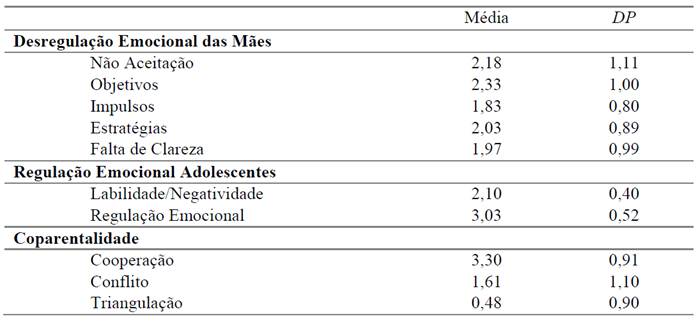
Foram realizadas estatísticas descritivas com as variáveis trabalhadas neste estudo, desregulação emocional das mães com as dimensões: não aceitação das emoções negativas (Não Aceitação), incapacidade de se envolver em comportamentos dirigidos por objetivos quando experiencia emoções negativas (Objetivos), problemas em controlar comportamento impulsivo quando experiencia emoções negativas (Impulsos), acesso limitado às estratégias de regulação emocional (Estratégias) e falta de clareza emocional (Clareza) (variável exógena), regulação emocional dos filhos adolescentes: dimensões labilidade/negatividade e regulação emocional (variável endógena) e coparentalidade: dimensões cooperação, conflito e triangulação (variável mediadora). A descrição das análises de média e desvio padrão se encontra na Tabela 1.
Tabela 1: Análise descritiva (N = 210)
As experiências de desregulação emocional das mães medidas pela DERS, apontaram que essas estão relacionadas com as variáveis de mediação e de desfecho. Depois de verificar que se tratava de uma amostra não-normal, foi realizada a análise de correlação de Spearman para avaliar as relações internas entre as dimensões. Muitas correlações moderadas e altas foram observadas, conforme apresentado na Tabela 2.
Tabela 2: Correlações entre variáveis
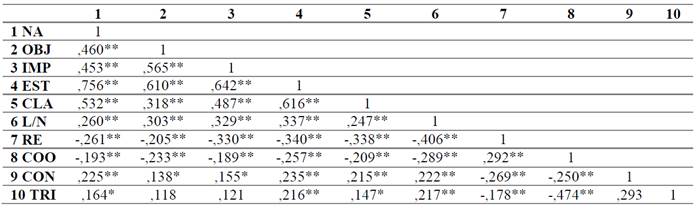
Notas: 1 NA: não aceitação; 2 OBJ: objetivos; 3 IMP: impulsos; 4 EST: estratégias; 5 CLA: clareza; 6 L/N: labilidade; 7 RE: regulação emocional; 8 COO: cooperação mãe; 9 CON: conflito mãe; 10 TRI: triangulação mãe.
** A correlação é significativa no nível 0,01 (2 extremidades)
* A correlação é significativa no nível 0,05 (2 extremidades)
Modelo Estrutural
Modelagem de equações estruturais é uma técnica que permite separar relações para cada conjunto de variáveis dependentes fornecendo a técnica de estimação apropriada e mais eficiente para uma série de equações de regressão múltipla separadas e estimadas simultaneamente. Nesse sentido, observar esse modelo nos permite verificar os caminhos das variáveis independentes (desregulação emocional das mães) com as dependentes (regulação emocional dos filhos) e a mediadora (coparentalidade).
Inicialmente o modelo apresentou ajuste adequado de dados CFI = 0,93, CMIN/DF = 2,40 e RMSEA = 0,08. Porém, ajustando a covariância existente entre objetivos e impulsos na desregulação emocional das mães e na cooperação e conflito da coparentalidade, o resultado apresentou ajuste excelente de dados CFI = 0,97, CMIN/DF = 1,52 e RMSEA = 0,05.
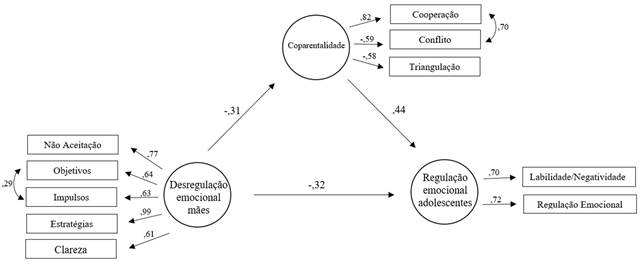
Quanto aos coeficientes padronizados de regressão do modelo, as direções já indicavam que as dimensões da desregulação emocional das mães interferem negativamente na regulação emocional percebida dos filhos adolescentes, bem como negativamente na variável mediadora coparentalidade (apresentou um caminho negativo para cooperação, enquanto para conflito e triangulação se relaciona positivamente). Identifica-se que a previsão das dimensões da desregulação emocional das mães para coparentalidade (β = -0,31) e para regulação emocional dos adolescentes (β = -0,32) apresentou índices moderados.
Os coeficientes padronizados de regressão do modelo indicam que as dimensões da desregulação emocional apresentaram índices altos e moderados, sendo β = 0,99 para estratégias, β = 0,77 para não aceitação, β = 0,64 objetivos, β = 0,63 impulsos e β = 0,61 clareza. Os coeficientes da variável latente coparentalidade apresentaram índices altos sendo β = 0,82 para cooperação, β = -0,59 para conflito e β = -0,58 para triangulação. Os coeficientes das dimensões da variável regulação emocional dos filhos adolescentes apresentaram índices β = 0,70 para labilidade e β = 0,72 para regulação emocional, considerados índices altos.
No caso da variável de mediação, considera-se que desregulação emocional das mães é reduzida ao adicionarmos a variável coparentalidade como preditor adicional (β = 0,44), portanto a mediação é sustentada (parcial). Identifica-se ainda que a magnitude de previsão da dimensão cooperação da variável latente é alta, que por sua vez impacta fortemente na regulação emocional dos filhos adolescentes. A Figura 1 retrata o modelo final.
Figura 1: Modelo estrutural final
Discussão e Conclusões
O objetivo desse estudo foi verificar o papel da desregulação emocional das mães, bem como a possível mediação da coparentalidade na regulação emocional dos filhos adolescentes a partir da percepção das mães. As habilidades de regulação emocional em adolescentes estão sendo relacionadas com fatores de proteção de saúde mental (Antunes et al., 2018) se forem adaptativas e com ansiedade (Young et al., 2019), depressão (Young et al., 2019) e ideação suicida (Miller et al., 2018), nos casos de déficits na regulação emocional de adolescentes. Dada tal magnitude, os resultados desse estudo demonstram a importância da família no desenvolvimento dos filhos adolescentes, reforçando o que vem sendo apontado nas pesquisas sobre a coparentalidade e a reverberação nos filhos (Machado & Mosmann, 2019; Mosmann et al., 2018).
Ao avaliar a composição das variáveis latentes do modelo de interação, corroborados com as médias e os índices de correlação, os dados refletem para uma amostra com níveis de desregulação emocional de mães, indicando dificuldades em se envolver em comportamentos dirigidos por objetivos quando experienciam emoções negativas (β = 0,64), problemas em aceitar emoções negativas (β = 0,77) e acesso limitado às estratégias de regulação emocional (β = 0,99), como as dimensões com médias mais altas construindo a variável latente desregulação emocional das mães. Esses índices de desregulação emocional podem estar relacionados com a sobrecarga de tarefas domésticas e parentais das mães. Em 2017 um estudo do Instituto Brasileiro de Geografia e Estatística-IBGE, apontou que as mães dedicam o dobro de tempo dos homens em afazeres domésticos e cuidados com pessoas. Nesse sentido, a sobrecarga de atividades e o sentimento de desproporcionalidade na responsabilidade pela gestão da casa e dos filhos, estão associados com a falta de bem-estar emocional das mães (Ciciolla & Luthar, 2019).
No entanto, percentual significativo da amostra relatou diagnóstico de transtornos mentais como transtornos de ansiedade e transtornos de humor. Esses grupos de transtornos estão associados com dificuldades de regulação emocional. No contexto da psicopatologia déficits na regulação emocional apresentam relações negativas com o bem-estar do sujeito (Kraiss et al., 2020), portanto trata-se de uma amostra de mães com importantes índices de transtorno mental e consequentemente com dificuldades de regulação emocional.
A composição da variável coparentalidade, foi primordialmente composta por cooperação coparental (β = 0,82). As análises descritivas mostram mães com níveis altos de desregulação, mas que se percebem com altos níveis de cooperação quando se referem ao exercício coparental. Este cenário, ainda que aparentemente contraditório, pode apontar para famílias com mães que, ainda que reconheçam ter dificuldades de regulação emocional, em nível individual, no que se refere a relação coparental adotam postura cooperativa, talvez justamente em um comportamento de compensação. Cientes de suas dificuldades individuais, buscam o apoio do par coparental.
Além disso, sabe-se que os cuidadores tendem a responder estudos acerca de seu desempenho parental de forma mais positiva, apresentando respostas de desejabilidade social (Almiro, 2017). Esse enviesamento ainda é um dos maiores desafios na avaliação de fenômenos psicológicos. É possível que os altos níveis de cooperação estejam expressando uma autoavaliação positiva dessas mães na sua postura coparental.
Essas particularidades contribuíram para compor aspectos específicos desta amostra. Porém para além das características desse grupo, foram investigadas as relações entre os construtos desregulação emocional das mães e regulação emocional dos filhos e a coparentalidade, tanto em nível de relações e correlações, quanto em nível de interações no modelo proposto, corroborando com a literatura científica da área e avançando em alguns aspectos.
A partir dessas considerações, esse estudo possui dois resultados principais. O primeiro resultado está relacionado com o papel mediador da coparentalidade entre a desregulação emocional de mães e a regulação emocional dos filhos adolescentes. No caso da regulação emocional dos filhos, o modelo interacional apontou que três variáveis observáveis tiveram magnitudes importantes e demostraram-se fortemente explicativas para esse construto, a dimensão falta de estratégias e não aceitação das emoções da mãe (na variável latente desregulação emocional das mães) e cooperação coparental (na variável latente coparentalidade). Essas variáveis observáveis foram significativas para explicar o modelo, destacando que as dimensões cooperação coparental (0,82) (impactando positivamente) e falta de estratégias para regular as emoções da mãe (0,99) (impactando negativamente) foram substancialmente maiores dos que as outras variáveis.
Nesse sentido, ao inserir a variável latente coparentalidade na equação estrutural a força do impacto da variável desregulação emocional das mães para a regulação emocional dos filhos foi reduzida (Hair et al., 2010), apresentando mediação parcial da coparentalidade entre elas. Isso significa que para além do que já é previsto, sobre a aprendizagem de regulação emocional através da aprendizagem social e modelagem (Morris et al. 2007; Reindl et al., 2018), observado na relação direta o subsistema coparental, a forma como o par parental exerce suas funções na família (Costa et al., 2017; Margolin et al., 2001) faz parte dessa relação.
Esses achados evidenciam a potencialidade da cooperação no coparentalidade, indica que a relação positiva entre os cuidadores pode reverberar na qualidade da saúde mental dos filhos. Na maioria das pesquisas encontradas sobre a coparentalidade as preocupações estão em torno das dimensões negativas como observados em estudos prévios (Margolin et al., 2001). Entretanto, teóricos que estudam esse tema salientam que a qualidade da coparentalidade na família parece ser mais importante para o funcionamento da criança do que outros aspectos do casal (Schoppe-Sullivan et al., 2001). Essa descoberta fornece mais evidências substanciais em apoio às pesquisas existentes que indicam que a cooperação coparental está relacionada com ajustamento socioemocional dos filhos (Choi et al., 2019), pois ela é a dimensão que mais impacta positivamente para a regulação emocional dos filhos adolescentes.
Salienta-se também, que a desregulação emocional das mães, apresentou efeito indireto na regulação emocional dos filhos adolescentes. Esse resultado pode ser mais bem explicado pelo fato de que a desregulação emocional das mães afeta a regulação emocional dos filhos se ela for direcionada ao adolescente e não somente atuando de forma individual. Esse achado é consistente com alguns estudos que examinaram a desregulação emocional das mães, sugerindo que essa variável estivesse relacionada com consequências na prole (Giordano et al., 2021), mas não somente com efeitos diretos na regulação emocional dos filhos.
Nesse sentido, o segundo resultado principal desse estudo está relacionado com a desregulação emocional de mães tendo um efeito negativo na cooperação coparental e positivo no conflito e na triangulação coparental. Ainda que as mães dessa amostra tenham se declarado cooperativas, o caminho negativo da variável latente desregulação emocional das mães para a coparentalidade indica que a desregulação emocional das mães reportada na DERS pôde predizer menor capacidade de cooperar com o par coparental. Esse resultado pode estar relacionado ao fato de que as mães precisam ter capacidade de regulação emocional para cooperar com seu par coparental. Isso também foi observado nas correlações em que a direção negativa corresponde a quanto mais desreguladas as mães, menos cooperação coparental. Consequentemente essa baixa cooperação pode impactar em menor regulação emocional dos filhos.
Esse dado fornece uma contribuição para os estudos a respeito da coparentalidade, pois acrescenta o que já foi visto anteriormente sobre as variáveis pessoais que contribuem ou atrapalham a qualidade da relação coparental. Fatores como qualidade conjugal antes do nascimento do filho (Schoppe-Sullivan et al., 2007), estresse (Kang et al., 2022), e a capacidade de resolução de problemas (Majdandžić et al., 2012), necessariamente são perpassadas pela regulação emocional (McRae & Gross, 2020) dos agentes da coparentalidade.
No geral, o presente estudo sugere que a qualidade da coparentalidade, a cooperação coparental, está associada à regulação emocional dos filhos adolescentes e a desregulação emocional das mães parece ter um impacto prejudicial na cooperação coparental. Dada a importância da coparentalidade para as crianças e o bem-estar da família (Costa et al., 2017; Mosmann et al., 2018), esses resultados indicam, no âmbito clínico, que atuar preventivamente junto a pais, com intervenções em regulação emocional para o desenvolvimento de habilidades no exercício do subsistema coparental são essenciais ao desenvolvimento adaptativo dos filhos (Frizzo et al., 2005).
Algumas limitações desse estudo precisam ser discutidas. Primeiramente, esse estudo foi aplicado durante o início da pandemia do Covid-19, enquanto pais, mães, outros cuidadores e filhos ficaram confinados, consequentemente aumentando os índices de estresse (Freisthler et al., 2021). A situação pandêmica pode ter impactado nos resultados de desregulação emocional relatado pelas mães. Outra limitação importante está relacionada com o método de delineamento transversal. A pesquisa longitudinal poderia testar as relações temporais entre os constructos e a ordem cronológica das variáveis. Outra consideração importante é que a pesquisa parte somente da perspectiva das mães. É possível que se acrescentada as perspectivas dos pais e dos adolescentes acerca da coparentalidade e regulação emocional, os resultados poderiam ser divergentes. Finalmente, para direções futuras sobre estudos em regulação emocional de pais e adolescentes e o papel da coparentalidade, poderiam investigar quais estratégias de regulação emocional estão relacionadas com as dimensões da coparentalidade, além de investigar as variáveis a partir das percepções de pai, mãe e filho que poderá fornecer respostas sobre a dinâmica das interações diádicas e triádicas que ocorrem na coparentalidade.
Referências:
Almiro, P. A. (2017). Uma nota sobre a desejabilidade social e o enviesamento de respostas. Revista Avaliação Psicológica, 16(03). https://doi.org/10.15689/ap.2017.1603.ed
Antunes, J., Matos, A. P., & Costa, J. J. (2018). Regulação emocional e qualidade do relacionamento com os pais como preditoras de sintomatologia depressiva em adolescentes. Revista Portuguesa de Enfermagem de Saúde Mental, Especial, 6, 52-58. https://doi.org/10.19131/rpesm.0213
Bariola, E., Gullone, E., & Hughes, E. K. (2011). Child and adolescent emotion regulation: the role of parental emotion regulation and expression. Clinical Child and Family Psychology Review, 14(2), 198-212. https://doi.org/10.1007/s10567-011-0092-5
Barnett, M. A., Scaramella, L. V., McGoron, L., & Callahan, K. (2011). Coparenting cooperation and child adjustment in low-income mother-grandmother and mother-father families. Family Science, 2(3), 159-170. https://doi.org/10.1080/19424620.2011.642479
Bjureberg, J., Ljótsson, B., Tull, M. T., Hedman, E., Sahlin, H., Lundh, L. G., Bjärehed, J., DiLillo, D., Messman-Moore, T., Hellner Gumpert, I., & Gratz, K. L. (2016). Development and validation of a Brief Version of the Difficulties in Emotion Regulation Scale: The DERS-16. Journal of Psychopathology and Behavioral Assessment, 38(2), 284-296. https://doi.org/10.1007/s10862-015-9514-x
Blair, B. L., Gangle, M. R., Perry, N. B., O’Brien, M., Calkins, S. D., Keane, S. P., & Shanahan, L. (2016). Indirect effects of emotion regulation on peer acceptance and rejection: the roles of positive and negative social behaviors. Merrill-Palmer Quarterly, 62(4), 415-439. https://doi.org/10.13110/merrpalmquar1982.62.4.0415
Campbell, C. G. (2022). Two decades of coparenting research: a scoping review. Marriage & Family Review, 1-33. https://doi.org/10.1080/01494929.2022.2152520
Cheung, R. Y. M., Chan, L. Y., & Chung, K. K. H. (2020). Emotion dysregulation between mothers, fathers, and adolescents: Implications for adolescents’ internalizing problems. Journal of Adolescence, 83(January), 62-71. https://doi.org/10.1016/j.adolescence.2020.07.001
Choi, J. K., Parra, G., & Jiang, Q. (2019). The longitudinal and bidirectional relationships between cooperative coparenting and child behavioral problems in low-income, unmarried families. Journal of Family Psychology, 33(2), 203-214. https://doi.org/10.1037/fam0000498
Ciciolla, L. & Luthar, S. S. (2019). Invisible household labor and ramifications for adjustment: mothers as captains of households. Sex Roles, 81(7-8), 467-486. https://doi.org/10.1007/s11199-018-1001-x
Costa, C. Machado, M. Schneider, M. Mosmann, C. (2017). Subsistema coparental: revisão sistemática de estudos empíricos. Psico, 48(4), 339-351. https://doi.org/10.15448/1980-8623.2017.4.25386
Crandall, A. A., Ghazarian, S. R., Day, R. D., & Riley, A. W. (2016). Maternal emotion regulation and adolescent behaviors: The mediating role of family functioning and parenting. Journal of Youth and Adolescence, 45(11), 2321-2335. https://doi.org/10.1007/s10964-015-0400-3
Creswell, J. W. (2010). Projeto de pesquisa: métodos qualitativo, quantitativo e misto (2nd ed.). Bookman.
Cui, L., Criss, M. M., Ratliff, E., Wu, Z., Houltberg, B. J., Silk, J. S., & Morris, A. S. (2020). Longitudinal links between maternal and peer emotion socialization and adolescent girls’ socioemotional adjustment. Developmental Psychology, 56(3), 595-607. https://doi.org/10.1037/dev0000861
D’Agostino, A., Covanti, S., Rossi Monti, M., & Starcevic, V. (2017). Reconsidering emotion dysregulation. Psychiatric Quarterly, 88(4), 807-825. https://doi.org/10.1007/s11126-017-9499-6
Flick, U. (2009). Uma introdução à pesquisa qualitativa (3rd ed.). Artmed/Bookman.
Freisthler, B., Gruenewald, P. J., Tebben, E., McCarthy, K. S., & Price Wolf, J. (2021). Understanding at-the-moment stress for parents during COVID-19 stay-at-home restrictions. Social Science & Medicine, 279, 114025. https://doi.org/10.1016/j.socscimed.2021.114025
Frizzo, G. B., Kreutz, C. M., Schmidt, C., Piccinini, C. A., & Bosa, C. (2005). O conceito de coparentalidade e suas implicações para a pesquisa e para a clínica: implication for research and clinical practice. Journal of Human Growth and Development, 15(3), 84. https://doi.org/10.7322/jhgd.19774
Gallegos, M. I., Murphy, S. E., Benner, A. D., Jacobvitz, D. B., & Hazen, N. L. (2017). Marital, parental, and whole-family predictors of toddlers’ emotion regulation: The role of parental emotional withdrawal. Journal of Family Psychology, 31(3), 294-303. https://doi.org/10.1037/fam0000245
Gil, A. (2010). Como elaborar projetos de pesquisa (5th ed.). Atlas.
Giordano, C., Lo Coco, G., Salerno, L., & Di Blasi, M. (2021). The role of emotion dysregulation in adolescents’ problematic smartphone use: A study on adolescent/parents triads. Computers in Human Behavior, 115, 106632. https://doi.org/10.1016/j.chb.2020.106632
Gratz, K. L. & Roemer, L. (2004). Multidimensional assessment of emotion regulation and dysregulation: development, factor structure, and initial validation of the difficulties in emotion regulation scale. Journal of Psychopathology and Behavioral Assessment, 26(1), 41-54. https://doi.org/10.1023/b:joba.0000007455.08539.94
Hair, J. F., Black, W. C., Babin, B. J., & Anderson, R. E. (2010). Multivariate Data Analysis (7th ed.). Pearson.
Inwood, E. & Ferrari, M. (2018). Mechanisms of change in the relationship between self-compassion, emotion regulation, and mental health: a systematic review. Applied Psychology: Health and Well-Being, 10(2), 215-235. https://doi.org/10.1111/aphw.12127
Kang, S. K., Choi, H. J., & Chung, M. R. (2022). Coparenting and parenting stress of middle-class mothers during the first year: bidirectional and unidirectional effects. Journal of Family Studies, 28(2), 551-568. https://doi.org/10.1080/13229400.2020.1744472
Karaer, Y. & Akdemir, D. (2019). Parenting styles, perceived social support and emotion regulation in adolescents with internet addiction. Comprehensive Psychiatry, 92, 22-27. https://doi.org/10.1016/j.comppsych.2019.03.003
Koch, C., Schaefer, J. R., Schneider, M., & Mosmann, C. (2020). Coparentalidade e conflito pais-filhos em adolescentes envolvidos em práticas restaurativas. Psico-USF, 25(2), 343-355. https://doi.org/10.1590/1413-82712020250212
Kraiss, J. T., ten Klooster, P. M., Moskowitz, J. T., & Bohlmeijer, E. T. (2020). The relationship between emotion regulation and well-being in patients with mental disorders: a meta-analysis. Comprehensive Psychiatry, 102, 152189. https://doi.org/10.1016/j.comppsych.2020.152189
Kwon, K., Hanrahan, A. R., & Kupzyk, K. A. (2017). Emotional expressivity and emotion regulation: Relation to academic functioning among elementary school children. School Psychology Quarterly, 32(1), 75-88. https://doi.org/10.1037/spq0000166
Lewis, J., Binion, G., Rogers, M., & Zalewski, M. (2020). The associations of maternal emotion dysregulation and early child dissociative behaviors. Journal of Trauma and Dissociation, 21(2), 203-216. https://doi.org/10.1080/15299732.2019.1678211
Li, D., Li, D., Wu, N., & Wang, Z. (2019). Intergenerational transmission of emotion regulation through parents’ reactions to children’s negative emotions: tests of unique, actor, partner, and mediating effects. Children and Youth Services Review, 101(December 2018), 113-122. https://doi.org/10.1016/j.childyouth.2019.03.038
Machado, M. R. & Mosmann, C. P. (2019). Dimensões negativas da coparentalidade e sintomas internalizantes: a regulação emocional como mediadora. Psicologia: Teoria e Pesquisa, 35(Spec. Iss.), e35nspe12. https://doi.org/10.1590/0102.3772e35nspe12
Macie, K. M. & Stolberg, A. L. (2003). Assessing Parenting After Divorce. Journal of Divorce & Remarriage, 39(1-2), 89-107. https://doi.org/10.1300/J087v39n01_06
Majdandžić, M., de Vente, W., Feinberg, M. E., Aktar, E., & Bögels, S. M. (2012). Bidirectional associations between coparenting relations and family member anxiety: a review and conceptual model. Clinical Child and Family Psychology Review, 15(1), 28-42. https://doi.org/10.1007/s10567-011-0103-6
Margolin, G., Gordis, E. B., & John, R. S. (2001). Coparenting: a link between marital conflict and parenting in two-parent families. Journal of Family Psychology, 15(1), 3-21. https://doi.org/10.1037/0893-3200.15.1.3
McRae, K. & Gross, J. J. (2020). Emotion regulation. Emotion, 20(1), 1-9. https://doi.org/10.1037/emo0000703
Miguel, F. K., Giromini, L., Colombarolli, M. S., Zuanazzi, A. C., & Zennaro, A. (2017). A Brazilian investigation of the 36- and 16-item Difficulties in Emotion Regulation Scales. Journal of Clinical Psychology, 73(9), 1146-1159. https://doi.org/10.1002/jclp.22404
Miller, A. B., McLaughlin, K. A., Busso, D. S., Brueck, S., Peverill, M., & Sheridan, M. A. (2018). Neural correlates of emotion regulation and adolescent suicidal ideation. Biological Psychiatry: Cognitive Neuroscience and Neuroimaging, 3(2), 125-132. https://doi.org/10.1016/j.bpsc.2017.08.008
Morris, A. S., Criss, M. M., Silk, J. S., & Houltberg, B. J. (2017). The Impact of Parenting on Emotion Regulation During Childhood and Adolescence. Child Development Perspectives, 11(4), 233-238. https://doi.org/10.1111/cdep.12238
Morris, A. S., Silk, J. S., Steinberg, L., Myers, S. S., & Robinson, L. R. (2007). The role of the family context in the development of emotion regulation. Social Development, 16(2), 361-388. https://doi.org/10.1111/j.1467-9507.2007.00389.x
Mosmann, C. & Wagner, A. (2008). Dimensiones de la conyugalidad y de la parentalidad: un modelo correlacional. Revista Intercontinental de Psicología y Educación, 10(2), 79-103.
Mosmann, C. P., Costa, C. B., Einsfeld, P., Silva, A. G. M., & Koch, C. (2017). Conjugalidade, parentalidade e coparentalidade: associações com sintomas externalizantes e internalizantes em crianças e adolescentes. Estudos de Psicologia (Campinas), 34, 487-498. https://doi.org/10.1590/1982-02752017000400005
Mosmann, C., Costa, C., Silva, A. & Luz, S. K. (2018). Filhos com sintomas psicológicos clínicos: papel discriminante da conjugalidade, coparentalidade e parentalidade. Temas em Psicologia, 26(51), 429-442. https://doi.org/10.9788/TP2018.1-17Pt
Pallini, S., Vecchio, G. M., Baiocco, R., Schneider, B. H., & Laghi, F. (2019). Student-teacher relationships and attention problems in school-aged children: the mediating role of emotion regulation. School Mental Health, 11(2), 309-320. https://doi.org/10.1007/s12310-018-9286-z
Perry, N. B., Dollar, J. M., Calkins, S. D., Keane, S. P., & Shanahan, L. (2020). Maternal socialization of child emotion and adolescent adjustment: Indirect effects through emotion regulation. Developmental Psychology, 56(3), 541-552. https://doi.org/10.1037/dev0000815
Qian, Y., Chen, F., & Yuan, C. (2020). The effect of co-parenting on children’s emotion regulation under fathers’ perception: a moderated mediation model of family functioning and marital satisfaction. Children and Youth Services Review, 119(October), 105501. https://doi.org/10.1016/j.childyouth.2020.105501
Reindl, V., Gerloff, C., Scharke, W., & Konrad, K. (2018). Brain-to-brain synchrony in parent-child dyads and the relationship with emotion regulation revealed by fNIRS-based hyperscanning. NeuroImage, 178(May), 493-502. https://doi.org/10.1016/j.neuroimage.2018.05.060
Reis, A. H., Silva De Oliveira, S. E., Bandeira, D. R., Andrade, N. C., Abreu, N., & Sperb, T. M. (2016). Emotion Regulation Checklist (ERC): estudos preliminares da adaptação e validação para a cultura Brasileira. Temas Em Psicologia, 24(1), 77-96. https://doi.org/10.9788/TP2016.1-06
Riina, E. M., Lee, J.-K., & Feinberg, M. E. (2020). Bidirectional associations between youth adjustment and mothers’ and Fathers’ coparenting conflict. Journal of Youth and Adolescence, 49(8), 1617-1630. https://doi.org/10.1007/s10964-020-01262-6
Sabadini, A; Sampaio, M., & Koller, S. (2009). Publicar em Psicologia: um enfoque para a revista científica. Associação Brasileira de Editores Científicos de Psicologia.
Schoppe-Sullivan, S. J., Mangelsdorf, S. C., & Frosch, C. A. (2001). Coparenting, family process, and family structure: Implications for preschoolers’ externalizing behavior problems. Journal of Family Psychology, 15(3), 526-545. https://doi.org/10.1037/0893-3200.15.3.526
Schoppe-Sullivan, S. J., Mangelsdorf, S. C., Brown, G. L., & Szewczyk Sokolowski, M. (2007). Goodness-of-fit in family context: Infant temperament, marital quality, and early coparenting behavior. Infant Behavior and Development, 30(1), 82–96. https://doi.org/10.1016/j.infbeh.2006.11.008
Shields, A. M. & Cicchetti, D. (1995). The development of an emotion regulation assessment battery: Reliability and validity among at-risk grade-school children (Apresentação da conferência). Society for Research on Child Development, Indianapolis, Estados Unidos.
Szkody, E., Steele, E. H., & McKinney, C. (2020). Links between parental socialization of coping on affect: Mediation by emotion regulation and social exclusion. Journal of Adolescence, 80(June 2019), 60-72. https://doi.org/10.1016/j.adolescence.2020.02.004
Teubert, D. & Pinquart, M. (2011). The Coparenting Inventory for Parents and Adolescents (CI-PA) reliability and validity. European Journal of Psychological Assessment, 27(3), 206-215. https://doi.org/10.1027/1015-5759/a000068
Thomassin, K., Suveg, C., Davis, M., Lavner, J. A., & Beach, S. R. H. (2017). Coparental affect, children’s emotion dysregulation, and parent and child depressive symptoms. Family Process, 56(1), 126-140. https://doi.org/10.1111/famp.12184
Williams, W. C., Morelli, S. A., Ong, D. C., & Zaki, J. (2018). Interpersonal emotion regulation: implications for affiliation, perceived support, relationships, and well-being. Journal of Personality and Social Psychology, 115, 224-254. https://doi.org/10.1037/pspi0000132
Young, K. S., Sandman, C. F., & Craske, M. G. (2019). Positive and negative emotion regulation in adolescence: links to anxiety and depression. Brain Sciences, 9(4). https://doi.org/10.3390/brainsci9040076
Como citar: Dalla Corte Euzebio, L. & Pereira Mosmann, C. (2023). A coparentalidade como mediadora entre a desregulação emocional de mães e a percepção da regulação emocional de seus filhos adolescentes. Ciencias Psicológicas, 17(1), e-2583. https://doi.org/10.22235/cp.v17i1.2583
Participação dos autores: a) Planejamento e concepção do trabalho; b) Coleta de dados; c) Análise e interpretação de dados; d) Redação do manuscrito; e) Revisão crítica do manuscrito.
L. D. C. E. contribuiu em a, b, c, d, e; C. P. M. em a, b, c, d, e.
Editora científica responsável: Dra. Cecilia Cracco.
10.22235/cp.v17i1.2583
Original Articles
Coparenting as a mediator between mothers’ emotion dysregulation and the perception of adolescents’ emotion regulation
A coparentalidade como mediadora entre a desregulação emocional de mães
e a percepção da regulação emocional de seus filhos adolescentes
La coparentalidad como mediadora entre la desregulación emocional
de las madres y la percepción de la regulación emocional de sus hijos adolescentes
Luiza Dalla Corte Euzebio1, ORCID 0000-0003-0440-7177
Clarisse Pereira Mosmann2, ORCID 0000-0002-9275-1105
1 Universidade do Vale do Rio dos Sinos, Brazil, [email protected]
2 Universidade do Vale do Rio dos Sinos, Brazil
Abstract:
Research on the development of emotion regulation in childhood and adolescence suggests that the etiology of the phenomenon is multifactorial and that it is necessary to investigate the broader contextual aspects. Coparenting is a contextual variable that has been associated with outcomes in children and may be related to emotional regulation. The aim of this study was to test a structural model of direct and indirect relationship between mothers' emotional dysregulation and the perception of their adolescent children’s emotional regulation, evaluating the mediating role of coparenting. This is a quantitative, cross-sectional and explanatory study conducted with 210 mothers of adolescents (M = 15.59, SD = 1.39 years old). The sociodemographic questionnaire, the Difficulties in Emotion Regulation Scale (DERS), the Emotion Regulation Checklist (ERC) and the Coparenting Inventory for Parents and Adolescents (CI-PA) were administered online. Descriptive analyses, correlational analysis and structural modeling equations were conducted. The interactional model points to the partial mediating effect of coparenting in this relationship, as well as the indirect effect of the mothers' emotion dysregulation on the emotional regulation of the adolescents. The results also pointed out that the mothers' emotional dysregulation seems to have a detrimental impact on coparental cooperation. These results are important factors to be considered in the clinical context when working with adolescence and their families.
Keywords: emotional regulation; emotional dysregulation; coparenting; adolescents; mothers.
Resumo:
Pesquisas na área do desenvolvimento da regulação emocional sobre a infância e adolescência sugerem que a etiologia do fenômeno é multifatorial e que é necessário investigar aspectos contextuais relacionados. A coparentalidade é uma variável contextual que vem sendo associada a desfechos nos filhos, podendo ter relação com a regulação emocional. O objetivo desse estudo foi testar um modelo estrutural de relação direta e indireta entre desregulação emocional de mães e a percepção da regulação emocional de seus filhos adolescentes, avaliando o papel mediador da coparentalidade. Trata-se de um estudo quantitativo, transversal e explicativo realizado com 210 mães de adolescentes (M = 15,59, DP = 1,39 anos). Para isso foram utilizados o questionário sociodemográfico, o Difficulties in Emotion Regulation Scale (DERS), o Emotion Regulation Checklist (ERC) e o Coparenting Inventory for Parents and Adolescents (CI-PA) com aplicação online. Foram realizadas análises descritivas, análise correlacional e modelagem de equações estruturais. O modelo interacional aponta para o efeito mediador parcial da coparentalidade nessa relação, bem como efeito indireto da desregulação das mães para a regulação emocional dos adolescentes. Os resultados ainda apontaram que a desregulação emocional das mães parece ter um impacto prejudicial na cooperação coparental. Esses resultados indicam importantes fatores a serem considerados no âmbito clínico nas intervenções com adolescentes e suas famílias.
Palavras-chave: regulação emocional; desregulação emocional; coparentalidade; adolescentes; mães.
Resumen:
La investigación sobre el desarrollo de la regulación emocional en la infancia y la adolescencia sugiere que la etiología del fenómeno es multifactorial y que es necesario investigar aspectos contextuales relacionados. La crianza conjunta es una variable contextual que se ha asociado con los resultados en los niños y puede estar relacionada con la regulación emocional. El objetivo de este estudio fue probar un modelo estructural de relación directa e indirecta entre la desregulación emocional de las madres y la percepción de la regulación emocional de sus hijos adolescentes, evaluando el papel mediador de la coparentalidad. Se trata de un estudio cuantitativo, transversal y explicativo realizado con 210 madres de adolescentes (M = 15.59, DE = 1.39 años). Para ello se utilizó un cuestionario sociodemográfico, la Escala de Dificultades en la Regulación Emocional (DERS), la Lista de Verificación de Regulación Emocional (ERC) y el Inventario Coparental de Padres y Adolescentes (CI-PA) con aplicación en línea. Se realizaron análisis descriptivos, análisis correlacionales y modelado de ecuaciones estructurales. El modelo interaccional apunta al efecto mediador parcial de la coparentalidad en esta relación, así como el efecto indirecto de la desregulación de las madres para la regulación emocional de los adolescentes. Los resultados también señalaron que la desregulación emocional de las madres parece tener un impacto perjudicial en la cooperación coparental. Estos resultados indican factores importantes a considerar a nivel clínico en intervenciones con adolescentes y sus familias.
Palabras clave: regulación emocional; desregulación emocional; coparentalidad; adolescentes; madres.
Received: 26/5/2021
Accepted: 4/5/2023
In the last two decades, the interest in understanding adolescence as a critical period for the development of emotion regulation has increased (Crandall et al., 2016; Machado & Mosmann, 2019). Regulating emotions is an essential human development skill for maintaining successful relationships with peers (Blair et al., 2016) and family (Reindl et al., 2018), academic functioning (Kwon et al., 2017), well-being (Williams et al., 2018) and mental health (Inwood & Ferrari, 2018).
Emotional regulation involves having strategies to maintain, increase or decrease one or more components of the emotional response. It is a process of modulation, occurrence, duration, and intensity of internal states (positive and negative) and physiological processes related to emotion (Morris et al., 2017). The ability to regulate emotions implies influencing the emotional experience, according to the situation, timing, and emotional valence (McRae & Gross, 2020), in order to achieve the desired affective states and achieve adaptive results to deal with everyday situations.
On the other hand, the difficulty in emotion regulation (deficits in emotion regulation or emotional dysregulation) occurs through a dynamic process (D'Agostino et al., 2017) of interaction between difficulty in awareness, comprehension, or modulation of emotion (Bjureberg et al., 2016) and learning history of dysfunctional strategies to manage emotions (Bariola et al., 2011) throughout development (D'Agostino et al., 2017). In this sense, difficulties in emotion regulation are related to manifestations of internalizing and externalizing symptoms (Machado & Mosmann, 2019), various mental disorders (D'Agostino et al., 2017) and personality disorders (D'Agostino et al., 2017).
Because it is a relational variable, research on the development of emotional regulation from childhood to adolescence suggests that the etiology of the phenomenon is multifactorial. The main focus of research is related to the regulation of one’s own emotions (intrinsic regulation), but there has been a growing interest towards the regulation of other people and the context in which people are located (extrinsic regulation) (McRae & Gross, 2020).
Context, as extrinsic regulation, has gained strong empirical support as a contributor to the development of emotion regulation (Li et al., 2019). Studies about social factors suggested that interactions with mothers (Perry et al., 2020), fathers (Li et al., 2019), teachers (Pallini et al., 2019) and peers (Cui et al., 2020) were related to the development of emotional regulation in children.
Although the emotional regulation of both parents is crucial in the development of children's emotions, many studies have focused their attention on the mother's role and its impact on adolescents (Cheung et al., 2020; Crandall et al., 2016; Lewis et al., 2020). There is a vast literature connecting mothers' difficulty in emotion regulation with symptomatic outcomes in children, such as internalizing symptoms in adolescent children (Cheung et al., 2020), dissociation in children (Lewis et al., 2020) and difficulty in emotion regulation (Cheung et al., 2020). Thus, mothers with emotional regulation difficulties have an important impact on the emotional regulation of their adolescent children. A longitudinal study (Cheung et al., 2020) that investigated the emotion regulation difficulties experienced by 386 Hong Kong families including mothers, fathers and adolescents in two stages (over 12 months) discovered that only the mothers' emotion regulation difficulties were a predictor of difficulties in emotion regulation in the children, and even in the parents longitudinally, while the difficulty in emotion regulation of the parents had no influence on the emotions of the mothers or children in this study.
It is already a consensus in the literature that children tend to imitate or internalize the ways in which their mothers struggle with regulating emotions via modeling or social learning mechanisms (Bariola et al., 2011) throughout development. However, when analyzing studies about the development of emotion regulation, we find other aspects that contribute to regulation or difficulty in regulating children's emotions, such as parental socialization (Szkody et al., 2020), family climate (Morris et al., 2017; Morris et al., 2007), conjugality (Morris et al., 2007) and parental support (Karaer & Akdemir, 2019).
Although studies on emotional regulation of children and family relationships have advanced in recent years, authors in the field suggest that researchers explore interrelationships between family systems and subsystems (Gallegos et al., 2017; Thomassin et al., 2017). Thus, family and relational variables need to be investigated as mediating factors between the mothers' difficulty in emotional regulation and the development of emotional regulation in their adolescent children. A construct that is associated with relational aspects such as parenting, family climate and conjugality is coparenting (Mosmann & Wagner, 2008; Mosmann et al., 2018).
Coparenting is theoretically conceived as the intervening subsystem between the marital relationship and the relationships between parents and children (Mosmann et al., 2017), since the level of collaboration between the parental couple can influence the way how they interact with the children and perform their parental tasks. A scope review that discusses 20 years of research on coparenting indicates that this construct is related to the interaction in which the coparenting pair coordinates each one's parenting. The main findings of this review indicate that the characteristics of each of the coparenting duo, the state of the relationship (romantic), the context in which the family lives and the characteristics of the child interfere with the coparenting quality. On the other hand, the review also indicates that positive coparenting is related to better marital relationships and positive development of children (Mosmann et al., 2017).
A theoretical model (Margolin et al., 2001) proposes that coparenting has three dimensions: cooperation, conflict, and triangulation. The cooperation dimension (positive dimension) is related to support, validation, respect and understanding that the other caregiver is emotionally capable of exercising parental functions, the conflict dimension (negative dimension) refers to the amount, frequency and severity of disagreements or discussions about the children's education, and the triangulation (negative dimension) is related to a distortion of the limits between the coparental and father/mother-child subsystems, in which one of the caregivers establishes a coalition with the child, excluding or weakening the other figure parental.
A systematic review from 2017 (Costa et al., 2017), with the objective of analyzing the methodological characteristics, objectives and results of empirical studies on coparenting, investigated 29 studies from 2007 to 2016 in English, Spanish and Portuguese. In this study, it was possible to verify that the scientific literature has focused on identifying possible associations between characteristics of the children's behavior and the exercise of coparenting, as well as the impact of coparenting on the family climate. This indicates that coparenting may function as a link between parenting and outcomes for children's emotional and behavioral problems.
Many studies on coparenting have associated this phenomenon with outcomes in children. For example, the negative dimensions (conflict and triangulation) have been associated with internalizing and externalizing disorders (Mosmann et al., 2018), social anxiety behaviors (Riina et al., 2020) and mild antisocial behaviors (Koch et al., 2020). On the other hand, cooperation has been linked to children's social competence (Barnett et al., 2011) and better self-esteem (Macie & Stolberg, 2003).
Some studies that evaluate coparenting and emotional regulation indicate the importance of the association. The first study (Machado & Mosmann, 2019) evaluated the emotional regulation of 229 Brazilian adolescents (11 to 18 years old) as a mediator between the negative dimensions of coparenting and internalizing symptoms from their perception. The results revealed that emotional regulation plays a decisive role in the development of internalizing symptoms in the context of coparenting difficulties. Another study (Thomassin et al., 2017), carried out in the United States, sought to examine the role of coparental affection in children's emotional regulation difficulties in 51 mother-father-child triads (children aged between 7 and 12 years). The study also investigated whether this association mediated the link between parental depressive symptoms and children's emotional regulation. The triads were recorded talking about sad and happy situations. This study verified that the congruence of positive affect from the parents during the discussion about the emotion of sadness predicted emotional dysregulation in the children, both due to the negative affect of the child and the punitive reactions from the parents. Another study (Qian et al., 2020) that carried out a mediation model focusing on family functioning and marital satisfaction to understand the relationship between coparenting and emotional regulation of children indicated that the coparenting relationship is positively associated with emotional regulation of children. However, these studies do not identify the relationships between mothers' emotional regulation and the role of coparenting as part of the development of emotional regulation in children, so the nature of these connections has not yet been fully elucidated.
In this sense, studies indicate as a limitation the need to understand how individual variables contribute to coparenting (Campbell, 2022; Mosmann et al., 2018). Although there is some evidence of the relationship between coparenting and symptomatic outcomes in children, there is a gap in understanding in regards to the dynamics of mothers' difficulty in emotional regulation, the dimensions of coparenting (contextual variable) and emotional regulation of children. It is possible to measure this interaction through interactional models such as Structural Equation Modeling. Therefore, this study aimed to test a structural model of direct and indirect relationship between emotional dysregulation of mothers and the perception of the emotional regulation of their children, evaluating the mediating role of coparenting (triangulation, conflict, and cooperation).
Materials and methods
Study design
This is a quantitative, cross-sectional, and explanatory study (Creswell, 2010). Quantitative approaches aim at the numerical presentation of data, with the goal of describing, explaining and/or predicting a phenomenon (Sabadini et al., 2009). The explanatory character aims to deepen the knowledge of reality in order to explain factors that contribute to the occurrence of a certain phenomenon (Gil, 2010).
Sample
The study included 210 mothers of adolescents, aged between 30 and 58 years (M = 43.19 and SD = 6.93). Inclusion criteria were being mothers of adolescents aged between 14 and 18 years (M = 15.59 and SD = 1.39) and being in a coparental dyad, in which caregivers did not necessarily need to be parents or married, but two people exercising parental care. The number of participants was determined according to the sample calculation proposed by Hair et al. (2010), in which 200 is the minimum number of participants for the calculation of structural equation modeling.
Among the participants, the highest concentration of the sample (28.1 %) reported that they had completed postgraduate studies (n = 59), followed by 23.3 % (n = 49) who had completed higher education, 18.1 % (n = 38) who had completed high school, 13.3 % (n = 28) with incomplete higher education, 5.2% (n = 11) with incomplete high school education, 3.3 % (n = 7) with incomplete graduate school education, 3.3 % (n = 7) with technical education, 3.3 % (n = 7) with incomplete primary education, and 1.9 % (n = 4) with complete elementary education. As for the income of the participants, 51 % (n = 107) received from 1 to 4 minimum wages, 21.4 % (n = 45) received from 4 to 6 minimum wages, 13.3 % (n = 28) reported not having a personal income, 7.1 % (n = 15) earned from 7 to 9 minimum wages, 5.2 % (n = 11) earned from 10 to 15 minimum wages and 1.9 % (n = 4) of sample earned 16 or more minimum wages.
Of this sample, 17.1 % of the participants reported being diagnosed with a psychiatric disorder. Anxiety disorders (Anxiety, Obsessive-Compulsive Disorder and Panic Disorder) and mood disorders (Major Depressive Disorder and Bipolar Disorder) were mentioned. Regarding the person who coparents with the mother, most participants (82.9 %) mentioned the father or partner (n = 174), while 12.9 % reported grandparents (n = 27), 1.9 % mentioned children (n = 4), 1.9 % mentioned other relatives (n = 4), and 0.5 % mentioned friends (n = 1) as the co-parenting dyad.
Instruments
Sociodemographic questionnaire. Constructed for this study, it has 15 questions, seeking to obtain information such as: gender, age, education, number of children, age of children, etc.
Difficulty of emotional regulation of Mothers. Difficulties in Emotion Regulation Scale (DERS; Gratz & Roemer, 2004). The DERS is a 36-item self-report scale that measures difficulties in emotion regulation. The present study used the short version (Bjureberg et al., 2016) in which the instrument consists of 16 items on a 5-point Likert scale, (1: almost never applies to me and 5: almost always applies to me). The scale assesses emotion regulation difficulties through the following dimensions: non-acceptance of negative emotions (3 items), inability to engage in goal-directed behavior when experiencing negative emotions (3 items), problems controlling impulsive behavior when experiencing negative emotions (3 items), limited access to emotion regulation strategies (5 items) and lack of emotional clarity (2 items). DERS-16 already has evidence of validity for the adult public in Brazil (Miguel et al., 2017), as it presented good rates of psychometric properties, with Cronbach's alpha values > .080 and Confirmatory Factor Analysis rates were RMSEA .096, NNFI .96, CFI .97 and SRMR .054.
Emotional regulation of adolescents. The emotional regulation variable of adolescent children was measured by adapting the Emotion Regulation Checklist (ERC; Shields & Cicchetti, 1995). The original version seeks to investigate emotional regulation of children (designed for children aged 3 to 12 years), based on the perception of parents. It consists of 24 items on a four-point Likert scale according to the frequency of the behavior (1: never to 4: almost always). The items are distributed in two scales: Emotional Regulation (ER) and Emotional Lability/Negativity (L/N). The Brazilian adaptation (Reis et al., 2016) of the original scale, which presented assumptions for exploratory factor analysis were adequate and the bifactorial solution (RE and L/N) was indicated, explaining 57 % of the variance (L/N α = .77 and RE α = .73). Lability/Negativity scores must be reversed for correction.
For this study, an adaptation was proposed for adolescents, involving several steps to analyze the validity and reliability of the instrument. These steps included: I) scale adaptation; II) content analysis; III) exploratory factor analysis; and IV) confirmatory factor analysis. The Content Validity Coefficient (CVCt), which involved content analysis performed by three expert judges in the field, yielded a value of 0.936921 for the scale, indicating an acceptable level of agreement among the judges regarding the clarity of language and practical relevance of the scale. The Cronbach's Alpha coefficient for the scale in the exploratory factor analysis was .85. The indices for the confirmatory factor analysis were as follows: CMIN/DF 1.53, CFI .90, RMSEA .05, and SRMR .04.
Dimensions of coparenting. The Coparenting Inventory for Parents and Adolescents CI-PA. The parent version (Teubert & Pinquart, 2011) consists of two parts, each of which assesses three subscales: cooperation, conflict, and triangulation. In the first part, caregivers report on coparenting at the dyadic level (dyad assessment), for example, “My partner and I agreed to fulfill our child's wishes and demands”. The second part evaluates the caregiver's perception of their partner's contribution to coparenting (evaluation of the other caregiver), for example, “My partner informs me about important events related to our child”. In this study, only the first part was used, reporting coparenting at a dyadic level. Each CI-PA item is rated on a Likert scale ranging from 0 (completely true) to 4 (not true at all). The Brazilian version (manuscript in preparation) showed good rates of psychometric properties, with the Cronbach's alpha values for Coparental Cooperation (α = .89), Coparental Conflict (α = .76) and Coparental Triangulation (α = .79). Confirmatory factor analysis of this scale showed RMSEA indices of .60, SRMR .50 and CFI .96 for the part that evaluates the dyad.
Ethical and data collection procedures
The study was approved by the Ethics Committee of the University of Vale do Rio dos Sinos. The participants were selected by convenience criteria, with the Snowball method (Flick, 2009), through social networks such as Facebook, WhatsApp and Instagram. The application was carried out online, through Google Forms. All participants agreed to participate in the study by indicating yes on the Free and Informed Consent Form of the online questionnaire. Confidentiality and autonomy were ensured in case they no longer wanted to take part in the research.
Data analysis
The collected data were entered into the Statistical Package for Social Sciences 22.0 software (IBM SPSS) and the significance level adopted was p ≤ 0.05. Descriptive analyses were carried out in order to know the behavior of the study variables and correlation analysis using the Spearman Coefficient, to verify the existence of a correlation between the sociodemographic variables, the dimensions of coparenting and the emotional dysregulation of mothers and the emotional regulation of the teenage children.
To test the proposed interaction model, data were entered into the Statistical Package for Social Sciences Analysis of Moment Structures 2.0 software (IBM SPSS AMOS). Structural equation modeling was carried out to analyze the explanatory relationships and the predictive value of emotional dysregulation of mothers and the mediating role of the dimensions of coparenting simultaneously, analyzing the direct and indirect relationships with the emotional regulation of adolescent children, with estimation through the Maximum Likelihood method. For the evaluation of model fit, the following indices were used: absolute measures (chi-square/degrees of freedom (χ²/df), Root Mean Square Error of Approximation (RMSEA)) and incremental fit measure (Comparative Fit Index (CFI)). Indicators of good model fit refer to χ²/df values below 5, RMSEA values smaller than .10 and CFI values greater than .90 (Hair et al., 2010).
Results
Descriptive analysis and correlation between factors
Descriptive statistics were performed with the variables examined in this study, emotional dysregulation of mothers with the following dimensions: non-acceptance of negative emotions (Non Acceptance), inability to engage in goal-directed behaviors when experiencing negative emotions (Goals), problems in controlling behavior impulsive when experiencing negative emotions (Impulses), limited access to emotion regulation strategies (Strategies) and lack of emotional clarity (Clarity) (exogenous variable), emotional regulation of adolescent children: dimensions lability/negativity and emotional regulation (endogenous variable) and coparenting: cooperation, conflict and triangulation dimensions (mediating variable). The description of the mean and standard deviation analyses is found in Table 1.
Table 1: Descriptive analysis (N = 210)
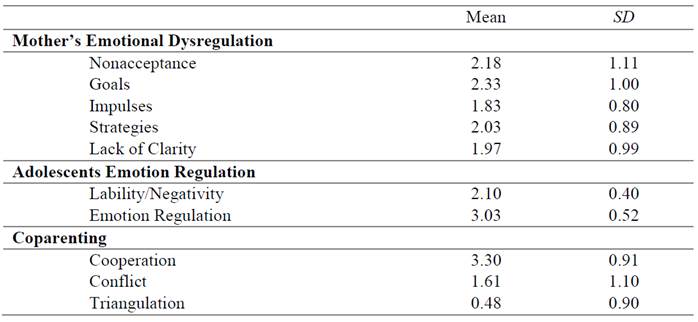
The experiences of emotional dysregulation of mothers measured by the DERS indicated that these are related to the mediation and outcome variables. After verifying that it was a non-normal sample, Spearman's correlation analysis was performed to assess the internal relationships between the dimensions. Many moderate and high correlations were observed, as shown in Table 2.
Table 2: Correlation between variables
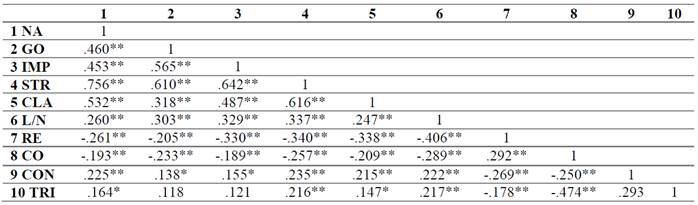
Notes: 1 NA: nonacceptance; 2 GO: goals; 3 IMP: impulse; 4 STR: strategy; 5 CLA: clarity; 6 L/N: lability/negativity; 7 RE: emotion regulation; 8 CO: mother’s cooperation; 9 CON: mother’s conflict; 10 TRI: mother’s triangulation.
** Correlation is significant at the 0.01 level (2 extremity)
* Correlation is significant at the 0.05 level (2 extremity)
Structural Model
Structural equation modeling is a technique that allows separating relationships for each set of dependent variables, providing the appropriate and most efficient estimation technique for a series of separate multiple regression equations estimated simultaneously. In this sense, observing this model allows us to verify the paths of the independent variables (emotional dysregulation of mothers) with the dependent ones (emotional regulation of children) and the mediator (coparenting).
Initially, the model showed adequate data adjustment: CFI = .93, CMIN/DF = 2.40 and RMSEA = .08. However, adjusting the existing covariance between goals and impulses in the mothers' emotional dysregulation and in the cooperation and conflict of coparenting, the result showed an excellent adjustment of data: CFI = .97, CMIN/DF = 1.52 and RMSEA = .05.
As for the model's standardized regression coefficients, the directions already indicated that the dimensions of the mothers' emotional dysregulation negatively affect the perceived emotional regulation of adolescent children, as well as negatively in the mediating variable coparenting (showing a negative relationship with cooperation, and a positive relationship with conflict and triangulation). It has been identified that the prediction of the dimensions of emotional dysregulation of mothers for coparenting (β = 0.31) and for emotional regulation of adolescents (β = -0.32) showed moderate indices.
The standardized regression coefficients of the model indicate that the dimensions of emotional dysregulation presented high and moderate indices, with β = 0.99 for strategies, β = 0.77 for non-acceptance, β = 0.64 objectives, β = 0.63 impulses and β = 0.61 clarity. The coefficients of the coparenting latent variable showed high rates, with β = 0.82 for cooperation, β = -0.59 for conflict and β = -0.58 for triangulation. The coefficients of the dimensions of the emotional regulation variable of the adolescent children showed indices β = 0.70 for lability and β = 0.72 for emotional regulation, considered high indices.
In the case of the mediating variable, it is considered that the mothers' emotional dysregulation is reduced when we add the coparenting variable as an additional predictor (β = 0.44), therefore the mediation is sustained (partial). It is also identified that the magnitude of prediction of the cooperation dimension of the latent variable is high, which in turn has a strong impact on the emotional regulation of adolescent children. Figure 1 depicts the final model.
Figure 1: Final Structural Model
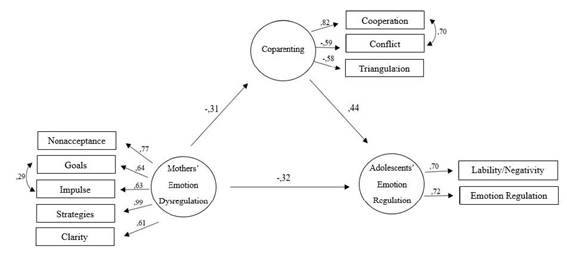
Discussion and Conclusions
The objective of this study was to verify the role of emotional dysregulation in mothers, as well as the possible mediation of coparenting in the emotional regulation of adolescent children from the perspective of mothers. Emotion regulation skills in adolescents are being linked with mental health protective factors (Antunes et al., 2018) if they are adaptive and with anxiety (Young et al., 2019), depression (Young et al., 2019) and suicidal ideation (Miller et al., 2018), in cases of emotional regulation deficits in adolescents. Given such magnitude, the results of this study demonstrate the importance of the family in the development of adolescent children, reinforcing what has been pointed out in research on coparenting and reverberation in children (Machado & Mosmann, 2019; Mosmann et al., 2018).
When evaluating the composition of the latent variables of the interaction model, corroborated with the averages and correlation indices, the data reflect a sample with levels of emotional dysregulation of mothers, indicating difficulties in engaging in goal-directed behaviors when experiencing negative emotions (β = 0.64), problems accepting negative emotions (β = 0.77) and limited access to emotion regulation strategies (β = 0.99), such as the dimensions with the highest means building the latent variable emotional dysregulation of mothers. These emotional dysregulation indices may be related to the mothers' overload of domestic and parental tasks. In 2017, a study by the Brazilian Institute of Geography and Statistics (IBGE) pointed out that mothers dedicate twice as much time as men to household chores and caring for people. In this sense, the overload of activities and the feeling of disproportionate responsibility for managing the household and the children are associated with the lack of emotional well-being of mothers (Ciciolla & Luthar, 2019).
However, a significant percentage of the sample reported diagnosis of mental disorders, such as anxiety disorders and mood disorders. These groups of disorders are associated with difficulties in emotion regulation. In the context of psychopathology, deficits in emotion regulation have negative relationships with the subject's well-being (Kraiss et al., 2020), so this is a sample of mothers with significant rates of mental disorder and consequently with difficulties in emotion regulation.
The composition of the coparenting variable was primarily composed of coparental cooperation (β = 0.82). Descriptive analyses show mothers with high levels of dysregulation, but who perceive themselves as having high levels of cooperation when referring to coparenting. This apparent contradiction could suggest that mothers who recognize their difficulties in emotional regulation may adopt a cooperative posture in their coparenting relationship, perhaps as a compensatory behavior. Aware of their individual difficulties, they seek support from the coparental pair.
In addition, it is known that caregivers tend to respond to studies about their parental performance more positively, giving socially desirable responses (Almiro, 2017). This bias is still one of the biggest challenges in evaluating psychological phenomena. It is possible that the high levels of cooperation are expressing a positive self-evaluation of these mothers in their coparenting posture.
These particularities contributed to the formation of specific aspects of this sample. However, in addition to the characteristics of this group, the relationships between the constructs emotional dysregulation of mothers and emotional regulation of children and coparenting were investigated, both in terms of relationships and correlations, as well as in terms of interactions in the proposed model, supporting the scientific literature in the field and advancing the understanding in some areas.
Based on these considerations, this study yielded two main results. The first result is related to the mediating role of coparenting between the emotional dysregulation of mothers and the emotional regulation of adolescent children. In the case of children's emotional regulation, the Interactional Model pointed out that three observable variables were highly influential and proved to be strongly explanatory for this construct: the dimension lack of strategies and non-acceptance of the mother's emotions (in the latent variable emotional dysregulation of mothers) and coparenting cooperation (in the latent variable coparenting). These observable variables were significant in explaining the model, highlighting that the dimensions of coparenting cooperation (.82) (positively impacting) and lack of strategies to regulate the mother's emotions (.99) (negatively impacting) were substantially greater than the other variables.
In this sense, by inserting the latent variable coparenting in the structural equation, the strength of the impact of the emotional dysregulation variable of mothers on the emotional regulation of their children was reduced (Hair et al., 2010), showing partial mediation of coparenting between them. This means that, in addition to what has already been foreseen about learning emotional regulation through social learning and modeling (Morris et al. 2007; Reindl et al., 2018), observed in the direct relationship the coparenting subsystem, the way in which the parental couple performs their functions in the family (Costa et al., 2017; Margolin et al., 2001) is part of this relationship.
These findings show the potential of cooperation in coparenting, indicating that the positive relationship between caregivers can reverberate in the quality of the children's mental health. Most research on coparenting has focused on its negative dimensions, as it has been noted in previous studies (Margolin et al., 2001). However, theorists who study this topic point out that the quality of coparenting in the family seems to be more important for the child's functioning than other aspects of the couple (Schoppe-Sullivan et al., 2001). This finding provides more substantial evidence in support of existing research indicating that coparental cooperation is related to the socio-emotional adjustment of children (Choi et al., 2019), as it is the dimension that most positively impacts the emotional regulation of adolescent children.
It should also be noted that the emotional dysregulation of mothers had an indirect effect on the emotional regulation of adolescent children. This result can be better explained by the fact that the emotional dysregulation of the mothers affects the emotional regulation of the children if it is directed towards the adolescent and not acting only on an individual level. This finding is consistent with some studies that examined the emotional dysregulation of mothers, suggesting that this variable was related to consequences in the offspring (Giordano et al., 2021), which were not limited to direct effects on the emotional regulation of the children.
In this sense, the second main result of this study is related to the emotional dysregulation of mothers having a negative effect on coparental cooperation and a positive effect on conflict and coparental triangulation. Although the mothers in this sample declared themselves cooperative, the negative path of the latent variable mothers' emotional dysregulation to coparenting indicates that the mothers' emotional dysregulation reported in the DERS could predict a lower ability to cooperate with the coparenting partner. This result may be related to the fact that mothers need to have emotional regulation skills to cooperate with their coparental partner. This was also observed in the correlations in which the negative direction corresponds to mothers who were more dysregulated having lower levels of coparental cooperation. Consequently, this low cooperation can impact on lower emotional regulation of children.
This data contributes to the existing research on coparenting by building on previous findings regarding personal variables that influence the quality of the coparenting relationship. Factors such as marital quality before the birth of the child (Schoppe-Sullivan et al., 2007), stress (Kang et al., 2022), and the ability to solve problems (Majdandžić et al., 2012) are necessarily permeated by emotional regulation (McRae & Gross, 2020) of parents in a coparenting relationship.
Overall, the present study suggests that the quality of coparenting, specifically coparenting cooperation, is associated with the emotional regulation of adolescent children, and that the emotional dysregulation of mothers seems to have a detrimental impact on coparenting cooperation. Given the importance of coparenting for children and the well-being of the family (Costa et al., 2017; Mosmann et al., 2018), these results indicate, in the clinical context, that taking a preventative approach with parents, through interventions that provide emotional regulation support for the development of skills in the exercise of the coparenting subsystem, are essential for the adaptive development of children (Frizzo et al., 2005).
Some limitations of this study need to be discussed. First, this study was applied during the beginning of the Covid-19 pandemic, while fathers, mothers, other caregivers and children were confined, which consequently increases stress levels (Freisthler et al., 2021). The pandemic situation may have had an impact on the results of emotional dysregulation reported by mothers. Another important limitation is related to the cross-sectional design method. Longitudinal research could test temporal relationships between constructs and the chronological order of variables. Another important consideration is that the research adopts only the perspective of mothers. It is possible that if we added the perspectives of parents and adolescents about coparenting and emotional regulation, the results could be different. Finally, regarding future directions of research on emotional regulation of parents and adolescents and the role of coparenting, there could be an investigation about which emotional regulation strategies are related to the dimensions of coparenting, in addition to investigating the variables from the perceptions of the father, the mother and the child, which may provide answers about the dynamics of dyadic and triadic interactions that occur in coparenting.
References:
Almiro, P. A. (2017). Uma nota sobre a desejabilidade social e o enviesamento de respostas. Revista Avaliação Psicológica, 16(03). https://doi.org/10.15689/ap.2017.1603.ed
Antunes, J., Matos, A. P., & Costa, J. J. (2018). Regulação emocional e qualidade do relacionamento com os pais como preditoras de sintomatologia depressiva em adolescentes. Revista Portuguesa de Enfermagem de Saúde Mental, Especial, 6, 52-58. https://doi.org/10.19131/rpesm.0213
Bariola, E., Gullone, E., & Hughes, E. K. (2011). Child and adolescent emotion regulation: the role of parental emotion regulation and expression. Clinical Child and Family Psychology Review, 14(2), 198-212. https://doi.org/10.1007/s10567-011-0092-5
Barnett, M. A., Scaramella, L. V., McGoron, L., & Callahan, K. (2011). Coparenting cooperation and child adjustment in low-income mother-grandmother and mother-father families. Family Science, 2(3), 159-170. https://doi.org/10.1080/19424620.2011.642479
Bjureberg, J., Ljótsson, B., Tull, M. T., Hedman, E., Sahlin, H., Lundh, L. G., Bjärehed, J., DiLillo, D., Messman-Moore, T., Hellner Gumpert, I., & Gratz, K. L. (2016). Development and validation of a Brief Version of the Difficulties in Emotion Regulation Scale: The DERS-16. Journal of Psychopathology and Behavioral Assessment, 38(2), 284-296. https://doi.org/10.1007/s10862-015-9514-x
Blair, B. L., Gangle, M. R., Perry, N. B., O’Brien, M., Calkins, S. D., Keane, S. P., & Shanahan, L. (2016). Indirect effects of emotion regulation on peer acceptance and rejection: the roles of positive and negative social behaviors. Merrill-Palmer Quarterly, 62(4), 415-439. https://doi.org/10.13110/merrpalmquar1982.62.4.0415
Campbell, C. G. (2022). Two decades of coparenting research: a scoping review. Marriage & Family Review, 1-33. https://doi.org/10.1080/01494929.2022.2152520
Cheung, R. Y. M., Chan, L. Y., & Chung, K. K. H. (2020). Emotion dysregulation between mothers, fathers, and adolescents: Implications for adolescents’ internalizing problems. Journal of Adolescence, 83(January), 62-71. https://doi.org/10.1016/j.adolescence.2020.07.001
Choi, J. K., Parra, G., & Jiang, Q. (2019). The longitudinal and bidirectional relationships between cooperative coparenting and child behavioral problems in low-income, unmarried families. Journal of Family Psychology, 33(2), 203-214. https://doi.org/10.1037/fam0000498
Ciciolla, L. & Luthar, S. S. (2019). Invisible household labor and ramifications for adjustment: mothers as captains of households. Sex Roles, 81(7-8), 467-486. https://doi.org/10.1007/s11199-018-1001-x
Costa, C. Machado, M. Schneider, M. Mosmann, C. (2017). Subsistema coparental: revisão sistemática de estudos empíricos. Psico, 48(4), 339-351. https://doi.org/10.15448/1980-8623.2017.4.25386
Crandall, A. A., Ghazarian, S. R., Day, R. D., & Riley, A. W. (2016). Maternal emotion regulation and adolescent behaviors: The mediating role of family functioning and parenting. Journal of Youth and Adolescence, 45(11), 2321-2335. https://doi.org/10.1007/s10964-015-0400-3
Creswell, J. W. (2010). Projeto de pesquisa: métodos qualitativo, quantitativo e misto (2nd ed.). Bookman.
Cui, L., Criss, M. M., Ratliff, E., Wu, Z., Houltberg, B. J., Silk, J. S., & Morris, A. S. (2020). Longitudinal links between maternal and peer emotion socialization and adolescent girls’ socioemotional adjustment. Developmental Psychology, 56(3), 595-607. https://doi.org/10.1037/dev0000861
D’Agostino, A., Covanti, S., Rossi Monti, M., & Starcevic, V. (2017). Reconsidering emotion dysregulation. Psychiatric Quarterly, 88(4), 807-825. https://doi.org/10.1007/s11126-017-9499-6
Flick, U. (2009). Uma introdução à pesquisa qualitativa (3rd ed.). Artmed/Bookman.
Freisthler, B., Gruenewald, P. J., Tebben, E., McCarthy, K. S., & Price Wolf, J. (2021). Understanding at-the-moment stress for parents during COVID-19 stay-at-home restrictions. Social Science & Medicine, 279, 114025. https://doi.org/10.1016/j.socscimed.2021.114025
Frizzo, G. B., Kreutz, C. M., Schmidt, C., Piccinini, C. A., & Bosa, C. (2005). O conceito de coparentalidade e suas implicações para a pesquisa e para a clínica: implication for research and clinical practice. Journal of Human Growth and Development, 15(3), 84. https://doi.org/10.7322/jhgd.19774
Gallegos, M. I., Murphy, S. E., Benner, A. D., Jacobvitz, D. B., & Hazen, N. L. (2017). Marital, parental, and whole-family predictors of toddlers’ emotion regulation: The role of parental emotional withdrawal. Journal of Family Psychology, 31(3), 294-303. https://doi.org/10.1037/fam0000245
Gil, A. (2010). Como elaborar projetos de pesquisa (5th ed.). Atlas.
Giordano, C., Lo Coco, G., Salerno, L., & Di Blasi, M. (2021). The role of emotion dysregulation in adolescents’ problematic smartphone use: A study on adolescent/parents triads. Computers in Human Behavior, 115, 106632. https://doi.org/10.1016/j.chb.2020.106632
Gratz, K. L. & Roemer, L. (2004). Multidimensional assessment of emotion regulation and dysregulation: development, factor structure, and initial validation of the difficulties in emotion regulation scale. Journal of Psychopathology and Behavioral Assessment, 26(1), 41-54. https://doi.org/10.1023/b:joba.0000007455.08539.94
Hair, J. F., Black, W. C., Babin, B. J., & Anderson, R. E. (2010). Multivariate Data Analysis (7th ed.). Pearson.
Inwood, E. & Ferrari, M. (2018). Mechanisms of change in the relationship between self-compassion, emotion regulation, and mental health: a systematic review. Applied Psychology: Health and Well-Being, 10(2), 215-235. https://doi.org/10.1111/aphw.12127
Kang, S. K., Choi, H. J., & Chung, M. R. (2022). Coparenting and parenting stress of middle-class mothers during the first year: bidirectional and unidirectional effects. Journal of Family Studies, 28(2), 551-568. https://doi.org/10.1080/13229400.2020.1744472
Karaer, Y. & Akdemir, D. (2019). Parenting styles, perceived social support and emotion regulation in adolescents with internet addiction. Comprehensive Psychiatry, 92, 22-27. https://doi.org/10.1016/j.comppsych.2019.03.003
Koch, C., Schaefer, J. R., Schneider, M., & Mosmann, C. (2020). Coparentalidade e conflito pais-filhos em adolescentes envolvidos em práticas restaurativas. Psico-USF, 25(2), 343-355. https://doi.org/10.1590/1413-82712020250212
Kraiss, J. T., ten Klooster, P. M., Moskowitz, J. T., & Bohlmeijer, E. T. (2020). The relationship between emotion regulation and well-being in patients with mental disorders: a meta-analysis. Comprehensive Psychiatry, 102, 152189. https://doi.org/10.1016/j.comppsych.2020.152189
Kwon, K., Hanrahan, A. R., & Kupzyk, K. A. (2017). Emotional expressivity and emotion regulation: Relation to academic functioning among elementary school children. School Psychology Quarterly, 32(1), 75-88. https://doi.org/10.1037/spq0000166
Lewis, J., Binion, G., Rogers, M., & Zalewski, M. (2020). The associations of maternal emotion dysregulation and early child dissociative behaviors. Journal of Trauma and Dissociation, 21(2), 203-216. https://doi.org/10.1080/15299732.2019.1678211
Li, D., Li, D., Wu, N., & Wang, Z. (2019). Intergenerational transmission of emotion regulation through parents’ reactions to children’s negative emotions: tests of unique, actor, partner, and mediating effects. Children and Youth Services Review, 101(December 2018), 113-122. https://doi.org/10.1016/j.childyouth.2019.03.038
Machado, M. R. & Mosmann, C. P. (2019). Dimensões negativas da coparentalidade e sintomas internalizantes: a regulação emocional como mediadora. Psicologia: Teoria e Pesquisa, 35(Spec. Iss.), e35nspe12. https://doi.org/10.1590/0102.3772e35nspe12
Macie, K. M. & Stolberg, A. L. (2003). Assessing Parenting After Divorce. Journal of Divorce & Remarriage, 39(1-2), 89-107. https://doi.org/10.1300/J087v39n01_06
Majdandžić, M., de Vente, W., Feinberg, M. E., Aktar, E., & Bögels, S. M. (2012). Bidirectional associations between coparenting relations and family member anxiety: a review and conceptual model. Clinical Child and Family Psychology Review, 15(1), 28-42. https://doi.org/10.1007/s10567-011-0103-6
Margolin, G., Gordis, E. B., & John, R. S. (2001). Coparenting: a link between marital conflict and parenting in two-parent families. Journal of Family Psychology, 15(1), 3-21. https://doi.org/10.1037/0893-3200.15.1.3
McRae, K. & Gross, J. J. (2020). Emotion regulation. Emotion, 20(1), 1-9. https://doi.org/10.1037/emo0000703
Miguel, F. K., Giromini, L., Colombarolli, M. S., Zuanazzi, A. C., & Zennaro, A. (2017). A Brazilian investigation of the 36- and 16-item Difficulties in Emotion Regulation Scales. Journal of Clinical Psychology, 73(9), 1146-1159. https://doi.org/10.1002/jclp.22404
Miller, A. B., McLaughlin, K. A., Busso, D. S., Brueck, S., Peverill, M., & Sheridan, M. A. (2018). Neural correlates of emotion regulation and adolescent suicidal ideation. Biological Psychiatry: Cognitive Neuroscience and Neuroimaging, 3(2), 125-132. https://doi.org/10.1016/j.bpsc.2017.08.008
Morris, A. S., Criss, M. M., Silk, J. S., & Houltberg, B. J. (2017). The Impact of Parenting on Emotion Regulation During Childhood and Adolescence. Child Development Perspectives, 11(4), 233-238. https://doi.org/10.1111/cdep.12238
Morris, A. S., Silk, J. S., Steinberg, L., Myers, S. S., & Robinson, L. R. (2007). The role of the family context in the development of emotion regulation. Social Development, 16(2), 361-388. https://doi.org/10.1111/j.1467-9507.2007.00389.x
Mosmann, C. & Wagner, A. (2008). Dimensiones de la conyugalidad y de la parentalidad: un modelo correlacional. Revista Intercontinental de Psicología y Educación, 10(2), 79-103.
Mosmann, C. P., Costa, C. B., Einsfeld, P., Silva, A. G. M., & Koch, C. (2017). Conjugalidade, parentalidade e coparentalidade: associações com sintomas externalizantes e internalizantes em crianças e adolescentes. Estudos de Psicologia (Campinas), 34, 487-498. https://doi.org/10.1590/1982-02752017000400005
Mosmann, C., Costa, C., Silva, A. & Luz, S. K. (2018). Filhos com sintomas psicológicos clínicos: papel discriminante da conjugalidade, coparentalidade e parentalidade. Temas em Psicologia, 26(51), 429-442. https://doi.org/10.9788/TP2018.1-17Pt
Pallini, S., Vecchio, G. M., Baiocco, R., Schneider, B. H., & Laghi, F. (2019). Student-teacher relationships and attention problems in school-aged children: the mediating role of emotion regulation. School Mental Health, 11(2), 309-320. https://doi.org/10.1007/s12310-018-9286-z
Perry, N. B., Dollar, J. M., Calkins, S. D., Keane, S. P., & Shanahan, L. (2020). Maternal socialization of child emotion and adolescent adjustment: Indirect effects through emotion regulation. Developmental Psychology, 56(3), 541-552. https://doi.org/10.1037/dev0000815
Qian, Y., Chen, F., & Yuan, C. (2020). The effect of co-parenting on children’s emotion regulation under fathers’ perception: a moderated mediation model of family functioning and marital satisfaction. Children and Youth Services Review, 119(October), 105501. https://doi.org/10.1016/j.childyouth.2020.105501
Reindl, V., Gerloff, C., Scharke, W., & Konrad, K. (2018). Brain-to-brain synchrony in parent-child dyads and the relationship with emotion regulation revealed by fNIRS-based hyperscanning. NeuroImage, 178(May), 493-502. https://doi.org/10.1016/j.neuroimage.2018.05.060
Reis, A. H., Silva De Oliveira, S. E., Bandeira, D. R., Andrade, N. C., Abreu, N., & Sperb, T. M. (2016). Emotion Regulation Checklist (ERC): estudos preliminares da adaptação e validação para a cultura Brasileira. Temas Em Psicologia, 24(1), 77-96. https://doi.org/10.9788/TP2016.1-06
Riina, E. M., Lee, J.-K., & Feinberg, M. E. (2020). Bidirectional associations between youth adjustment and mothers’ and Fathers’ coparenting conflict. Journal of Youth and Adolescence, 49(8), 1617-1630. https://doi.org/10.1007/s10964-020-01262-6
Sabadini, A; Sampaio, M., & Koller, S. (2009). Publicar em Psicologia: um enfoque para a revista científica. Associação Brasileira de Editores Científicos de Psicologia.
Schoppe-Sullivan, S. J., Mangelsdorf, S. C., & Frosch, C. A. (2001). Coparenting, family process, and family structure: Implications for preschoolers’ externalizing behavior problems. Journal of Family Psychology, 15(3), 526-545. https://doi.org/10.1037/0893-3200.15.3.526
Schoppe-Sullivan, S. J., Mangelsdorf, S. C., Brown, G. L., & Szewczyk Sokolowski, M. (2007). Goodness-of-fit in family context: Infant temperament, marital quality, and early coparenting behavior. Infant Behavior and Development, 30(1), 82–96. https://doi.org/10.1016/j.infbeh.2006.11.008
Shields, A. M. & Cicchetti, D. (1995). The development of an emotion regulation assessment battery: Reliability and validity among at-risk grade-school children (Conference presentation). Society for Research on Child Development, Indianapolis, United States.
Szkody, E., Steele, E. H., & McKinney, C. (2020). Links between parental socialization of coping on affect: Mediation by emotion regulation and social exclusion. Journal of Adolescence, 80(June 2019), 60-72. https://doi.org/10.1016/j.adolescence.2020.02.004
Teubert, D. & Pinquart, M. (2011). The Coparenting Inventory for Parents and Adolescents (CI-PA) reliability and validity. European Journal of Psychological Assessment, 27(3), 206-215. https://doi.org/10.1027/1015-5759/a000068
Thomassin, K., Suveg, C., Davis, M., Lavner, J. A., & Beach, S. R. H. (2017). Coparental affect, children’s emotion dysregulation, and parent and child depressive symptoms. Family Process, 56(1), 126-140. https://doi.org/10.1111/famp.12184
Williams, W. C., Morelli, S. A., Ong, D. C., & Zaki, J. (2018). Interpersonal emotion regulation: implications for affiliation, perceived support, relationships, and well-being. Journal of Personality and Social Psychology, 115, 224-254. https://doi.org/10.1037/pspi0000132
Young, K. S., Sandman, C. F., & Craske, M. G. (2019). Positive and negative emotion regulation in adolescence: links to anxiety and depression. Brain Sciences, 9(4). https://doi.org/10.3390/brainsci9040076
How to cite: Dalla Corte Euzebio, L. & Pereira Mosmann, C. (2023). Coparenting as a mediator between mothers’ emotion dysregulation and the perception of adolescents’ emotion regulation. Ciencias Psicológicas, 17(1), e-2583. https://doi.org/10.22235/cp.v17i1.2583
Authors’ participation: a) Conception and design of the work; b) Data acquisition; c) Analysis and interpretation of data; d) Writing of the manuscript; e) Critical review of the manuscript.
L. D. C. E. has contributed in a, b, c, d, e; C. P. M. in a, b, c, d, e.
Scientific editor in-charge: Dra. Cecilia Cracco.