10.22235/cp.v17i1.2478
Intervenções promotoras da capacidade de mentalização e função reflexiva: uma revisão integrativa
Interventions to improve mentalization and reflective functioning: a scoping review
Intervenciones promotoras de la capacidad de mentalización y función reflexiva: una revisión integrativa
Márcia Pinheiro Schaefer1, ORCID 0000-0002-4060-5261
Débora Becker2, ORCID 0000-0002-5556-2567
Tagma Marina Schneider Donelli3, ORCID 0000-0003-3083-0083
1 Universidade do Vale do Rio dos Sinos, Brasil, [email protected]
2 Universidade do Vale do Rio dos Sinos, Brasil
3 Universidade do Vale do Rio dos Sinos, Brasil
Resumo:
Esta revisão integrativa da literatura objetivou sistematizar as possibilidades de intervenções promotoras da Capacidade de Mentalização (CM) e Função Reflexiva (FR), publicadas entre 2008 a 2019. Utilizou-se os descritores “reflective functioning OR mentalizing OR mentalization AND intervention” e incluiu-se artigos empíricos, disponibilizados em Inglês, Português ou Espanhol, provenientes de diferentes áreas. Analisou-se os dados através das categorias: objetivos; delineamentos; participantes; tipo de intervenção utilizada; instrumentos de avaliação da intervenção empregados; resultados. Encontrou-se 34 artigos que predominantemente verificaram a eficácia das intervenções, possuíam delineamento quantitativo, voltados para adultos e, ainda, intervenções com potencial para fortalecer os vínculos pais/cuidadores-criança. Concluiu-se sobre a necessidade de se desenvolver instrumentos específicos para avaliar FR e CM, estudos que abordem a realidade brasileira e, ainda, a sistematização desses conceitos, que na maioria dos artigos, se apresentaram como sinônimos.
Palavras-chave: mentalização; intervenção; função reflexiva.
Abstract:
This scoping review explores research conducted between 2008 to 2019, that aims to understand the conceptual use of mentalization (M) and reflective functioning (RF) and explore possibilities for interventions that promote these skills. The review utilized the descriptors “reflective functioning OR mentalizing OR mentalization AND intervention”. Reviewed papers were written in English, Portuguese or Spanish, and covered several research areas. The analysis considered several categories, including aims, study design, participants, type of intervention, intervention assessments and outcomes. Thirty-four papers were considered, most of them using a quantitative approach and addressed to adults and parents/caregivers-infants. The present review highlights the need to develop specific assessments procedures to evaluate RF and M, as well as studies that consider the Brazilian context. The study also emphasizes the need for theoretical systematization of M and RF concepts, considering they are frequently used as synonyms.
Keywords: mentalization; intervention; reflective functioning.
Resumen:
La presente revisión integrativa exploró investigaciones realizadas entre 2008 y 2019 para sistematizar información acerca del uso conceptual de capacidad de mentalización (CM) y función reflexiva (FR), así como las posibilidades de intervenciones para su promoción. Los descriptores fueron “reflective functioning OR mentalizing OR mentalization AND intervention” en la búsqueda artículos empíricos en inglés, portugués o español, de distintas áreas del conocimiento. El análisis de los datos consideró las categorías: objetivos, diseños, participantes, tipo de intervención utilizada, instrumentos de evaluación de la intervención y resultados. Treinta y cuatro artículos fueron elegidos, en su mayoría cuantitativos, destinados a adultos y padres-bebés. La revisión destaca la necesidad del desarrollo de instrumentos de evaluación específicos para evaluar FR y CM, así como la necesidad de investigaciones que exploren la realidad de países como Brasil. Otro aspecto es la sistematización de los conceptos, ya que, en su mayoría, fueron referidos como sinónimos.
Palabras clave: mentalización; intervención; función reflexiva.
Recebido: 26/2/2021
Aceito: 25/1/2023
O bebê, crianças entre 0 e 24 meses, dotado de um aparato psíquico incipiente, irá se constituir a partir da comunicação inconsciente que firmará especialmente com sua mãe, utilizando-se do psiquismo materno como um ego auxiliar para orientar-se no mundo real (Cramer & Palacio-Espasa, 1993). Desta forma, a herança das vivências maternas das relações reais e fantasiadas com suas figuras parentais irá interferir na interação atual mãe-bebê, facilitando ou dificultando a criação de um vínculo saudável e prazeroso (Feliciano & Souza, 2011).
Neste sentido, as investigações mais recentes, embasadas em estudos primariamente conduzidos nos anos 90 (Fonagy & Target, 1997), têm reconhecido o papel da capacidade de mentalização (CM) e da função reflexiva (FR) como um processo fundamental e implícito às relações de apego entre pais e filhos (Tomlin et al., 2009), desempenhando um papel importante no desenvolvimento socioemocional da criança, no processo de autorregulação das emoções e no desenvolvimento de um apego seguro (Slade, 2005), o que traz reverberações ao longo de toda a vida.
A teoria da mentalização foi desenvolvida por Fonagy e colaboradores na década de 90 (Holmes, 2006) e tem como base teórico-epistemológica a teoria da mente, a teoria do apego, a psicopatologia do desenvolvimento, assim como a neurociência. Ela engloba a CM, que é definida como a capacidade de compreender a si mesmo e aos outros em termos de processos e estados mentais subjacentes, como sentimentos, desejos e crenças (Fonagy & Allison, 2012), assim como a FR, que consiste na habilidade do sujeito mentalizar seus estados mentais, assim como os dos outros (Slade, 2005), sendo, portanto, a operacionalização da capacidade de mentalização. No âmbito das relações pais/cuidador-criança a habilidade do adulto para refletir o estado interno da criança mediante respostas condizentes com seu estado interno e que expressem suas emoções, e não as projeções parentais, é chamada de função reflexiva parental (FRP) (Ramires & Godinho, 2011). Quanto maior for a FRP, maior será a capacidade parental para lidar com a labilidade emocional do bebê, sem que sejam dominados pelas próprias emoções (Kelly et al., 2005).
A condição materna para manter em sua mente a representação de seu bebê como detentor de sentimentos, desejos e intenções, permitirá a esta o espelhamento e a reapresentação do estado afetivo da criança, que assim poderá descobrir sua própria experiência interna (Slade, 2005). Este processo, que ocorre conforme o desenvolvimento infantil e a interação mãe-filho, propicia a criação de um vínculo positivo e uma experiência física e psicológica de conforto e segurança para a criança, e possui um papel vital na transmissão transgeracional do apego (Ordway et al., 2015).
Esse vínculo único e significativo com a figura de apego (geralmente a mãe) gera no bebê um senso de segurança, advindo do conhecimento sobre a disponibilidade e sensibilidade maternas. Esse senso de segurança será primordial para o fortalecimento da relação da díade e para o desenvolvimento de uma base segura nas explorações da criança, reverberando ao longo de toda a sua vida (Bowlby, 1989; Dalbem & Dalbosco, 2005). Se nesta relação de apego seguro, os pais responderem aos estados emocionais infantis de forma acolhedora e significativa, através de sua FR, possibilitarão que a criança compreenda e diferencie seus estados mentais e emoções, desenvolvendo uma percepção de si e uma CM (Ensink et al., 2015; Fonagy & Target, 2006; Zevalkink, 2008).
A aquisição da CM, integra assim, um processo intersubjetivo entre pais/cuidador e a criança que possibilitará à última, atingir a autorregulação das próprias emoções, desenvolvendo sua segurança interna, a autoestima, a autonomia e, em última instância, sua própria CM e FR (Fonagy, 1999; Ramires & Schneider, 2010). Mais recentemente, observa-se que estudos baseados na teoria da mentalização têm se dedicado, não só a desvelar a estruturação destas habilidades importantes para a vinculação e desenvolvimento emocional humano, mas também a desenvolver intervenções que se configuram como estratégias de prevenção e promoção da saúde em diferentes contextos e com distintos públicos.
Neste sentido, partindo do entendimento de que a CM e a FR resultam da associação entre vivências infantis e que em situações de impacto emocional intenso, poderão ficar temporariamente obstaculizadas, repercutindo na relação mãe-bebê, no desenvolvimento emocional do último (Mesa & Gómez, 2010) e na qualidade das interações sociais ao longo da vida, torna-se fundamental investigar estratégias de intervenções capazes de aprimorar e promover estas capacidades. Assim este estudo objetivou sistematizar as intervenções que se propuseram a aprimorar ou promover o desenvolvimento da CM e da FR, publicadas entre os anos de 2008 e 2019, a fim de delinear um panorama global acerca da temática proposta. Ainda, considerando que ainda há estudos que utilizam os termos CM e FR como sinônimos (Dalbem & Dalbosco, 2005), evidencia-se também, a necessidade de uma sistematização conceitual acerca de suas configurações a partir da literatura existente.
Este estudo de revisão teve como motivação a seguinte questão: quais são as intervenções realizadas nos últimos anos que aprimoram ou promovem a CM e/ou a FR apontadas pela literatura? Buscando respondê-la, efetivaram-se buscas em bases de dados durante o mês de maio de 2020, utilizando-se os descritores assim combinados: “reflective functioning OR mentalizing OR mentalization AND intervention”.
O levantamento bibliográfico ocorreu mediante pesquisas nas bases de dados Academic Search Complete, CINAHL, Medline Complete, Scopus, PsycINFO, LILACS e SciELO, já que o tema é pertinente a campos interdisciplinares como a psicologia, a medicina e a enfermagem. Para fins de acurar a seleção dos artigos, utilizou-se como critérios de inclusão: (a) ser artigo empírico, tese ou dissertação; (b) ter sido publicado entre maio de 2008 a dezembro de 2019; (c) estar o material disponível integralmente; e (d) estar disponível em inglês, português ou espanhol. Como critérios de exclusão, desconsiderou-se estudos: (a) publicados em formato de livro, capítulo de livro, resenhas, artigos teóricos, relatos de experiência, estudos de casos e revisões sistemáticas ou de literatura; (b) não relacionados a intervenções que favoreçam o desenvolvimento da CM e FR.
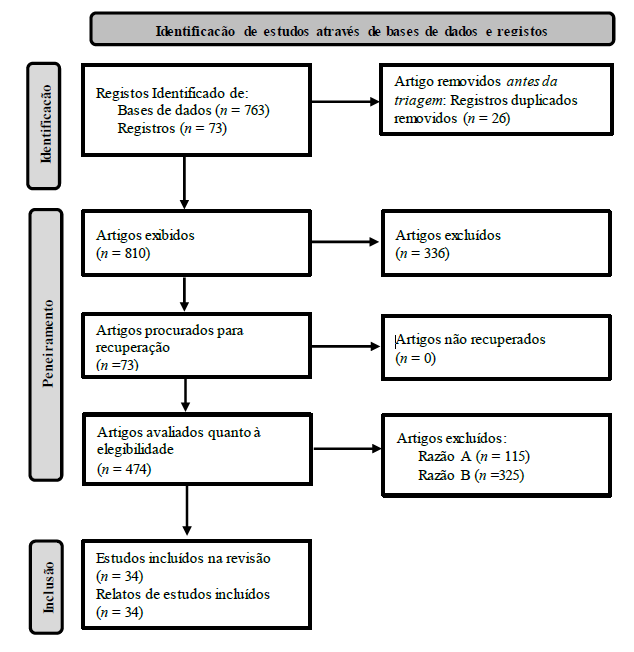
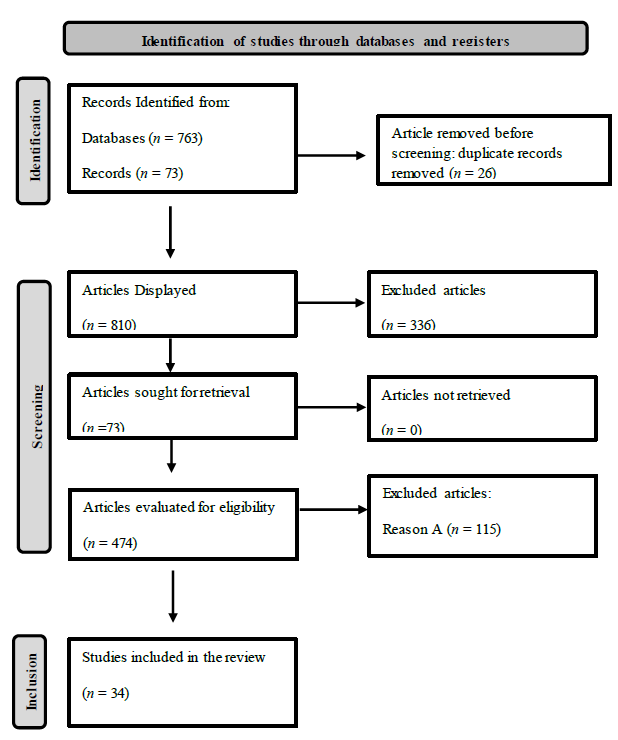
Ao se iniciar as buscas iniciais, aplicaram-se os filtros: a) ano de publicação, b) artigo científico, e c) artigo revisado por pares. A seguir, efetuou-se a seleção conforme Figura 1, considerando os critérios de inclusão e exclusão.
Nesta etapa, grande parte dos artigos descartados pertenciam à neurociência, com análises do funcionamento cerebral mediante ressonância magnética ou eletroencefalograma e, dentre aqueles que não abordavam o tema, destacaram-se estudos relativos à biologia de insetos, como a análise de estruturas corneanas para compreensão da difração ótica. Ressalta-se que dois juízes independentes efetuaram os procedimentos para seleção dos artigos, a fim de assegurar a qualidade dos achados e diminuir possíveis vieses e, ainda, que para a elaboração desta escrita, utilizou-se as diretrizes do Preferred Reporting Items for Systematic Reviews and Meta-Analyses (Moher et al., 2009; Prisma <www.prisma-statement.org/>).
Figura 1: Fluxograma do processo de seleção dos artigos
Resultado e Discussão
Visando realizar uma análise global dos resultados, os artigos que se adequaram aos critérios de inclusão foram submetidos a uma análise quantitativa das categorias a fim de se identificar a frequência de cada item, e qualitativa, para se apreciar o conteúdo delas. Neste sentido, identificou-se que entre 2008 e 2010 não se encontrou publicações a partir dos descritores pesquisados. As primeiras produções datam de 2009, com dois do total dos artigos selecionados (Fonagy et al., 2009; Vik & Hafting, 2009), mesmos índices de 2018 (De Meulemeester et al., 2018; Ordway et al., 2018).
Evidencia-se um aumento de publicações acerca da temática a partir de 2013, sendo que em 2016 e 2019 obteve-se uma maior incidência, totalizando sete dos artigos encontrados em cada um dos anos (Ashton et al., 2016; Barnicot & Crawford, 2019; Bateman et al., 2016; Einy et al., 2019; Enav et al., 2019; Esposito et al., 2019; Griffiths et al., 2019; Hertzmann et al., 2016; Kivity et al., 2019; Meschino et al., 2016; Pajulo et al., 2016; Stacks et al., 2019; Suchman et al., 2016; Ware et al., 2016), sugerindo que neste período houve um maior interesse nas investigações acerca destas intervenções. A seguir, tem-se 2015 (Freda et al., 2015; Howieson & Priddis, 2015; Rice et al., 2015; Rosenblau et al., 2015) e 2017 com quatro artigos divulgados (Bo et; al., 2017; Bressi et al., 2017; Edel et al., 2017; Suchman et al., 2017). Os anos de 2013 (Ensink et al., 2013; Ingley-Cook & Dobel-Ober, 2013; Sadler et al., 2013) e 2014 (Bain, 2014; Ordway et al., 2014; Ramsauer et al., 2014), constituem três publicações. Já em 2011 (Twemlow et al., 2011) e 2012 (Jakobsen et al., 2012) o número de artigos obtido em cada ano foi de um.
Percebe-se que a distribuição das publicações por ano reflete a evolução das pesquisas no âmbito da teoria da mentalização, somada ao aprimoramento dos conceitos de CM e FR que vêm sendo realizado por Fonagy e colaboradores desde a década de 90 (Holmes, 2006; Slade, 2007). Ainda, cabe destacar a criação de grupos de estudos específicos dedicados ao desenvolvimento de programas de intervenções para pais e crianças menores em ambiente de alto risco, a exemplo do da Yale Child Study Center, fundado em 2003 (Slade, 2007).
Em uma análise mais detalhada acerca da abordagem dos conceitos de CM e FR ao longo do período desta revisão, observa-se, conforme a Figura 2, que os mesmos despontaram na literatura em 2009, sendo a CM, a temática predominantemente explorada até 2015. Tais resultados corroboram estudo que apontou o aumento expressivo do uso termo mentalização entre 1991 e 2017, que passou de 7 para 844, segundo o buscador Thompson Reuter da Web of Science (Malda-Castillo et al., 2019).
Figura 2: Apresentação dos conceitos de FR e CM ao longo do tempo
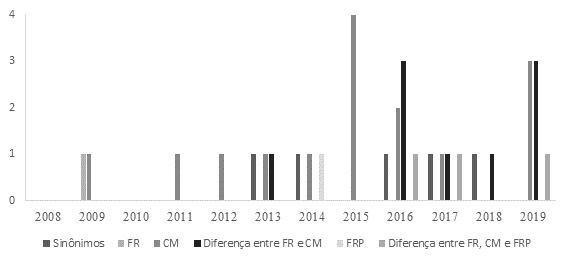
Destaca-se ainda, conforme Figura 2, que desde 2013 se observam articulações teóricas sobre a distinção conceitual entre CM e FR, apresentando um pico em 2016 e a partir daí, estiveram presentes nos estudos aqui selecionados. Já a FR, ainda que não estivesse presente no corpo teórico dos estudos científicos, foi tratada por diversos teóricos como sinônimo de CM a partir de 2013, levando a um uso indiscriminado entre ambos os termos, para defini-los como sendo a percepção de si e dos outros como seres psicológicos, considerando-se pensamentos, sentimentos, intenções, desejos e motivações implícitos aos comportamentos (Ensink et al., 2015).
Dessa forma, percebe-se que a FR foi incorporada, ao longo do tempo, a muitas pesquisas como um instrumento de análise da CM, entendendo-se nestas situações e inclusive na atualidade, como a manifestação observável e mensurável da última (Bain, 2014; Bateman et al., 2016; Bo et al., 2017; De Meulemeester et al., 2018; Pajulo et al., 2016; Ramsauer et al., 2014).
Tal situação pode ter sido gerada pela compreensão inicial de que a CM engloba um comportamento reflexivo e introspectivo que permitirá ao indivíduo, reconhecer em si e nos outros, os estados mentais intencionais e subjacentes às condutas humanas. Entretanto, nota-se diferenças entre eles e embora se encontre na literatura mais recente uma diferenciação clara entre os conceitos de CM e FR, estes ainda são tratados como sinônimos em alguns dos estudos recentes, indicando que são constructos teóricos ainda em estruturação, e por isso, a necessidade de uma maior consolidação teórica acerca deles.
Após a análise do modo de abordagem da temática ao longo do tempo, o exame dos artigos que compuseram esta revisão deu-se mediante as seguintes categorias: 1) Objetivos, 2) Delineamentos, 3) Participantes, 4) Tipo de intervenção utilizada, 5) Instrumentos de avaliação da intervenção, e 6) Resultados. Frente à categoria 1) Objetivos, duas subcategorias foram encontradas: 1a) estudos que objetivaram descrever e explorar os resultados da intervenção aplicada; e 1b) estudos que objetivaram avaliar a eficácia de intervenções.
Destas, destaca-se a 1a, composta por 21 artigos que exploraram as potencialidades da intervenção mediante estudos comparativos de resultados com outras propostas, como na Creating a Peaceful School Learning Environment (CAPSLE), uma intervenção escolar baseada na mentalização, que foi comparada à consulta psiquiátrica escolar manualizada e tratamento usual na redução da agressão e vitimização em estudantes do ensino fundamental (Fonagy et al., 2009). Já o outro, para pacientes com transtorno depressivo maior, comparou os efeitos da terapia cognitiva de terceira onda versus Terapia Baseada na Mentalização (MBT; Jakobsen et al., 2012).
Ainda na subcategoria 1a, outros 18 estudos objetivaram descrever a intervenção e explorar seus resultados a partir dela própria. Dentre estes, estão pesquisas que ocorreram no ambiente escolar (Twemlow et al., 2011); em um cenário forense (Ware et al., 2016); voltado a treinamento de terapeutas iniciantes (Ensink et al., 2013); em terapias de grupo para adolescente com transtorno da personalidade borderline (Bo et al., 2017) e com crianças adotadas ou em processo de adoção (Ingley-Cook & Dobel-Ober, 2013); no meio hospitalar, com gestantes usuárias de substâncias psicoativas (Pajulo et al., 2016) e com mães com depressão pós parto (Vik & Hafting, 2009); no âmbito clínico, comparando processos de mentalização implícita e explícita entre indivíduos diagnosticados com autismo (Rosenblau et al., 2015); em contexto familiar, voltados a programas de mediação (Howieson & Priddis, 2015) e por fim, aqueles voltados às mães e pais que exploram a FRP (Ashton et al., 2016; Enav et al., 2019; Ordway et al., 2014; Ordway et al., 2018; Stacks et al., 2019 ).
Já a subcategoria 1b concentrou 13 estudos e objetivaram avaliar a eficácia de intervenções (Bain, 2014; Bateman et al., 2016; Bressi et al., 2017; De Meulemeester et al., 2018; Freda et al., 2015; Griffiths et al., 2019; Hertzmann et al., 2016; Meschino et al., 2016; Ramsauer et al., 2014; Rice et al., 2015; Sadler et al., 2013; Suchman et al., 2016; Suchman et al., 2017;). Destes, 6 abrangeram a CM e RFP (Bain, 2014; Meschino et al., 2016; Ramsauer et al., 2014; Sadler et al., 2013; Suchman et al., 2016; Suchman et al., 2017).
Considerando estes dados, destaca-se que embora a maior parte dos estudos tenham se dedicado à descrição e exploração das intervenções idealizadas (n = 18), grande parcela dos objetivos (n = 13) concentrou-se em avaliar a eficácia de intervenções relativas à FR e CM em diferentes populações e contextos, denotando uma tendência atual pela busca por práticas, na área da saúde, baseadas em evidências (Melnik et al., 2014). Neste sentido, percebe-se que ao se propor uma intervenção, o interesse e o foco inicial dos pesquisadores é promover, tanto uma prática eficaz, quanto a aplicação de princípios empiricamente baseados em casos clínicos, avaliações psicológicas, intervenções e relação terapêutica (Melnik et al., 2014).
Com relação à análise da categoria 2) Delineamentos, optou-se por dividi-la em subcategorias para uma análise mais aprofundada, sendo elas: 2a) estudos quantitativos; 2b) estudos qualitativos; e 2c) estudos mistos. Destas subcategorias, destaca-se a 2a, contemplando 29 estudos e sendo constituída, em sua maioria, por ensaios clínicos randomizados e estudos piloto, sendo que apenas cinco deles realizaram follow-up (Bressi et al., 2017; Einy et al., 2019; Enav et al., 2019; Ingley-Cook & Dobel-Ober, 2013; Ordway et al., 2014).
Com menor ocorrência, três artigos, encontra-se a subcategoria 2b) cujos estudos são de natureza qualitativa (Ordway et al., 2018; Vik & Hafting, 2009; Ware et al., 2016). Já a subcategoria 3c) contou com duas pesquisas de métodos mistos (Hertzmann et al., 2016; Howieson & Priddis, 2015). Assim, percebe-se que há uma tendência em realizar investigações de cunho quantitativo e em especial, estudos randomizados, já que este tipo de ensaio clínico apresenta baixa incidência de vieses, sendo considerado padrão ouro (Leonardi, 2017). Ademais, permite avaliar com rigor científico a eficácia de tratamentos e intervenções psicológicas.
Neste sentido, entende-se que a opção por um delineamento mais controlado e baseado em evidências, está em consonância com o predomínio de objetivos voltados à avaliação de eficácia das intervenções já que ensaios clínicos randomizados e meta-análises vêm sendo considerados importantes instrumentos de validação destas propostas interventivas (Baptista, 2010). Ainda, no sentido de se alinhar com a pesquisa baseada em evidências, o follow-up, que é recomendado em estudos de eficácia e efetividade para avaliar a manutenção dos resultados após o término da intervenção, não foi uma ferramenta utilizada na maioria dos estudos, o que também pode ser verificado nos estudos de Volkert et al. (2019) e de Malda-Castillo et al. (2019), onde a maioria dos estudos revisados não fizeram ou não reportaram o follow-up.
Já com relação à menor incidência de estudos de natureza qualitativa, cabe destacar que também apresentam potencialidades, uma vez que permitem a exploração e a implementação de novas intervenções, bem como a identificação de procedimentos que podem ser efetivos no âmbito clínico (Leonardi, 2017).
A categoria 3) Participantes refere-se ao público-alvo que compôs as pesquisas, e foi dividida em quatro subcategorias: a 3a) crianças; a 3b) adolescentes; 3c) adultos; 3d) família; e 3e) cuidador-criança. Destas, predomina a subcategoria 3c, totalizando metade dos estudos (n = 17) (Barnicot & Crawford, 2019; Bressi et al., 2017; Bateman et al., 2016; De Meulemeester et al., 2018; Edel et al., 2017; Einy et al., 2019; Ensink et al., 2013; Esposito et al., 2019; Freda et al., 2015; Jakobsen et al., 2012; Kivity et al., 2019; Pajulo et al., 2016; Rosenblau et al., 2015; Suchman et al., 2017; Vik & Hafting, 2009; Ware et al., 2016), sendo as demais distribuídas conforme Figura 3.
Figura 3: Apresentação dos estudos conforme participantes
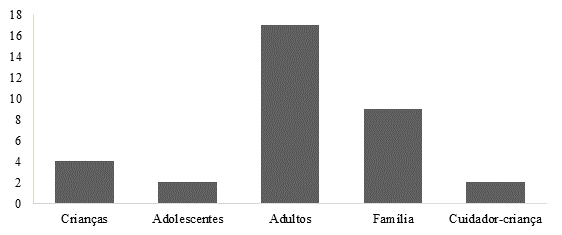
A ênfase em ter como participantes a população adulta pode estar relacionada aos trabalhos iniciais de Fonagy e colaboradores, ao desenvolverem a MBT, que originariamente destinou-se a pacientes com transtorno borderline, informação que pode ser corroborada por uma revisão conduzida por Volkert et al (2019), que buscou explorar os tratamentos baseados na mentalização para pacientes diagnosticados com transtorno da personalidade borderline, que apontou que a população adolescente foi menos prevalente nos estudos analisados. Já a expressiva participação de famílias nos estudos, denota a expansão da aplicação dos conceitos de FR e CM para o âmbito das relações entre os sujeitos e para outros contextos.
Referente à categoria 4) Tipo de intervenção utilizada, optou-se por dividi-la em subcategorias, sendo elas: 4a) intervenções em contexto clínico (aplicadas em clínicas e consultórios, que seguem o setting padrão das psicoterapias) e 4b) intervenções em outros contextos (aplicadas em ambientes distintos e que não seguem o setting padrão das psicoterapias). Aqui destaca-se a categoria 4b), a qual abarca 20 estudos (Bain, 2014; De Meulemeester et al., 2018; Edel et al., 2017; Ensink et al., 2013; Esposito et al., 2019; Fonagy et al., 2009; Freda et al., 2015; Howieson & Priddis, 2015; Ordway et al., 2014; Ordway et al., 2018; Pajulo et al., 2016; Rice et al., 2015; Rosenblau et al., 2015; Sadler et al., 2013; Stacks et al., 2019; Suchman et al., 2016; Suchman et al., 2017; Twemlow et al., 2011; Vik & Haftig, 2009; Ware et al., 2016). Já a categoria 4a) contou com nove estudos (Ashton et al., 2016; Bateman et al., 2016; Bo et al., 2017; Bressi et al., 2017; Hertzmann et al., 2016; Ingley-Cook & Dobel-Ober, 2013; Jakobsen et al., 2012; Meschino et al., 2016; Ramsauer, 2014). Observa-se na Tabela 1, alguns exemplos de intervenções citadas com maior frequência e que ainda não foram retratadas nesta escrita.
Tabela 1: Exemplos de intervenções encontradas
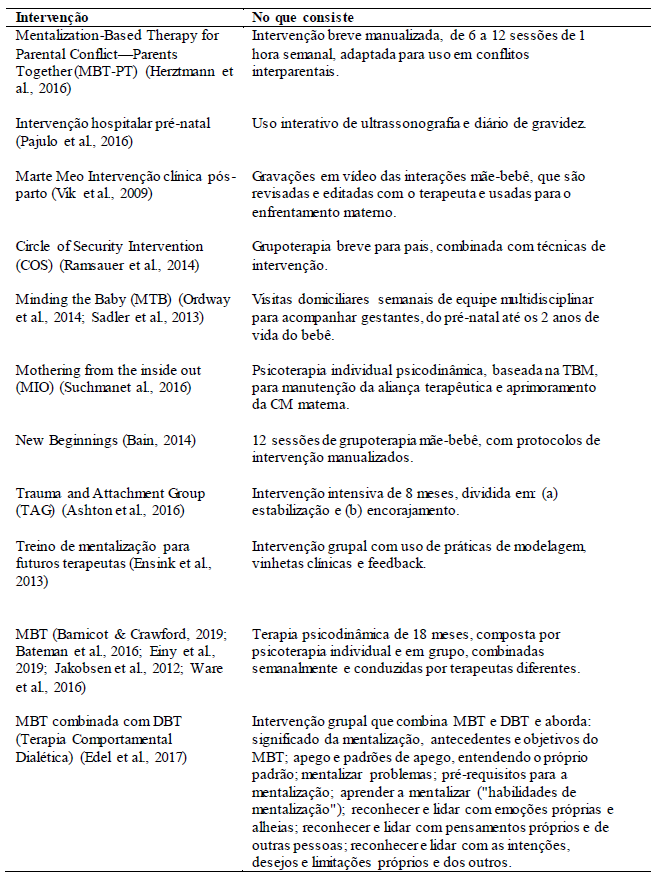
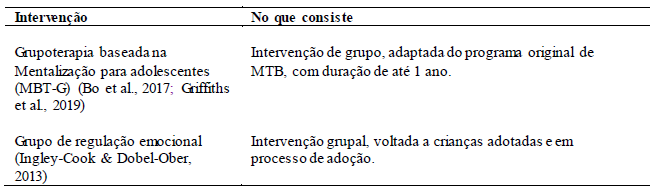
Percebe-se assim, que há uma diversidade de intervenções passíveis de aplicação, que visam desenvolver a CM e FR, sendo que nos últimos 5 anos verifica-se uma ascendência de estudos que consistem em programas estruturados para a promoção da FRP. Entre as intervenções que se destacam nesta revisão, está a MBT, possivelmente por ser foco de atenção de Fonagy e colaboradores, que buscam averiguar evidências de sua eficácia e efetividade. Assim, esta intervenção, vem servindo inspiração para outras propostas, que usam seus princípios teóricos e técnicos.
Evidencia-se, ainda, que grande parte das intervenções desta revisão voltaram-se para o tratamento de psicopatologias, tais como o transtorno da personalidade borderline, os transtornos do espectro autista e o transtorno depressivo maior, ainda que em diferentes contextos, como o clínico, escolar, hospitalar institucional e comunitário.
Quanto à categoria 5) Instrumentos de avaliação da intervenção, observou-se o uso de uma gama de instrumentos (n = 107), que avaliaram diversos indicadores de mudança, exigindo a criação em subcategorias para uma melhor exploração. Assim, concebeu-se as seguintes subdivisões: 5a) coleta de dados sociodemográficos da família; 5b) avaliação da aliança terapêutica (AT) e contratransferência (CT) dos participantes para com a intervenção; 5c) FR e CM dos participantes; 5d) sintomatologia psicológica dos participantes; 5e) Interação mãe-criança; 5f) Funcionamento e desenvolvimento global dos participantes; 5g) Avaliação específica da intervenção. O número total de instrumentos obtidos, constam na Figura 4.
Figura 4: Distribuição dos instrumentos por subcategoria
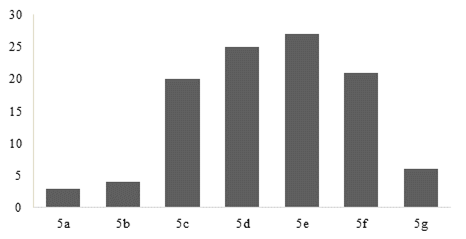
Neste sentido, destaca-se a subcategoria 5e, que concentrou 27 instrumentos que captaram desde a sensibilidade materna, tipos de apego presente, ajustamento social e o tipo de interação da dupla mãe-criança. Dentre os instrumentos deste recorte, o Strange Situation Procedure (SSP) foi o mais usado (n = 3) (Ramsauer et al., 2014; Sadler et al., 2013; Suchman et al., 2017), seguido de sessões de hora do jogo mãe-criança (n = 2) (Ordway et al., 2018; Suchman et al., 2016).
A seguir, encontra-se a subcategoria 5d, centralizando 25 instrumentos empregados para avaliar características maternas como ansiedade, depressão, estresse, alexitimia e personalidade borderline. Destaca-se aqui, o uso do Beck Depression Inventory (BDI), aplicado em cinco estudos (Bateman et.al., 2016; Bo et al., 2017; Edel et al., 2017; Jakobsen et al., 2012; Ramsauer et at., 2014). Já nas subcategorias 5c e 5f, abrangendo respectivamente 20 e 21 instrumentos, destaca-se o emprego do Parental Development Interview (PDI) (Enav et al., 2019; Hertzmann et al., 2016; Ordway et al., 2016; Sadler et al., 2013; Suchman et al., 2017) e do Parental Reflective Functioning Questionnaire (PRFQ-1; Ashton et al., 2016; Hertzmann et al., 2016; Pajulo et al., 2016; Ramsauer et al., 2014).
Na subcategoria 5g, que abarcou 6 do total de instrumentos empregados, ressalta-se o uso de entrevistas para avaliar a as intervenções em todos os artigos (Hertzmann et al., 2016; Howieson & Priddis, 2015; Ingley‐Cook & Dobel‐Ober, 2013; Meschino et al., 2016; Ware et al., 2016; Vik & Hafting, 2009). Por último, encontram-se as subcategorias 5a e 5b, cada uma concentrando 3 e 4 instrumentos citados, sendo que as entrevistas semiestruturadas foram empregadas com mais frequência (n = 2) na subcategoria 5a (Ordway et al., 2014; Sadler et al., 2013). Na 5b, não houve repetição de instrumentos, sendo aplicados o Working Alliance Inventory-Revised (Sadler et al., 2013), a Parenting Alliance Measure (PAM; Hertzmann, 2016), a Countertransference Rating Scale (CRS; Ensink et al., 2013) e o Psychotherapy Q-Sort (Kivity et al., 2019).
Considerando que o tema investigado tem sido explorado e implementado nas últimas décadas, verifica-se que há poucos instrumentos utilizados para avaliar especificamente a intervenção, havendo apenas um instrumento desenvolvido para este fim, o Revised MIO/PE Adherence Rating Scale (Sadler et al., 2013; Suchman et al., 2017), que avaliou a eficácia da intervenção MIO. Tal condição pode ser a responsável pela vasta variabilidade de instrumentos encontrada, sendo estes usados na avaliação de diferentes marcadores de mudança que nortearam as discussões acerca dos resultados produzidos pelas intervenções. Segundo Baptista (2010), apesar de limitações no campo de estudos sobre evidência de eficácia nos processos psicoterápicos é possível estabelecer protocolos de avaliação e procedimentos acurados, como a meta-análise.
A categoria 6) Resultados demonstrou que as intervenções propostas, em sua maioria, têm obtido resultados satisfatórios (n = 23) (Bain, 2014; Bateman et al., 2016; Edel et al., 2017; Einy et al., 2019; Enav et al., 2019; Ensink et al., 2013; Fonagy et al., 2009; Freda et al., 2015; Griffiths et al., 2019; Howieson & Priddis, 2015; Kivity et al., 2019; Meschino et al., 2016; Ordway et al., 2018; Rice et al., 2015; Rosenblau et al., 2015; Sadler et al., 2013; Stacks et al., 2019; Suchman et al., 2016; Suchman et al., 2017; Twemlow et al., 2011; Vik & Hafting, 2009; Ware et al., 2016). Dentre elas, as intervenções baseadas na MBT têm-se mostrado eficazes, gerando redução na gravidade de sintomas em pacientes borderline ou com transtorno de personalidade antissocial (Bateman et al., 2016; De Meulemeester et al., 2018; Edel et al., 2017; Einy et al., 2019), melhorias na gestão de comportamentos e emoções (Ware et al., 2016), assim como na CM e nos padrões de apego estabelecidos entre pares (Bo et al., 2017).
A MBT, quando combinada com a Terapia Comportamental Dialética (DBT), obteve resultados ainda mais satisfatórios na redução do apego inseguro e na melhoria da CM em pacientes com personalidade borderline (Edel et al., 2017). Isto ocorre pelo fato de que ambas as abordagens priorizarem a criação de uma relação de segurança na terapia, do uso da empatia e validação na relação recíproca, do fortalecimento das capacidades do paciente para reduzir comportamentos impulsivos, assim como o aumento da autoconsciência (Swenson & Choi-Kain, 2015).
Por outro lado, estudo conduzido por Jakobsen et al. (2012) apontou que a terapia cognitiva de terceira onda pode ser mais efetiva que a MBT frente a sintomas depressivos. Da mesma forma apontou o estudo de Barnicot e Crawford (2019), especialmente no que se refere à redução de comportamentos auto lesivos ao longo do tempo. No entanto, sugere-se que mais ensaios clínicos randomizados sejam realizados para avaliar os efeitos destas diferentes abordagens. Ademais, cabe salientar que estudos que se propuseram a avaliar a eficácia de intervenções que utilizaram a DBT têm se mostrado mais prevalentes na última década.
Considerações finais
A elaboração desta revisão integrativa permitiu uma compreensão ampla acerca da temática proposta e de sua aplicabilidade entre os anos de 2008 a 2019. Destaca-se que CM e FR são conceitos relativamente novos na psicologia, que vêm sendo explorados nas últimas décadas, com um expressivo número de publicações no ano de 2016.
Embora sejam constructos distintos, a FR foi apresentada em diferentes estudos, como equivalente à CM. Em virtude disso, instrumentos que avaliam a FR foram sistematicamente usados nas pesquisas desta revisão, para medir a CM, denotando-se uma escassez de ferramentas voltadas a sua investigação e a necessidade de investimentos relativos à construção de recursos para avaliação de ambos os constructos, de forma distinta.
Por outro lado, à medida que as pesquisas avançaram e se expandiram para diferentes contextos, foi-se delineando uma diferenciação importante entre CM e FR, que agrega à primeira, uma nova dimensão, a da habilidade do indivíduo de refletir ou retratar ao outro os estados mentais do segundo, que em um momento anterior, foram reconhecidos e compreendidos pelo primeiro, através de sua CM. Assim, entendendo que CM e FR são habilidades distintas em seus elementos constitutivos, sugere-se que a literatura considere suas características peculiares e a interdependência entres ambos, conforme Figura 5, já que uma pessoa pode apresentar uma adequada CM e dificuldades em sua FR, ainda que o inverso não se aplique.
Figura 5: Interdependência entre os conceitos de CM e FR
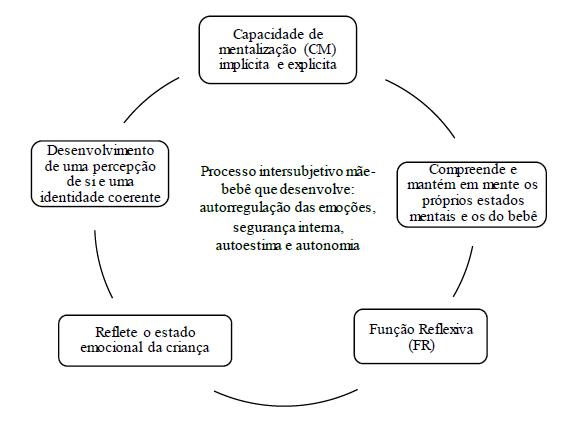
Fonte. Figura elaborada por Márcia Pinheiro Schaefer para este artigo.
Desta forma, embora a maior parte das pesquisas avaliadas neste estudo objetivou verificar a eficácia de intervenções voltadas à promoção da CM e FR, possivelmente expressando um movimento voltado à avaliação de resultados a fim de consolidar as propostas relacionadas à temática e à necessidade de se construir práticas baseadas em evidências, entende-se que se inaugura um novo momento. À medida que a produção científica tem apontado para resultados positivos quanto à aplicabilidade e produção de mudanças significativas destas intervenções através de estudos prioritariamente quantitativos, cabe agora aos pesquisadores voltarem-se às especificidades destas propostas, bem como sua abrangência em diferentes contextos através de delineamentos qualitativos ou mistos, que têm em seu âmago, esta característica.
Frente às intervenções que fizeram uso da MBT, sugere-se que os ensaios clínicos randomizados sejam mais explorados a fim de confirmarem a eficácia dessa abordagem. Outro ponto a destacar refere-se à importância de realizar estudos com follow-up, os quais contribuem para aumentar a eficácia e efetividade da pesquisa, assim como identificar possíveis mudanças nas intervenções ao longo do tempo.
Considerando ainda, que os desfechos obtidos nas pesquisas desta revisão apontaram que as intervenções facilitadoras da CM e FR possuem potencialidade para fortalecer os vínculos pais/cuidadores-criança, contribuindo para o estabelecimento de um apego seguro e repercutindo diretamente na formação do psiquismo infantil, torna-se vital ampliar o conhecimento científico acerca das possibilidades destas intervenções em diferentes contextos. Ampliar para diferentes participantes, incluindo díades e tríades pais/cuidadores-crianças, assim como para diferentes grupos étnicos e com diferenças socioculturais também se faz necessário para que o campo de atuação seja ampliado e um maior número de pessoas possa ser beneficiada. Ademais é vital o desenvolvimento de instrumentos específicos para avaliação dos constructos em questão, bem como estudos que reportem intervenções no Brasil e em demais países da América Latina, uma vez que é uma temática de grande relevância clínica e social.
Como limitações deste artigo, encontra-se a não inclusão de pesquisas brasileiras a partir dos termos de buscas usados, ainda que seja de conhecimento das autoras, a existência de alguns estudos já publicados. Tal fato pode estar relacionado ao uso de palavras-chaves não indexadas nas publicações ou ainda, a indisponibilidade de alguns artigos nas bases de dados no momento da consulta. Ademais, evidenciou-se na literatura a falta de um maior aprofundamento teórico acerca dos conceitos de CM e FR, possivelmente por advirem de uma teoria atual e que está em franco desenvolvimento, destacando-se mais uma vez a importância de estudos teóricos que discutam as convergências e divergências dos conceitos.
Referências:
Akhtar, S. (2007). Primeiros relacionamentos e sua internalização. Em E. Person, A.M. Cooper & G. Gabbard (Eds.), Compêndio de Psicanálise (pp. 54-66). Artmed.
Ashton, C. K., O’Brien-Langer, A., & Silverstone, P. H. (2016). The CASA Trauma and Attachment Group (TAG) Program for children who have attachment issues following early developmental trauma. Journal of the Canadian Academy of Child and Adolescent Psychiatry, 25(1), 35-42.
Bain, K. (2014). “New beginnings” in South African shelters for the homeless: piloting of a group psychotherapy intervention for high‐risk mother–infant dyads. Infant Mental Health Journal, 35(6), 591-603. http://doi.org/10.1002/imhj.21457
Baptista, M. N. (2010). Questões sobre avaliação de processos psicoterápicos. Revista Psicologia em Pesquisa, 4(2).
Barnicot, K. & Crawford, M. (2019). Dialectical behaviour therapy v. mentalisation-based therapy for borderline personality disorder. Psychological Medicine, 49(12), 2060-2068. http://doi.org/10.1017/S0033291718002878
Bateman, A., O’Connell, J., Lorenzini, N., Gardner, T., & Fonagy, P. (2016). A randomised controlled trial of mentalization-based treatment versus structured clinical management for patients with comorbid borderline personality disorder and antisocial personality disorder. BMC Psychiatry, 16(1), 304. http://doi.org/10.1186/s12888-016-1000-9
Bo, S., Sharp, C., Beck, E., Pedersen, J., Gondan, M., & Simonsen, E. (2017). First empirical evaluation of outcomes for mentalization-based group therapy for adolescents with BPD. Personality Disorders: Theory, Research, and Treatment, 8(4), 396. http://doi.org/10.1037/per0000210
Bowlby, J. (1989). Uma base segura. Artes Médicas.
Bressi, C., Fronza, S., Minacapelli, E., Nocito, E. P., Dipasquale, E., Magri, L., Lionetti, F., & Barone, L. (2017). Short‐term psychodynamic psychotherapy with mentalization‐based techniques in major depressive disorder patients: relationship among alexithymia, reflective functioning, and outcome variables–a pilot study. Psychology and Psychotherapy: theory, research and practice, 90(3), 299-313. http://doi.org/10.1111/papt.12110
Cramer, B. & Palacio-Espasa, F. (1993). Técnicas psicoterápicas mãe/bebê. Artes Médicas.
Dalbem, J. X. & Dalbosco, D. D. (2005). Teoria do apego: bases conceituais e desenvolvimento dos modelos internos de funcionamento. Arquivos Brasileiros de Psicologia, 57(1), 12-24.
De Meulemeester, C., Vansteelandt, K., Luyten, P., & Lowyck, B. (2018). Mentalizing as a mechanism of change in the treatment of patients with borderline personality disorder: a parallel process growth modeling approach. Personality Disorders: Theory, Research, and Treatment, 9(1), 22. http://doi.org/10.1037/per0000256
Edel, M. A., Raaff, V., Dimaggio, G., Buchheim, A., & Brüne, M. (2017). Exploring the effectiveness of combined mentalization‐based group therapy and dialectical behaviour therapy for inpatients with borderline personality disorder–A pilot study. British Journal of Clinical Psychology, 56(1), 1-15. http://doi.org/10.1111/bjc.12123
Einy, S., Narimani, M., & Sadeghi-Movahhed, F. (2019). Comparing the effectiveness of mentalization-based therapy and cognitive-analytic therapy on ego strength and defense mechanisms in people with Borderline Personality Disorder. Quarterly of the Horizon of Medical Sciences, 25(4), 324-339. http://doi.org// 10.32598/hms.25.4.324
Enav, Y., Erhard-Weiss, D; Kopelman, M; Samson, A. C; Mehta, S; Gross, J. J., & Hardan, A. Y., (2019). A non randomized mentalization intervention for parents of children with autism. Autism Research, 12(7), 1077-1086. http://doi.org/10.1002/aur.2108
Ensink, K., Fonagy, P., Normandin, L., Berthelot, N., & Biberdzic, M. (2015). O papel protetor da mentalização de experiências traumáticas: implicações quando da entrada na parentalidade. Estilos Clínicos, 20(1), 76-91. http://doi.org/10.11606/issn.1981-1624.v20ilp76-91
Ensink, K., Maheux, J., Normandin, L., Sabourin, S., Diguer, L., Berthelot, N., & Parent, K. (2013). The impact of mentalization training on the reflective function of novice therapists: A randomized controlled trial. Psychotherapy Research, 23(5), 526-538. http://doi.org/10.1080/10503307.2013.800950
Esposito, G., Karterud, S., & Freda, M. F. (2019). Mentalizing underachievement in group counseling: Analyzing the relationship between members' reflective functioning and counselors' interventions. Psychological Services, 18(1), 73-83. http://doi.org/10.1037/ser0000350
Feliciano, D. de S. & Souza, A. S. L. (2011). Para além do seio: uma proposta de intervenção psicanalítica pais-bebê a partir de dificuldades na amamentação. Jornal de Psicanálise,44(81), 145-161.
Fonagy, P. & Allison, E. (2012). What is mentalization? The concept and its foundations in developmental research. Em N. Midgley & I. Vrouva, Minding the child: Mentalization-based interventions with children, young people and their families (pp. 11-34). Routledge/Taylor & Francis Group.
Fonagy, P. & Target, M. (1997). Attachment and reflective function: their role in self-organization. Development & Psychopathology, 9(04), 679-700. https://doi.org/10.1017/s0954579497001399
Fonagy, P. & Target, M. (2006). The mentalization-focused approach to self pathology. Journal of Personality Disorders, 20(6), 544-576. http://doi.org/10.1521/pedi.2006.20.6.544
Fonagy, P. (1999). Persistencias transgeneracionales del apego: una nueva teoria. Aperturas Psicoanaliticas, 3, 1-17.
Fonagy, P., Twemlow, S. W., Vernberg, E. M., Nelson, J. M., Dill, E. J., Little, T. D., & Sargent, J. A. (2009). A cluster randomized controlled trial of child‐focused psychiatric consultation and a school systems‐focused intervention to reduce aggression. Journal of Child Psychology and Psychiatry, 50(5), 607-616. http://doi.org/10.1111/j.1469-7610.2008.02025.x
Freda, M. F., Esposito, G., & Quaranta, T. (2015). Promoting mentalization in clinical psychology at universities: A linguistic analysis of student accounts. Europe's Journal of Psychology, 11(1), 34. http://doi.org/10.5964/ejop.v11i1.812
Griffiths, H., Duffy, F., Duffy, L., Brown, S., Hockaday, H., Eliasson, E., Graham, J., Smith, J., Thomson, A., & Schwannauer, M. (2019). Efficacy of mentalization-based group therapy for adolescents: the results of a pilot randomised controlled trial. BMC Psychiatry, 19, 167-180. https://doi.org/10.1186/s12888-019-2158-8
Hertzmann, L., Target, M., Hewison, D., Casey, P., Fearon, P., & Lassri, D. (2016). Mentalization-based therapy for parents in entrenched conflict: a random allocation feasibility study. Psychotherapy, 53(4), 388. http://doi.org/10.1037/pst0000092
Holmes, J. (2006). Mentalizing from a psychoanalytic perspective: What’s new? Em J. Allen & P. Fonagy (Eds.), The Handbook of Mentalization Based Treatment (pp. 31-50). John Wiley & Sons.
Howieson, J. & Priddis, L. (2015). A Mentalizing‐based approach to family mediation: harnessing our fundamental capacity to resolve conflict and building an evidence‐based practice for the field. Family court review, 53(1), 79-95. http://doi.org/10.1111/fcre.12132
Ingley‐Cook, G. & Dobel‐Ober, D. (2013). Innovations in practice: group work with children who are in care or who are adopted: lessons learnt. Child and Adolescent Mental Health, 18(4), 251-254. http://doi.org/10.1111/j.1475-3588.2012.00683.x
Jakobsen, J. C., Gluud, C., Kongerslev, M., Larsen, K. A., Sørensen, P., Winkel, P., Lange, T., Sogaard, U., & Simonsen, E. (2012). ‘Third wave’cognitive therapy versus mentalization-based therapy for major depressive disorder: a protocol for a randomised clinical trial. BMC Psychiatry, 12(1), 232. http://doi.org/10.1186/1471-244X-12-232
Kelly, K., Slade, A., & Grienenberger, J. F. (2005). Maternal reflective functioning, mother–infant affective communication, and infant attachment: exploring the link between mental states and observed caregiving behavior in the intergenerational transmission of attachment. Attachment & Human Development, 7(3), 299-311. http://doi.org/10.1080/14616730500245963
Kivity, Y., Levy, K.N., Wasserman, R.H., Beeney, J.E., Meehan, K.B., & Clarkin, J.F. (2019). Conformity to prototypical therapeutic principles and its relation with change in reflective functioning in three treatments for borderline personality disorder. Journal of Consulting and Clinical Psychology, 87(11), 975-988. http://doi.org/10.1037/ccp0000445
Lecannelier, F. (2006). Estrategias de intervención temprana en salud mental. Revista Psicología & Sociedad, 1-9.
Leonardi, J. L. (2017). Métodos de pesquisa para o estabelecimento da eficácia das psicoterapias. Interação em Psicologia, 21(3), 176-186. http://doi.org/10.5380/psi.v2li3.54757
Malda-Castillo, J., Browne, C., & Perez-Algorta, G. (2019). Mentalization-based treatment and its evidence-base status: A systematic literature review. Psychology and Psychotherapy: Theory, Research and Practice, 92(4), 465-498. http://doi.org/10.1111/papt.12195
Melnik, T., Fernandes de Souza, W., & Regine de Carvalho, M. (2014). A importância da prática da psicologia baseada em evidências: aspectos conceituais, níveis de evidência, mitos e resistências. Revista Costarricense de Psicología, 33(2), 79-92.
Mesa, A. M. & Gómez, A. C. (2010). La mentalización como estrategia para promover la salud mental en bebés prematuros. Revista Latinoamericana de Ciencias Sociales, Niñez y Juventud, 8(2), 835-848.
Meschino, D. de C., Philipp, D., Israel, A., & Vigod, S. (2016). Maternal-infant mental health: postpartum group intervention. Archives of women's mental health, 19(2), 243-251. http://doi.org/10.1007/s00737-015-0551-y
Moher, D., Liberati, A., Tetzlaff, J., & Altman, D. G. (2009). Preferred reporting items for systematic reviews and meta-analyses: the PRISMA statement. Annals of internal medicine, 151(4), 264-269. http://doi.org/10.7326/0003-4819-151-4-200908180-00135
Ordway, M. R., McMahon, T. J., Kuhn, L. de L. H., & Suchman, N. E. (2018). Implementation of an evidenced‐based parenting program in a community mental health setting. Infant Mental Health Journal, 39(1), 92-105. http://doi.org/10.1002/imhj.21691
Ordway, M. R., Sadler, L. S., Dixon, J., Close, N., Mayes, L., & Slade, A. (2014). Lasting effects of an interdisciplinary home visiting program on child behavior: Preliminary follow-up results of a randomized trial. Journal of Pediatric Nursing, 29(1), 3-13. http://doi.org/10.1016/j.pedn.2013.04.006
Ordway, M. R., Webb, D., Sadler, L. S., & Slade, A. (2015). Parental reflective functioning: an approach to enhancing parent-child relationships in pediatric primary care. Journal of Pediatric Health Care, 29(4), 324-334. http://doi.org/10.1016/j.pedhc.2014.12.002
Pajulo, H., Pajulo, M., Jussila, H., & Ekholm, E. (2016). Substance‐abusing pregnant women: prenatal intervention using ultrasound consultation and mentalization to enhance the mother–child relationship and reduce substance use. Infant mental Health Journal, 37(4), 317-334. http://doi.org/10.1002/imhj.21574
Ramires, V. R. R. & Godinho, L. R. (2011). Psicoterapia baseada na mentalização de crianças que sofreram maus-tratos. Psicologia em Estudo, 16(1), 61-70. https://doi.org/10.1590/S1413-73722011000100008
Ramires, V. R. R. & Schneider, M. S. (2010). Revisitando alguns conceitos da teoria do apego: comportamento versus representação? Psicologia: Teoria E Pesquisa, 26, 25-33. https://doi.org/10.1590/S0102-37722010000100004
Ramsauer, B., Lotzin, A., Mühlhan, C., Romer, G., Nolte, T., Fonagy, P., & Powell, B. (2014). A randomized controlled trial comparing Circle of Security Intervention and treatment as usual as interventions to increase attachment security in infants of mentally ill mothers: Study Protocol. BMC Psychiatry, 14(1), 24. http://doi.org/10.1186/1471-244X-14-24
Rice, L. M., Wall, C. A., Fogel, A., & Shic, F. (2015). Computer-assisted face processing instruction improves emotion recognition, mentalizing, and social skills in students with ASD. Journal of Autism and Developmental Disorders, 45(7), 2176-2186. http://doi.org/10.1007/s10803-015-2380-2
Rosenblau, G., Kliemann, D., Heekeren, H. R., & Dziobek, I. (2015). Approximating implicit and explicit mentalizing with two naturalistic video-based tasks in typical development and autism spectrum disorder. Journal of Autism and Developmental Disorders, 45(4), 953-965. http://doi.org/10.1007/s10803-014-2249-9
Sadler, L. S., Slade, A., Close, N., Webb, D. L., Simpson, T., Fennie, K., & Mayes, L. C. (2013). Minding the baby: Enhancing reflectiveness to improve early health and relationship outcomes in an interdisciplinary home‐visiting program. Infant Mental Health Journal, 34(5), 391-405. http://doi.org/10.1002/imhj.21406
Slade, A. (2005). Parental reflective functioning: an introduction. Attachment and Human Development, 7(3), 269-281. http://doi.org/10.1080/14616730500245906
Slade, A. (2007). Reflective parenting programs: theory and development. Psychoanalytic Inquiry, 26(4), 640-657. http://doi.org/10.1080/07351690701310698
Stacks, A. M., Barron, C. C., & Wong, K. (2019). Infant mental health home visiting in the context of an infant—toddler court team: Changes in parental responsiveness and reflective functioning. Infant Mental Health Journal, 40(4), 523-540. https://doi.org/10.1002/21785
Suchman, N. E., De Coste, C. L., McMahon, T. J., Dalton, R., Mayes, L. C., & Borelli, J. (2017). Mothering from the Inside Out: Results of a second randomized clinical trial testing a mentalization-based intervention for mothers in addiction treatment. Development and Psychopathology, 29(2), 617-636. http://doi.org/10.1017/S0954579417000220
Suchman, N. E., Ordway, M. R., de las Heras, L., & McMahon, T. J. (2016). Mothering from the Inside Out: results of a pilot study testing a mentalization-based therapy for mothers enrolled in mental health services. Attachment & Human Development, 18(6), 596-617. http://doi.org/10.1080/14616734.2016.1226371
Swenson, C. R. & Choi-Kain, M. D. (2015). Mentalization and Dialectical Behavior Therapy. American Journal of Psychotherapy, 69(2). 199-217. https://doi.org/10.1176/appi.psychotherapy.2015.69.2.199
Tomlin, A. M., Sturm, L., & Koch, S. M. (2009). Observe, listen, wonder, and respond: A preliminary exploration of reflective function skills in early care providers. Infant Mental Health Journal, 30(6), 634-647. http://doi.org10.1002/imhj.20233
Twemlow, S. W., Fonagy, P., Sacco, F. C., Vernberg, E., & Malcom, J. M. (2011). Reducing violence and prejudice in a Jamaican all age school using attachment and mentalization theory. Psychoanalytic Psychology, 28(4), 497. http://doi.org/10.1037/a0023610
Vik, K. & Hafting, M. (2009). The outside view as facilitator of self‐reflection and vitality: A phenomenological approach. Journal of Reproductive and Infant Psychology, 27(3), 287-298. http://doi.org/10.1080/02646830802409645
Volkert, J., Hauschild, S., & Taubner, S. (2019). Mentalization-Based treatment for personality disorders: efficacy, effectiveness, and new developments. Current Psychiatry Reports, 21(4), 21-25.http://doi.org/10.1007/s11920-019-1012-5
Ware, A., Wilson, C., Tapp, J., & Moore, E. (2016). Mentalisation-based therapy (MBT) in a high-secure hospital setting: expert by experience feedback on participation. The Journal of Forensic Psychiatry & Psychology, 27(5), 722-744. http://doi.org/10.1080/14789949.2016.1174725
Zevalkink, J. (2008). Assessment of mentalizing problems in children. In A.J.E. Verheugt-Pleiter, J., Zevalkink & M.G.C. Schmeets (Eds.), Mentalizing in children therapy (pp. 22-40). Karnac.
Como citar: Pinheiro Schaefer, M., Becker, D., & Donelli, T. M. S. (2023). Intervenções promotoras da capacidade de mentalização e função reflexiva: uma revisão integrativa. Ciencias Psicológicas, 17(1), e-2478. https://doi.org/10.22235/cp.v17i1.2478
Participação dos autores: Participação dos autores: a) Planejamento e concepção do trabalho; b) Coleta de dados; c) Análise e interpretação de dados; d) Redação do manuscrito; e) Revisão crítica do manuscrito.
M. P. S. contribuiu em a, b, c, d; D. B. em c, d; T. M. S. D. em e.
Editora científica responsável: Dra. Cecilia Cracco.
10.22235/cp.v17i1.2478
Original Articles
Interventions to improve mentalization and reflective functioning: a scoping review
Intervenções promotoras da capacidade de mentalização e função reflexiva: uma revisão integrativa
Intervenciones promotoras de la capacidad de mentalización y función reflexiva: una revisión integrativa
Márcia Pinheiro Schaefer1, ORCID 0000-0002-4060-5261
Débora Becker2, ORCID 0000-0002-5556-2567
Tagma Marina Schneider Donelli3, ORCID 0000-0003-3083-0083
1 Universidade do Vale do Rio dos Sinos, Brazil, [email protected]
2 Universidade do Vale do Rio dos Sinos, Brazil
3 Universidade do Vale do Rio dos Sinos, Brazil
Abstract:
This scoping review explores research conducted between 2008 to 2019, that aims to understand the conceptual use of mentalization (M) and reflective functioning (RF) and explore possibilities for interventions that promote these skills. The review utilized the descriptors “reflective functioning OR mentalizing OR mentalization AND intervention”. Reviewed papers were written in English, Portuguese or Spanish, and covered several research areas. The analysis considered several categories, including aims, study design, participants, type of intervention, intervention assessments and outcomes. Thirty-four papers were considered, most of them using a quantitative approach and addressed to adults and parents/caregivers-infants. The present review highlights the need to develop specific assessments procedures to evaluate RF and M, as well as studies that consider the Brazilian context. The study also emphasizes the need for theoretical systematization of M and RF concepts, considering they are frequently used as synonyms.
Keywords: mentalization; intervention; reflective functioning.
Resumo:
Esta revisão integrativa da literatura objetivou sistematizar as possibilidades de intervenções promotoras da Capacidade de Mentalização (CM) e Função Reflexiva (FR), publicadas entre 2008 a 2019. Utilizou-se os descritores “reflective functioning OR mentalizing OR mentalization AND intervention” e incluiu-se artigos empíricos, disponibilizados em Inglês, Português ou Espanhol, provenientes de diferentes áreas. Analisou-se os dados através das categorias: objetivos; delineamentos; participantes; tipo de intervenção utilizada; instrumentos de avaliação da intervenção empregados; resultados. Encontrou-se 34 artigos que predominantemente verificaram a eficácia das intervenções, possuíam delineamento quantitativo, voltados para adultos e, ainda, intervenções com potencial para fortalecer os vínculos pais/cuidadores-criança. Concluiu-se sobre a necessidade de se desenvolver instrumentos específicos para avaliar FR e CM, estudos que abordem a realidade brasileira e, ainda, a sistematização desses conceitos, que na maioria dos artigos, se apresentaram como sinônimos.
Palavras-chave: mentalização; intervenção; função reflexiva.
Resumen:
La presente revisión integrativa exploró investigaciones realizadas entre 2008 y 2019 para sistematizar información acerca del uso conceptual de capacidad de mentalización (CM) y función reflexiva (FR), así como las posibilidades de intervenciones para su promoción. Los descriptores fueron “reflective functioning OR mentalizing OR mentalization AND intervention” en la búsqueda artículos empíricos en inglés, portugués o español, de distintas áreas del conocimiento. El análisis de los datos consideró las categorías: objetivos, diseños, participantes, tipo de intervención utilizada, instrumentos de evaluación de la intervención y resultados. Treinta y cuatro artículos fueron elegidos, en su mayoría cuantitativos, destinados a adultos y padres-bebés. La revisión destaca la necesidad del desarrollo de instrumentos de evaluación específicos para evaluar FR y CM, así como la necesidad de investigaciones que exploren la realidad de países como Brasil. Otro aspecto es la sistematización de los conceptos, ya que, en su mayoría, fueron referidos como sinónimos.
Palabras clave: mentalización; intervención; función reflexiva.
Received: 26/2/2021
Accepted: 25/1/2023
Studies focused on parent-infant interactions and their repercussions on the formation of the infant psyche suggest that early interactions are crucial for the infant's psychological development and have a strong influence on infants’ emotional health, on the formation of later social relationships and on problem-solving ability (Akhtar, 2007). Empirical evidence supports a link between the affective experiences during the first years of life and the incidence of biopsychosocial disorders, such as affective and anxiety disorders, chronic stress, and psychosocial difficulties (Lecannelier, 2006).
The infant, equipped with an incipient psychic apparatus, forms their psyche through unconscious communication established with their mother, using the maternal psychism as an auxiliary ego to navigate the real world (Cramer & Palacio-Espasa, 1993). In this way, the inheritance of maternal experiences of real and fantasized relationships with parental figures may interfere in the mother-infant interaction, facilitating or hindering the creation of a healthy bond (Feliciano & Souza, 2011). Recent investigations, based on studies primarily conducted in the 1990s (Fonagy & Target, 1997), have recognized the crucial role of mentalization (M) and reflective functioning (RF) in attachment relationships between parents and their children (Tomlin et al., 2009), specially related to infant’s emotion regulation process and in the development of a secure attachment (Slade, 2005), which reverberate throughout the life.
The mentalization theory, developed by Fonagy and colleagues in the 1990s (Holmes, 2006) is based on the theory of mind, attachment theory, developmental psychopathology, cognitive psychology as well as neuroscience. It encompasses the concepts of mentalization and reflective functioning. Mentalization is defined as an imaginative capacity and a transactional social process (Fonagy & Target, 1997), understood as the ability to understand oneself and others in terms of underlying processes and mental states, such as feelings, desires and beliefs (Fonagy & Allison, 2012). Reflective functioning, on the other hand, is a manifestation of mentalization, and refers to an individual’s ability to mentalize their own mental states, as well as those of others (Slade, 2005). In the context of parent/caregiver-infant relationships, the adult's ability to reflect infant’s internal states through consistent responses to infant’s internal state and emotions rather than parental projections, is called parental reflective functioning (PRF) (Ramires & Godinho, 2011). The concept of Parental Reflective Functioning (PRF) was introduced by Slade (2005). Higher PRF predicts greater parental ability to deal with infant's emotional lability, without being dominated by their own emotions (Kelly et al., 2005).
The maternal condition to keep in mind the representation of the infant as someone with feelings, desires, and intentions will allow the mother to mirror and re-present infant’s affective state, enabling the infant to discover their own internal experience (Slade, 2005). This process provides the creation of a positive bond and a physical and psychological experience of security for the infant, playing a vital role in the transgenerational transmission of attachment (Ordway et al., 2015).
This unique and significant bond between infant and the attachment figure generates a sense of security in the infant, arising from maternal availability and sensitivity. This sense of security will be essential for the strengthening of the dyadic relationship and for the development of a secure base during infant’s explorations (Bowlby, 1989; Dalbem & Dalbosco, 2005). In a secure attachment relationship, parents respond to child's emotional states in a welcoming and meaningful way through their FR, which allows the child to understand and differentiate their mental states and emotions, developing a perception of themselves and their own mentalization (Ensink et al., 2015; Fonagy & Target, 2006; Zevalkink, 2008).
The acquisition of mentalization integrates an intersubjective process between parents/caregiver-infant which enable the achievement of infant’s emotion self-regulation, being important for the development of their internal security, self-esteem and autonomy (Fonagy, 1999; Ramires & Schneider, 2010). In this sense, based on the understanding that M and RF result from the association between childhood experiences and that they may be temporarily impaired in situations of great emotional impact, impacting on the mother-baby relationship, the latter's emotional development (Mesa & Gómez, 2010) and the quality of social interactions throughout life, it becomes essential to investigate interventions capable of improving and promoting these skills. Therefore, this study aimed to discuss the interventions focused on the improvement and promotion of M and RF, published between 2008 and 2019. Also, considering the number of studies using the terms M and RF as synonyms (Dalbem & Dalbosco, 2005), a conceptual systematization from the existing literature is also important.
Method
The review presented herein was motivated by the following question: What are the interventions carried out in the recent years focused on the improvement or promotion of mentalization and/or reflective functioning? Seven data bases from psychology, medicine and nursing were searched (Academic Search Complete, CINAHL, Medline Complete, Scopus, PsycINFO, LILACS and SciELO) during the month of May 2020, using the combined descriptors: “reflective functioning OR mentalizing OR mentalization AND intervention”.
The following inclusion criteria were adopted: (a) be an empirical article, thesis, or dissertation; (b) have been published between May 2008 and December 2019; (c) the material is available in its entirety; and (d) material available in English, Portuguese or Spanish. As exclusion criteria it were stablished: (a) published in book format, book chapter, reviews, theoretical articles, experience reports, case studies and systematic or literature reviews; (b) publications not related to mentalization-based interventions. Moreover, the following filters were applied: a) year of publication, b) scientific paper, and c) peer-reviewed paper. The selection was made according to Figure 1, considering the inclusion and exclusion criteria.
Figure 1: Diagram of publications selection process
The majority of excluded publications were not related to interventions, focused on brain functioning, biology of insects, such as corneal structures and the understanding of optical diffraction. To reduce possible biases and ensure the quality of the findings, two independent judges carried out the procedures. The guidelines of the Preferred Reporting Items for Systematic Reviews and Meta-Analyses (Moher et al., 2009; Prisma <www.prisma-statement.org/>) were applied. Aiming to carry out a global analysis of the results, the publications which met the inclusion criteria were quantitatively analyzed. A qualitative analysis was also applied to explore the content.
Results and Discussion
No publications were found based on the searched descriptors between 2008 and 2010, The first publications were retrieved in 2009, with two publications (Fonagy et al., 2009; Vik & Hafting, 2009), same rates as in 2018 (De Meulemeester et al., 2018; Ordway et al., 2018). Since 2013 the number of publications on the topic has been increasing. The highest incidence of publications reporting interventions focused on mentalization and reflective functioning was observed during 2016 and 2019, with seven publications found in each year (Ashton et al ., 2016; Barnicot & Crawford, 2019; Bateman et al., 2016; Einy et al., 2019; Enav et al., 2019; Esposito et al., 2019; Griffiths et al., 2019; Hertzmann et al., 2016; Kivity et al., 2019; Meschino et al., 2016; Pajulo et al., 2016; Stacks et al., 2019; Suchman et al., 2016; Ware et al., 2016). During 2015 and 2017 four publications were found in each year (Bo et al. al., 2017; Bressi et al., 2017; Edel et al., 2017; Freda et al., 2015; Howieson & Priddis, 2015; Rice et al., 2015; Rosenblau et al., 2015; Suchman et al., 2017). In 2013 and 2014 three publications were found in each year (Bain, 2014; Ensink et al., 2013; Ingley-Cook & Dobel-Ober, 2013; Ordway et al., 2014; Ramsauer et al., 2014; Sadler et al., 2013). In 2011 and 2012 just one publication was found in each year (Jakobsen et al., 2012; Twemlow et al. 2011).
The distribution of publications per year reflects the evolution of research in the field of mentalization theory, carried out by Fonagy and collaborators since the 90s (Holmes, 2006; Slade, 2007). Moreover, the creation of specific study groups dedicated to the development of intervention programs for parents and younger children in a high-risk environment (Slade, 2007), may also contributed with the increasing of the research.
Upon analyzing the concepts of M and RF throughout the review, it was observed, as shown in Figure 2, that these terms emerged in the literature in 2009, with mentalization being the predominant concept explored until 2015. These findings are consistent with a study that reported a significant increase in the use of the term mentalization between 1991 and 2017, which went from 7 to 844, according to the Thompson Reuter searcher - Web of Science (Malda-Castillo et al., 2019).
Figure 2: Presentation of RF and M over time
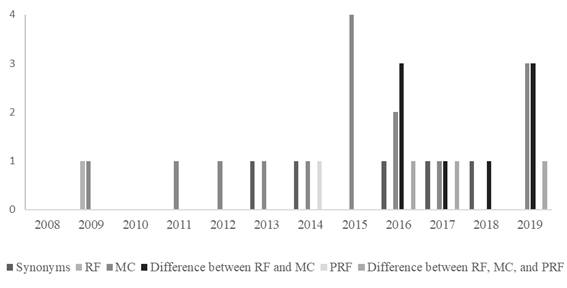
Moreover, as shown in Figure 2, since 2013 theoretical articulations among the differences between M and RF have been observed, with a peak in 2016. As for RF, even though it was not present in the theoretical body of scientific studies, it was treated by several researchers as a synonym of M from 2013, leading to an indiscriminate use of both terms. The terms were defined as being the perception of oneself and others as psychological subjects, considering thoughts, feelings, intentions, desires and motivations implicit in behavior (Ensink et al., 2015).
Therefore, it can be seen that RF has been mentioned, in many studies, as an instrument for analyzing M, being reported as an observable and measurable manifestation of M (Bain, 2014; Bateman et al., 2016; Bo et al., 2017; De Meulemeester et al., 2018; Pajulo et al., 2016; Ramsauer et al., 2014). This may have been generated from the initial understanding that M entails a reflexive and introspective behavior that enables an individual to recognize both their own and others intentional and underlying mental states. However, it should be noted that M and RF are distinct concepts, and despite recent literature highlighting the differences between the concepts, they are still being treated as synonyms in some of recent studies, indicating the need for a theoretical consolidation.
The findings of this review were examined according to the following categories: 1) Aims, 2) Study design, 3) Participants, 4) Type of intervention, 5) Intervention assessments, and 6) Outcomes. Considering the category 1) Aims, two subcategories were explored: 1a) studies focused on describing and exploring the results of the applied intervention; and 1b) studies focused on the intervention efficacy.
The subcategory 1a stands out, comprising twenty-one of the publications which explored the effect of the interventions, such as Creating a Peaceful School Learning Environment (CAPSLE), a manual-based antiviolence program/mentalization-based intervention, a manualized School Psychiatric Consultation (SPC) and treatment-as-usual (TAU), in reducing aggression and victimization among elementary school students (Fonagy et al., 2009). Another study, focused on patients with major depressive disorder, compared the effects of third-wave cognitive therapy versus Mentalization Based Therapy (MBT; Jakobsen et al., 2012). Still in subcategory 1a, (n = 18) of studies aimed to describe the interventions and explore their results.
Some of them were implemented in various settings, such as schools (Twemlow et al., 2011); forensic contexts (Ware et al., 2016); with novice therapists (Ensink et al., 2013); group therapy with adolescents with borderline personality disorder (Bo et al., 2017) and with children who are adopted or in the process of adoption (Ingley-Cook & Dobel-Ober, 2013). Other interventions took place in hospitals, with pregnant women using substances (Pajulo et al., 2016) and mothers diagnosed with postpartum depression (Vik & Hafting, 2009); in a clinical context comparing implicit and explicit mentalization processes in individuals diagnosed with Autism (Rosenblau et al., 2015); in a family context focusing on mediation programs (Howieson & Priddis, 2015) and finally, interventions targeting mothers and fathers that explored PRF (Ashton et al., 2016; Enav et al., 2019; Ordway et al., 2014; Ordway et al., 2018; Stacks et al., 2019).
The subcategory 1b identified thirteen studies, which aimed to evaluate the effectiveness of interventions (Bain, 2014; Bateman et al., 2016; Bressi et al., 2017; De Meulemeester et al., 2018; Freda et al., 2015; Griffiths et al., 2019; Hertzmann et al., 2016; Meschino et al., 2016; Ramsauer et al., 2014; Rice et al., 2015; Sadler et al., 2013; Suchman et al.., 2017; Suchman et al., 2016). Six of them were focused on M and PRF (Bain, 2014; Meschino et al., 2016; Ramsauer et al., 2014; Sadler et al., 2013; Suchman et al., 2017; Suchman et al., 2016).Considering these data, despite most studies (n = 18) have been dedicated to the description and evaluation of interventions, a large portion of the studies (n = 13) have evaluated the effectiveness of interventions focused on RF and M in different populations and contexts, denoting a search for more evidence-based practices in the field (Melnik et al., 2014).
The category 2) Study design was divided into three subcategories: 2a) quantitative studies; 2b) qualitative studies; and 2c) mixed-methods studies. The 2a stands out, covering 29 studies, most of them focused on randomized control trials (RCT) and pilot studies. Only five of them performed follow-ups (Bressi et al., 2017; Einy et al., 2019; Enav et al., 2019; Ingley-Cook & Dobel-Ober, 2013; Ordway et al., 2014). Only three studies were included in the subcategory 2b. All of them using a qualitative design (Ordway et al., 2018; Vik & Hafting, 2009; Ware et al., 2016). Subcategory 2c counted with 2 mixed-methods studies (Hertzmann et al., 2016; Howieson & Priddis, 2015). It was observed a tendency to carry out quantitative investigations and, in particular, RCT, since this type of clinical trial has a low incidence of bias, being considered the gold standard procedure to evaluate the effectiveness of treatments (Leonardi, 2017).
The predominant choice of a controlled and evidence-based design is in line with the study aims, most of them focused on the evaluation of intervention’s effectiveness, since RCT and meta-analyses have been considered important methods to evaluate interventions efficacy and effectiveness (Baptista, 2010). Moreover, the follow-up strategy, which is recommended in efficacy and effectiveness studies to assess the maintenance of results after the end of the intervention, was not applied in most studies, which was also reported in the studies conducted by Volkert et al. (2019) and Malda-Castillo et al. (2019), where most of the reviewed studies did not do or did not report the follow-up procedure.
Regarding a small range of publications using a qualitative approach, it should be noted that qualitative studies may be consider in future research, since they allow the exploration and implementation of new interventions, as well as the identification of procedures that can be effective in a clinical context (Leonardi, 2017).
Related to category 3) Participants, it refers to the target population, and it was divided into five subcategories: 3a) children; 3b) teenagers; 3c) adults; 3d) family; and 3e) caregiver-child. The subcategory 3c had a total of 17 studies (Barnicot & Crawford, 2019; Bateman et al., 2016; Bressi et al., 2017; De Meulemeester et al., 2018; Edel et al., 2017; Einy et al., 2019; Ensink et al., 2013; Esposito et al., 2019; Freda et al., 2015; Jakobsen et al., 2012; Kivity et al., 2019; Pajulo et al., 2016; Rosenblau et al., 2015; Suchman et al., 2017; Vik & Hafting, 2009; Ware et al., 2016), with the others distributed as shown in Figure 3.
Figure 3: Participants
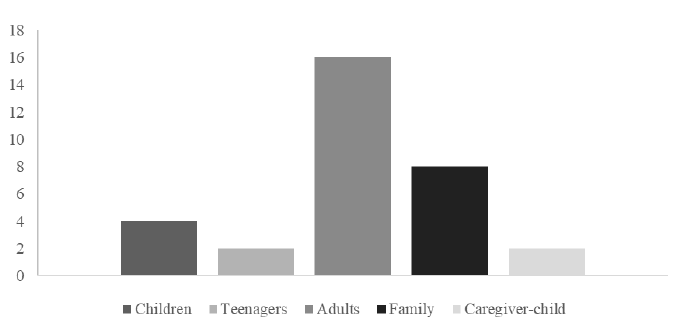
The emphasis on having the adults as the main participants of the studies may be related to the initial work of Fonagy and collaborators, when developing the MBT, which was originally focused on patients with borderline personality disorder, information that can be corroborated by a review conducted by Volkert et al. (2019), which explored mentalization-based treatments for patients diagnosed with borderline personality disorder. The study pointed out that adolescent population was less prevalent in the reviewed studies. The participation of families in the studies, however, denotes the expansion of the application of the concepts of RF and M to the scope of parents-child relationships.
The category 4) Type of intervention was divided into two subcategories: 4a) interventions in a clinical context (applied in clinics, which follow the standard setting of psychotherapies) and 4b) interventions in other contexts (applied in different contexts that do not follow the standard setting of psychotherapies). The category 4b) comprises twenty studies (Bain, 2014; De Meulemeester et al., 2018; Edel et al., 2017; Ensink et al., 2013; Esposito et al. al., 2019; Fonagy et al., 2009; Freda et al., 2015; Howieson & Priddis, 2015; Ordway et al., 2014; Ordway et al., 2018; Pajulo et al., 2016; Rice et al. , 2015; Rosenblau et al., 2015; Sadler et al., 2013; Stacks et al., 2019; Suchman et al., 2016; Suchman et al., 2017; Twemlow et al., 2011; Vik & Haftig, 2009; Ware et al., 2016). On the other hand, category 4a), which compiled the interventions in clinical settings, counted with nine studies (Ashton et al., 2016; Bateman et al., 2016; Bo et al., 2017; Bressi et al., 2017; Hertzmann et al., 2016; Ingley-Cook & Dobel-Ober, 2013; Jakobsen et al., 2012; Meschino et al., 2016; Ramsauer, 2014). Table 1 shows some examples of interventions cited more frequently and which have not yet been portrayed in this writing.
Table 1: Examples of interventions found in the review
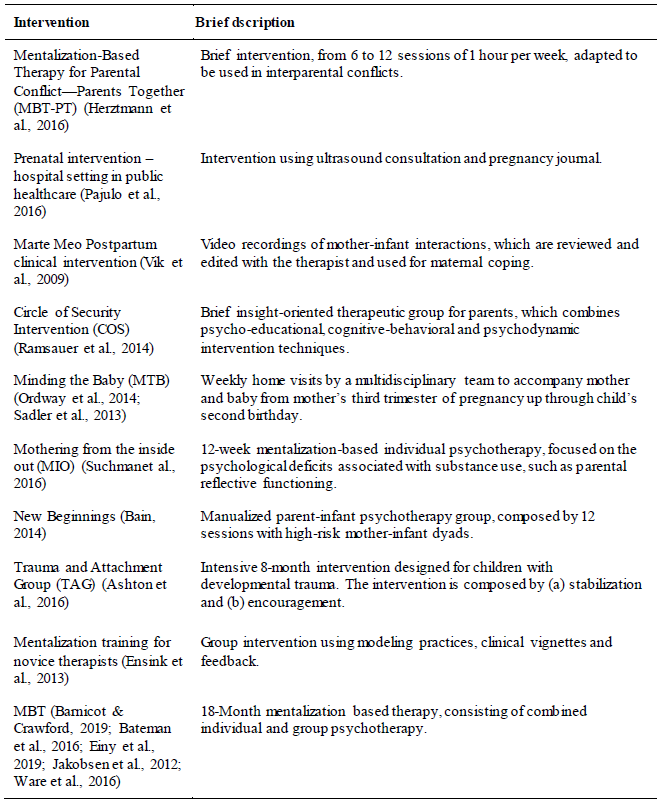
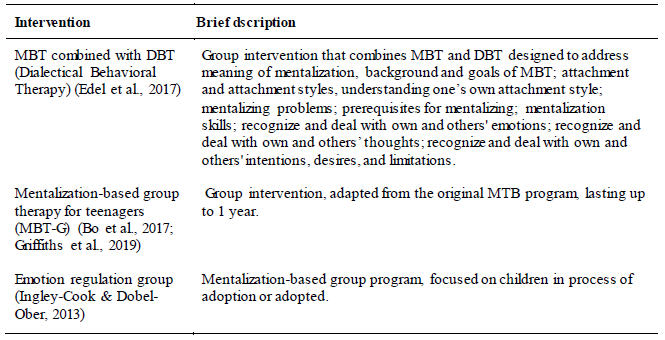
There is a diversity of interventions that can be applied to develop M and RF, and in the last 5 years it was observed an increase of studies about programs focusing on PRF. MBT is the most prevalent intervention among the interventions which stand out in this review, possibly because Fonagy and collaborators seek to investigate evidence of its efficacy and effectiveness. Therefore, MBT has been serving as inspiration for other proposals, which use its theoretical and technical principles. Moreover, most of the reviewed interventions focused on the treatment of psychopathologies, such as borderline personality disorder, autism spectrum disorders and major depressive disorder, and were applied in different contexts, such as clinical, school, hospital and community.
The category 5) Intervention assessments, is related to the measures used to evaluate the interventions. A range of instruments was observed (n = 107). The instruments used assessed different indicators of change, requiring the creation of subcategories for better exploration. Thus, the following subcategories were developed: 5a) family sociodemographic data collection; 5b) evaluation of the therapeutic alliance (TA) and countertransference (CT) of the participants towards the intervention; 5c) to measure RF and M; 5d) to measure symptomatology of the participants; 5e) Mother-child interaction; 5f) Functioning and global development of the participants; 5g) Specific evaluation of the intervention. The total number of instruments obtained are shown in Figure 4.
Figure 4: Distribution of instruments by subcategory
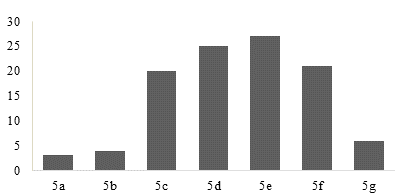
In this sense, subcategory 5e concentrated 27 instruments focused on capturing maternal sensitivity, attachment patterns, social adjustment and the type of interaction of mother-infant dyad. Among the 27 instruments found, the Strange Situation Procedure (SSP) was the most used (n = 3) (Ramsauer et al., 2014; Sadler et al., 2013; Suchman et al., 2017), followed by sessions of mother-child free play (n = 2) (Ordway et al., 2018; Suchman et al., 2016).
In the subcategory 5d, twenty-five instruments assessed maternal mental health conditions, such as anxiety, depression, stress, alexithymia, and borderline personality. The Beck Depression Inventory (BDI) stands out here, being applied in five studies (Bateman et al., 2016; Bo et al., 2017; Edel et al., 2017; Jakobsen et al., 2012; Ramsauer et al., 2014). In subcategories 5c and 5f, with twenty and twenty-one instruments each, the use of the Parental Development Interview (PDI) stands out (Enav et al., 2019; Hertzmann et al., 2016; Ordway et al., 2016; Sadler et al., 2013; Suchman et al., 2017), as well as the Parental Reflective Functioning Questionnaire (PRFQ; Ashton et al., 2016; Hertzmann et al., 2016; Pajulo et al., 2016; Ramsauer et al., 2014).
The subcategory 5g, which encompasses six instruments, focused on a range of interviews to assess interventions (Hertzmann et al., 2016; Howieson & Priddis, 2015; Ingley-Cook & Dobel-Ober, 2013; Meschino et al., 2016; Vik & Hafting, 2009; Ware et al., 2016). Finally, the subcategories 5a and 5b, with 3 and 4 instruments each, with semi-structured interviews reported twice on the subcategory 5a (n = 2) (Ordway et al., 2014; Sadler et al., 2013). In the subcategory 5b, the measures applied were the Working Alliance Inventory-Revised (Sadler et al., 2013), the Parenting Alliance Measure (PAM; Hertzmann, 2016), the Countertransference Rating Scale (CRS; Ensink et al., 2013) and the Psychotherapy Q-Sort (Kivity et al., 2019).
Considering that mentalization theory has been explored and implemented in recent decades, it was observed few instruments used to assess the intervention, with only one instrument developed for this purpose. The Revised MIO/PE Adherence Rating Scale (Sadler et al., 2013; Suchman et al., 2017), was the only instrument reported on the studies to evaluate the efficacy of the program Mothering from the Inside Out (MIO). This statement may be responsible for a variability of measures found, which are used in the evaluation of different indicators of change which guided the discussions related to intervention’s outcomes. According to Baptista (2010), despite limitations in the field of studies on evidence of effectiveness in psychotherapeutic processes, it is possible to establish assessment protocols and accurate procedures, such as meta-analysis.
The category 6) Outcomes, highlighted that the proposed interventions, mostly, have showed satisfactory outcomes, (n = 23) (Bain, 2014; Bateman et al., 2016; Edel et al., 2017; Enav et al., 2019; Ensink et al. al., 2013; Einy et al., 2019; Fonagy et al., 2009; Freda et al., 2015; Griffiths et al., 2019; Howieson & Priddis, 2015; Kivity et al., 2019; Ordway et al., 2018; Rosenblau et al. , 2015; Rice et al., 2015; Ware et al., 2016; Sadler et al., 2013; Stacks et al., 2019; Suchman et al., 2016; Suchman et al., 2017; Twemlow et al., 2011; Vik & Hafting, 2009). Among them, interventions based on MBT have been effective, decreasing symptoms severity in patients diagnosed with borderline personality disorder and antisocial personality disorder (Bateman et al., 2016; De Meulemeester et al., 2018; Edel et al., 2017; Einy et al., 2019). Improvement on emotion regulation, behavior (Ware et al., 2016), as well as in mentalization and attachment patterns established between peers (Bo et al., 2017) were also observed.
MBT, when combined with Dialectical Behavior Therapy (DBT), achieved even more satisfactory results in reducing insecure attachment and improving mentalization in patients diagnosed with borderline personality disorder (Edel et al., 2017). Both approaches prioritize the creation of a secure relationship in therapy, the use of empathy and validation in reciprocal relationship, the strengthening of patient's capacities to reduce impulsive behaviors, as well as the increase of self-awareness (Swenson & Choi-Kain, 2015).
On the other hand, a study conducted by Jakobsen et al. (2012) pointed out that third-wave cognitive therapy may be more effective than MBT in addressing depressive symptoms. Similarly pointed out the study of Barnicot and Crawford (2019), especially regarding the reduction of self-injurious behaviors over time. However, it is suggested investments in RCT to evaluate the effectiveness of different approaches. Furthermore, it should be noted that studies focused on the evaluation of DBT effectiveness have been more prevalent in the last decade.
Conclusions
It is noteworthy that the terms mentalization and reflective functioning are relatively new in psychology and have been explored extensively in recent decades, with a large number of publications in 2016. While these constructs are related, they have particularities that should be considered in further studies. Reflective functioning has been presented in some studies as being equivalent to mentalization, resulting in instruments that assess RF being used to measure mentalization. This finding highlights a lack of measures to evaluate mentalization and reflective functioning separately.
On the other hand, as research progresses into different contexts, an important differentiation between mentalization and reflective functioning has emerged. It is suggested that the literature consider the interdependence between mentalization and reflective functioning, as illustrated in Figure 5. This is because an individual may demonstrate adequate mentalization but experience difficulties with their reflective functioning, while the opposite may not necessarily be true.
Figure 5: Interdependence between M and RF concepts
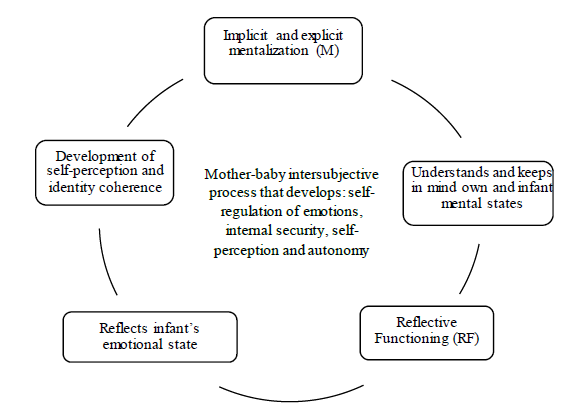
Source. Figure prepared by Márcia Pinheiro Schaefer for this article.
Although most of the research evaluated in this study aimed to verify the effectiveness of interventions focused on mentalization and reflective functioning, possibly expressing a movement aimed at evaluating outcomes to consolidate proposals related to the theme and the need to build evidence-based practices, it is understood that regarding quantitative studies, it is now required for researchers to return to the specificities of the proposals, as well as their scope in different contexts through qualitative or mixed-methods designs.
Faced with interventions that used MBT, it is suggested that RCT be further explored. Another important point is carried out studies with follow-up, which may contribute to the evaluation of evidence-based treatments, as well as to identify possible changes in interventions over time.
Considering that the outcomes of the studies pointed out that interventions focused on mentalization and reflective functioning have the potential to contribute to the establishment of a secure attachment, it is crucial to expand intervention programs in different contexts, targeting different populations, such as parent/caregiver-child dyads and triads, as well as different ethnic groups. Moreover, there is a need to develop measures to assess mentalization and reflective functioning and report interventions in other countries, such as countries from Latin America are needed.
As limitations of this review, the non-inclusion of research conducted in Brazil should be noted. Although some studies have been published, the use of keywords not indexed in the publications or the unavailability of some papers in databases at the time of the query may have result in the failure to find these publications.
References:
Akhtar, S. (2007). Primeiros relacionamentos e sua internalização. In E. Person, A.M. Cooper & G. Gabbard (Eds.), Compêndio de Psicanálise (pp. 54-66). Artmed.
Ashton, C. K., O’Brien-Langer, A., & Silverstone, P. H. (2016). The CASA Trauma and Attachment Group (TAG) Program for children who have attachment issues following early developmental trauma. Journal of the Canadian Academy of Child and Adolescent Psychiatry, 25(1), 35-42.
Bain, K. (2014). “New beginnings” in South African shelters for the homeless: piloting of a group psychotherapy intervention for high‐risk mother–infant dyads. Infant Mental Health Journal, 35(6), 591-603. http://doi.org/10.1002/imhj.21457
Baptista, M. N. (2010). Questões sobre avaliação de processos psicoterápicos. Revista Psicologia em Pesquisa, 4(2).
Barnicot, K. & Crawford, M. (2019). Dialectical behaviour therapy v. mentalisation-based therapy for borderline personality disorder. Psychological Medicine, 49(12), 2060-2068. http://doi.org/10.1017/S0033291718002878
Bateman, A., O’Connell, J., Lorenzini, N., Gardner, T., & Fonagy, P. (2016). A randomised controlled trial of mentalization-based treatment versus structured clinical management for patients with comorbid borderline personality disorder and antisocial personality disorder. BMC Psychiatry, 16(1), 304. http://doi.org/10.1186/s12888-016-1000-9
Bo, S., Sharp, C., Beck, E., Pedersen, J., Gondan, M., & Simonsen, E. (2017). First empirical evaluation of outcomes for mentalization-based group therapy for adolescents with BPD. Personality Disorders: Theory, Research, and Treatment, 8(4), 396. http://doi.org/10.1037/per0000210
Bowlby, J. (1989). Uma base segura. Artes Médicas.
Bressi, C., Fronza, S., Minacapelli, E., Nocito, E. P., Dipasquale, E., Magri, L., Lionetti, F., & Barone, L. (2017). Short‐term psychodynamic psychotherapy with mentalization‐based techniques in major depressive disorder patients: relationship among alexithymia, reflective functioning, and outcome variables–a pilot study. Psychology and Psychotherapy: theory, research and practice, 90(3), 299-313. http://doi.org/10.1111/papt.12110
Cramer, B. & Palacio-Espasa, F. (1993). Técnicas psicoterápicas mãe/bebê. Artes Médicas.
Dalbem, J. X. & Dalbosco, D. D. (2005). Teoria do apego: bases conceituais e desenvolvimento dos modelos internos de funcionamento. Arquivos Brasileiros de Psicologia, 57(1), 12-24.
De Meulemeester, C., Vansteelandt, K., Luyten, P., & Lowyck, B. (2018). Mentalizing as a mechanism of change in the treatment of patients with borderline personality disorder: a parallel process growth modeling approach. Personality Disorders: Theory, Research, and Treatment, 9(1), 22. http://doi.org/10.1037/per0000256
Edel, M. A., Raaff, V., Dimaggio, G., Buchheim, A., & Brüne, M. (2017). Exploring the effectiveness of combined mentalization‐based group therapy and dialectical behaviour therapy for inpatients with borderline personality disorder–A pilot study. British Journal of Clinical Psychology, 56(1), 1-15. http://doi.org/10.1111/bjc.12123
Einy, S., Narimani, M., & Sadeghi-Movahhed, F. (2019). Comparing the effectiveness of mentalization-based therapy and cognitive-analytic therapy on ego strength and defense mechanisms in people with Borderline Personality Disorder. Quarterly of the Horizon of Medical Sciences, 25(4), 324-339. http://doi.org// 10.32598/hms.25.4.324
Enav, Y., Erhard-Weiss, D; Kopelman, M; Samson, A. C; Mehta, S; Gross, J. J., & Hardan, A. Y., (2019). A non randomized mentalization intervention for parents of children with autism. Autism Research, 12(7), 1077-1086. http://doi.org/10.1002/aur.2108
Ensink, K., Fonagy, P., Normandin, L., Berthelot, N., & Biberdzic, M. (2015). O papel protetor da mentalização de experiências traumáticas: implicações quando da entrada na parentalidade. Estilos Clínicos, 20(1), 76-91. http://doi.org/10.11606/issn.1981-1624.v20ilp76-91
Ensink, K., Maheux, J., Normandin, L., Sabourin, S., Diguer, L., Berthelot, N., & Parent, K. (2013). The impact of mentalization training on the reflective function of novice therapists: A randomized controlled trial. Psychotherapy Research, 23(5), 526-538. http://doi.org/10.1080/10503307.2013.800950
Esposito, G., Karterud, S., & Freda, M. F. (2019). Mentalizing underachievement in group counseling: Analyzing the relationship between members' reflective functioning and counselors' interventions. Psychological Services, 18(1), 73-83. http://doi.org/10.1037/ser0000350
Feliciano, D. de S. & Souza, A. S. L. (2011). Para além do seio: uma proposta de intervenção psicanalítica pais-bebê a partir de dificuldades na amamentação. Jornal de Psicanálise,44(81), 145-161.
Fonagy, P. & Allison, E. (2012). What is mentalization? The concept and its foundations in developmental research. In N. Midgley & I. Vrouva, Minding the child: Mentalization-based interventions with children, young people and their families (pp. 11-34). Routledge/Taylor & Francis Group.
Fonagy, P. & Target, M. (1997). Attachment and reflective function: their role in self-organization. Development & Psychopathology, 9(04), 679-700. https://doi.org/10.1017/s0954579497001399
Fonagy, P. & Target, M. (2006). The mentalization-focused approach to self pathology. Journal of Personality Disorders, 20(6), 544-576. http://doi.org/10.1521/pedi.2006.20.6.544
Fonagy, P. (1999). Persistencias transgeneracionales del apego: una nueva teoria. Aperturas Psicoanaliticas, 3, 1-17.
Fonagy, P., Twemlow, S. W., Vernberg, E. M., Nelson, J. M., Dill, E. J., Little, T. D., & Sargent, J. A. (2009). A cluster randomized controlled trial of child‐focused psychiatric consultation and a school systems‐focused intervention to reduce aggression. Journal of Child Psychology and Psychiatry, 50(5), 607-616. http://doi.org/10.1111/j.1469-7610.2008.02025.x
Freda, M. F., Esposito, G., & Quaranta, T. (2015). Promoting mentalization in clinical psychology at universities: A linguistic analysis of student accounts. Europe's Journal of Psychology, 11(1), 34. http://doi.org/10.5964/ejop.v11i1.812
Griffiths, H., Duffy, F., Duffy, L., Brown, S., Hockaday, H., Eliasson, E., Graham, J., Smith, J., Thomson, A., & Schwannauer, M. (2019). Efficacy of mentalization-based group therapy for adolescents: the results of a pilot randomised controlled trial. BMC Psychiatry, 19, 167-180. https://doi.org/10.1186/s12888-019-2158-8
Hertzmann, L., Target, M., Hewison, D., Casey, P., Fearon, P., & Lassri, D. (2016). Mentalization-based therapy for parents in entrenched conflict: a random allocation feasibility study. Psychotherapy, 53(4), 388. http://doi.org/10.1037/pst0000092
Holmes, J. (2006). Mentalizing from a psychoanalytic perspective: What’s new? In J. Allen & P. Fonagy (Eds.), The Handbook of Mentalization Based Treatment (pp. 31-50). John Wiley & Sons.
Howieson, J. & Priddis, L. (2015). A Mentalizing‐based approach to family mediation: harnessing our fundamental capacity to resolve conflict and building an evidence‐based practice for the field. Family court review, 53(1), 79-95. http://doi.org/10.1111/fcre.12132
Ingley‐Cook, G. & Dobel‐Ober, D. (2013). Innovations in practice: group work with children who are in care or who are adopted: lessons learnt. Child and Adolescent Mental Health, 18(4), 251-254. http://doi.org/10.1111/j.1475-3588.2012.00683.x
Jakobsen, J. C., Gluud, C., Kongerslev, M., Larsen, K. A., Sørensen, P., Winkel, P., Lange, T., Sogaard, U., & Simonsen, E. (2012). ‘Third wave’cognitive therapy versus mentalization-based therapy for major depressive disorder: a protocol for a randomised clinical trial. BMC Psychiatry, 12(1), 232. http://doi.org/10.1186/1471-244X-12-232
Kelly, K., Slade, A., & Grienenberger, J. F. (2005). Maternal reflective functioning, mother–infant affective communication, and infant attachment: exploring the link between mental states and observed caregiving behavior in the intergenerational transmission of attachment. Attachment & Human Development, 7(3), 299-311. http://doi.org/10.1080/14616730500245963
Kivity, Y., Levy, K.N., Wasserman, R.H., Beeney, J.E., Meehan, K.B., & Clarkin, J.F. (2019). Conformity to prototypical therapeutic principles and its relation with change in reflective functioning in three treatments for borderline personality disorder. Journal of Consulting and Clinical Psychology, 87(11), 975-988. http://doi.org/10.1037/ccp0000445
Lecannelier, F. (2006). Estrategias de intervención temprana en salud mental. Revista Psicología & Sociedad, 1-9.
Leonardi, J. L. (2017). Métodos de pesquisa para o estabelecimento da eficácia das psicoterapias. Interação em Psicologia, 21(3), 176-186. http://doi.org/10.5380/psi.v2li3.54757
Malda-Castillo, J., Browne, C., & Perez-Algorta, G. (2019). Mentalization-based treatment and its evidence-base status: A systematic literature review. Psychology and Psychotherapy: Theory, Research and Practice, 92(4), 465-498. http://doi.org/10.1111/papt.12195
Melnik, T., Fernandes de Souza, W., & Regine de Carvalho, M. (2014). A importância da prática da psicologia baseada em evidências: aspectos conceituais, níveis de evidência, mitos e resistências. Revista Costarricense de Psicología, 33(2), 79-92.
Mesa, A. M. & Gómez, A. C. (2010). La mentalización como estrategia para promover la salud mental en bebés prematuros. Revista Latinoamericana de Ciencias Sociales, Niñez y Juventud, 8(2), 835-848.
Meschino, D. de C., Philipp, D., Israel, A., & Vigod, S. (2016). Maternal-infant mental health: postpartum group intervention. Archives of women's mental health, 19(2), 243-251. http://doi.org/10.1007/s00737-015-0551-y
Moher, D., Liberati, A., Tetzlaff, J., & Altman, D. G. (2009). Preferred reporting items for systematic reviews and meta-analyses: the PRISMA statement. Annals of internal medicine, 151(4), 264-269. http://doi.org/10.7326/0003-4819-151-4-200908180-00135
Ordway, M. R., McMahon, T. J., Kuhn, L. de L. H., & Suchman, N. E. (2018). Implementation of an evidenced‐based parenting program in a community mental health setting. Infant Mental Health Journal, 39(1), 92-105. http://doi.org/10.1002/imhj.21691
Ordway, M. R., Sadler, L. S., Dixon, J., Close, N., Mayes, L., & Slade, A. (2014). Lasting effects of an interdisciplinary home visiting program on child behavior: Preliminary follow-up results of a randomized trial. Journal of Pediatric Nursing, 29(1), 3-13. http://doi.org/10.1016/j.pedn.2013.04.006
Ordway, M. R., Webb, D., Sadler, L. S., & Slade, A. (2015). Parental reflective functioning: an approach to enhancing parent-child relationships in pediatric primary care. Journal of Pediatric Health Care, 29(4), 324-334. http://doi.org/10.1016/j.pedhc.2014.12.002
Pajulo, H., Pajulo, M., Jussila, H., & Ekholm, E. (2016). Substance‐abusing pregnant women: prenatal intervention using ultrasound consultation and mentalization to enhance the mother–child relationship and reduce substance use. Infant mental Health Journal, 37(4), 317-334. http://doi.org/10.1002/imhj.21574
Ramires, V. R. R. & Godinho, L. R. (2011). Psicoterapia baseada na mentalização de crianças que sofreram maus-tratos. Psicologia em Estudo, 16(1), 61-70. https://doi.org/10.1590/S1413-73722011000100008
Ramires, V. R. R. & Schneider, M. S. (2010). Revisitando alguns conceitos da teoria do apego: comportamento versus representação? Psicologia: Teoria E Pesquisa, 26, 25-33. https://doi.org/10.1590/S0102-37722010000100004
Ramsauer, B., Lotzin, A., Mühlhan, C., Romer, G., Nolte, T., Fonagy, P., & Powell, B. (2014). A randomized controlled trial comparing Circle of Security Intervention and treatment as usual as interventions to increase attachment security in infants of mentally ill mothers: Study Protocol. BMC Psychiatry, 14(1), 24. http://doi.org/10.1186/1471-244X-14-24
Rice, L. M., Wall, C. A., Fogel, A., & Shic, F. (2015). Computer-assisted face processing instruction improves emotion recognition, mentalizing, and social skills in students with ASD. Journal of Autism and Developmental Disorders, 45(7), 2176-2186. http://doi.org/10.1007/s10803-015-2380-2
Rosenblau, G., Kliemann, D., Heekeren, H. R., & Dziobek, I. (2015). Approximating implicit and explicit mentalizing with two naturalistic video-based tasks in typical development and autism spectrum disorder. Journal of Autism and Developmental Disorders, 45(4), 953-965. http://doi.org/10.1007/s10803-014-2249-9
Sadler, L. S., Slade, A., Close, N., Webb, D. L., Simpson, T., Fennie, K., & Mayes, L. C. (2013). Minding the baby: Enhancing reflectiveness to improve early health and relationship outcomes in an interdisciplinary home‐visiting program. Infant Mental Health Journal, 34(5), 391-405. http://doi.org/10.1002/imhj.21406
Slade, A. (2005). Parental reflective functioning: an introduction. Attachment and Human Development, 7(3), 269-281. http://doi.org/10.1080/14616730500245906
Slade, A. (2007). Reflective parenting programs: theory and development. Psychoanalytic Inquiry, 26(4), 640-657. http://doi.org/10.1080/07351690701310698
Stacks, A. M., Barron, C. C., & Wong, K. (2019). Infant mental health home visiting in the context of an infant—toddler court team: Changes in parental responsiveness and reflective functioning. Infant Mental Health Journal, 40(4), 523-540. https://doi.org/10.1002/21785
Suchman, N. E., De Coste, C. L., McMahon, T. J., Dalton, R., Mayes, L. C., & Borelli, J. (2017). Mothering from the Inside Out: Results of a second randomized clinical trial testing a mentalization-based intervention for mothers in addiction treatment. Development and Psychopathology, 29(2), 617-636. http://doi.org/10.1017/S0954579417000220
Suchman, N. E., Ordway, M. R., de las Heras, L., & McMahon, T. J. (2016). Mothering from the Inside Out: results of a pilot study testing a mentalization-based therapy for mothers enrolled in mental health services. Attachment & Human Development, 18(6), 596-617. http://doi.org/10.1080/14616734.2016.1226371
Swenson, C. R. & Choi-Kain, M. D. (2015). Mentalization and Dialectical Behavior Therapy. American Journal of Psychotherapy, 69(2). 199-217. https://doi.org/10.1176/appi.psychotherapy.2015.69.2.199
Tomlin, A. M., Sturm, L., & Koch, S. M. (2009). Observe, listen, wonder, and respond: A preliminary exploration of reflective function skills in early care providers. Infant Mental Health Journal, 30(6), 634-647. http://doi.org10.1002/imhj.20233
Twemlow, S. W., Fonagy, P., Sacco, F. C., Vernberg, E., & Malcom, J. M. (2011). Reducing violence and prejudice in a Jamaican all age school using attachment and mentalization theory. Psychoanalytic Psychology, 28(4), 497. http://doi.org/10.1037/a0023610
Vik, K. & Hafting, M. (2009). The outside view as facilitator of self‐reflection and vitality: A phenomenological approach. Journal of Reproductive and Infant Psychology, 27(3), 287-298. http://doi.org/10.1080/02646830802409645
Volkert, J., Hauschild, S., & Taubner, S. (2019). Mentalization-Based treatment for personality disorders: efficacy, effectiveness, and new developments. Current Psychiatry Reports, 21(4), 21-25.http://doi.org/10.1007/s11920-019-1012-5
Ware, A., Wilson, C., Tapp, J., & Moore, E. (2016). Mentalisation-based therapy (MBT) in a high-secure hospital setting: expert by experience feedback on participation. The Journal of Forensic Psychiatry & Psychology, 27(5), 722-744. http://doi.org/10.1080/14789949.2016.1174725
Zevalkink, J. (2008). Assessment of mentalizing problems in children. In A.J.E. Verheugt-Pleiter, J., Zevalkink & M.G.C. Schmeets (Eds.), Mentalizing in children therapy (pp. 22-40). Karnac.
How to cite: Pinheiro Schaefer, M., Becker, D., & Donelli, T. M. S. (2023). Interventions to improve mentalization and reflective functioning: a scoping review. Ciencias Psicológicas, 17(1), e-2478. https://doi.org/10.22235/cp.v17i1.2478
Authors’ participation: a) Conception and design of the work; b) Data acquisition; c) Analysis and interpretation of data; d) Writing of the manuscript; e) Critical review of the manuscript.
M. P. S. has contributed in a, b, c, d; D. B. in c, d; T. M. S. D. in e.
Scientific editor in-charge: Dra. Cecilia Cracco.